

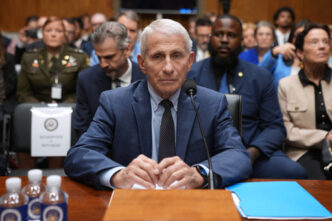
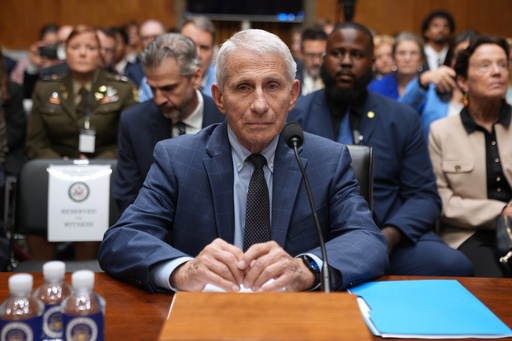
Dr. Anthony Fauci on Wednesday invoked the Fifth Amendment and declined to answer questions from senators in a Republican-led committee hearing about his handling of the COVID-19 pandemic.
Sen. Rand Paul of Kentucky subpoenaed Fauci to appear before a Senate committee. It’s part of Paul’s yearslong accusations that the now-retired infectious disease expert had lied about the pandemic, something Fauci has called “preposterous.” Paul closed the hearing by saying lawmakers will vote next week on whether to hold the now-retired infectious-disease expert in contempt for refusing to testify.
Democrats on the committee generally defended Fauci for refusing to engage, but Republicans hold an 8-7 majority on the panel. President Donald Trump told reporters, “I watched the whole thing today,” when asked about Fauci’s testimony.
Iran, meanwhile, launched a barrage of missiles at American forces in the Middle East early Wednesday as the U.S. partnered with Saudi Arabia to strike Tehran-backed militias in neighboring Iraq, killing at least 20 fighters. The flare-up on multiple fronts shattered a brief pause in fighting that followed nearly two weeks of daily bombing by the U.S. military.
Here’s the latest:
Trump showed no regrets over his handpicked Federal Reserve chair, Kevin Warsh, neglected to cut benchmark interest rates as the president has called for since returning to the White House.
Fed officials voted 9-3 to keep the federal funds rate steady, with the dissenters calling for a rate hike because inflation has stayed above the Fed’s 2% target.
“Kevin’s got a board. He’s fantastic. He’s a brilliant guy. Smart. I know he’d love to see lower interest rates, but he’s got a board and it’s a political board and they want to keep rates up,” Trump told reporters.
The president said the country is fighting through higher rates, saying he has achieved $19.2 trillion in investments in one year. That figure is bloated and inaccurate as it would constitute the bulk of U.S. gross domestic product and cannot be observed within broader economic data.
The U.S. president apparently took keen interest in the former COVID official’s appearance before a Senate committee earlier Wednesday.
“I watched the whole thing today,” Trump told reporters when asked about his testimony.
He used the question to tout his first-term efforts on COVID-19, including Operation Warp Speed, which was the administration’s initiative on developing and distributing a COVID vaccine.
Trump added: “COVID was a disaster, but Fauci did not help.”
Federal Reserve officials voted 9-3 to keep their benchmark rates unchanged, but the dissenters favored rate hikes as inflation continues to run above the central bank’s 2% target.
The federal funds rate — which determines the interest charged on overnight loans among banks — will stay in a range of 3.5% to 3.75%.
The bank statement said the economy is “expanding at a solid pace,” but stressed that there is “uncertainty” because of the Iran war and its impact on oil prices.
The three Fed officials who sought to raise the benchmark rates by 0.25% were Cleveland Fed President Beth Hammack, Minneapolis Fed President Neel Kashkari, and Fed Dallas President Lorie Logan. A rate hike would imply that inflation risks are mounting and could drive up the cost of mortgages, auto loans and government borrowing.
Trump has long attacked the Fed for not slashing its rates, but he has refrained from criticizing his pick as Fed chair, Kevin Warsh, for not delivering on his preferred policy.
All but three Republican governors in the U.S. signed a letter Wednesday supporting Trump’s push for requiring proof of citizenship for anyone registering to vote.
The governors said in a letter to Trump, who has made the measure a priority, that the SAVE America Act is “critical for restoring Americans’ trust in our electoral process.”
It’s not clear how much sway the Republican governors will have. GOP Majority Leader John Thune has said that Republicans lack the votes to pass the bill or get around a filibuster.
The GOP governors who didn’t sign are the leaders of New Hampshire, Ohio and Vermont.
Voting experts have warned that the requirement could disenfranchise 20 million voters who don’t have birth certificates or other documents available.
The Homeland Security and Governmental Affairs Committee ended a three-hour session with Dr. Anthony Fauci that offered two vastly different versions of his role leading the U.S. response to the COVID-19 pandemic.
For his part, Fauci repeatedly invoked the Fifth Amendment even as the Republican majority protested and demanded answers to their questions.
Chairman Rand Paul led questioning about coronavirus origins, trying to cast doubt on Fauci’s earlier contentions that it didn’t come from a Chinese lab. Other Republicans framed Fauci as a seeker of fame and fortune who has diminished public trust in science and government.
Some GOP members also doubled down on misinformation about COVID vaccines and public health precautions.
Democrats, meanwhile, cast Fauci as a victim of conspiratorial obsessions meant to take down an 85-year-old who spent more than a half-century as a physician and immunologist.
The chairman said senators will vote next week on whether to hold Fauci in contempt for declining to answer questions.
Paul argued that Biden’s presidential pardon means Fauci no longer has a Fifth Amendment privilege, though he added that it’s a “legal question that the courts may have to decide.”
The senator did not say whether he would push for a criminal contempt referral to federal prosecutors, a civil contempt charge referral to a federal court or the rarest form of congressional contempt, an internal Senate charge in which the chamber’s sergeant-at-arms can detain a witness.
Several Republicans hammered Fauci for not engaging, while Democrats generally defended him.
One Republican, Oklahoma’s Mark Lankford, told Fauci multiple times that “you have the right” to invoke the Fifth.
Republicans hold an 8-7 majority on the panel.
Iran launched a barrage of missiles at American forces in the Middle East early Wednesday as the U.S. partnered with Saudi Arabia to strike Tehran-backed militias in neighboring Iraq, killing at least 20 fighters.
Six Iranian advisers were killed in the U.S.-Saudi strike, two Iraqi militia officials told The Associated Press. It was not immediately clear if the advisers were included in the fighters who were killed. The militia officials spoke on condition of anonymity because they weren’t authorized to comment publicly.
The flare-up on multiple fronts, after several days of relative calm, raised the risk of a return to all-out war. It also underscored the difficulty of winding down a five-month conflict that has jolted the world economy and is unpopular among Americans. The fighting was also likely to add to concerns that the U.S. is further drawing down already diminished stockpiles of sophisticated munitions needed to defend its bases and allies.
— Samy Magdy and Elena Becatoros
Trump and the Justice Department are asking the Supreme Court to toss the verdict won by writer E. Jean Carroll after she accused him of sexual assault, saying he can’t be sued for comments he made while he was president.
It’s the second time Trump has asked the justices to nix damages awarded by a jury to Carroll, a longtime advice columnist and former TV talk show host. The Supreme Court refused in June to hear his appeal of another verdict, for $5 million, that found him liable for sexual abuse and defamation.
The latest case centers on comments Trump made during his first term as president. The Justice Department wants to invoke the Westfall Act, which shields government employees from being sued for doing their jobs.
“Well, nothing says honesty like taking the 5th, huh, doc?” the Republican Missouri senator said, launching immediately into a searing critique of Fauci declining to answer questions.
Hawley proceeded with a mocking exchange.
“What day of the week is it today?”
“What color tie are you wearing?”
“What color is the carpet in front of you?”
Each time, Fauci answered, “On the advice of counsel, I respectfully decline to answer based upon my rights under the Fifth Amendment to the Constitution.”
Hawley then proceeded to a lengthy list of questions that accused Fauci of misconduct in his government role.
Fauci’s answer was the same.
So was Hawley’s: “Yeah, well, silence is admission.”
In fact, individuals who invoke constitutional protections not to answer questions under oath are not admitting guilt of any crime.
In a public letter, more than 150 infectious-disease experts and other scientists wrote that “no credible evidence has been produced to support these absurd charges” and that they are “urging our elected representatives in Congress stop these witch-hunts.”
The Fox News host used her show and social media platform to repeatedly spread misinformation during the pandemic.
In the pandemic’s early stages, Ingraham downplayed the spread of COVID-19. She went on to mock mask mandates, social distancing guidelines, people who wore masks and those who got vaccinations.
She also endorsed unproven remedies — including hydroxychloroquine — that the FDA had warned against.
Recently on her show, Ingraham has discussed Fauci’s diary entries that Sen. Paul released. She called Fauci a “little man with a big ego” and had Health Secretary Robert F. Kennedy Jr. on her show to blast Fauci’s “mismanagement” of the pandemic.
A representative who was among those who accompanied Fauci tried to speak without being recognized, angering Paul and leading to the man’s removal.
“He is not recognized by the committee or the chair. If he speaks again, he will be removed from the room,” Paul said. “This testimony is from Anthony Fauci. This is not a game with his lawyers.”
Paul said Fauci’s representatives and advisers “are all allowed to talk to him. … But the attorneys are not recognized” to address lawmakers.
When the man persisted, Paul summoned Capitol Police.
“Please remove him from the room,” Paul said.
Sen. Gary Peters, the ranking Democrat, said he wanted to hear what Fauci’s counsel had to say. The Republican chair quipped back that Fauci “will still have the advice of the other half a dozen attorneys that he brought along today.”
Before President Joe Biden left office, he gave Fauci a preemptive “full and unconditional” pardon, dating back to 2014. So, why would Fauci need to invoke the Fifth now?
The decision may center on several Republicans’ comments that Fauci could still be criminally prosecuted for perjury if he lies under oath.
Health Secretary Robert F. Kennedy Jr., a longtime anti-vaccine activist before entering office, was among the Trump allies suggesting that possibility this week.
Fauci said in his opening statement that he believed Paul wanted him to testify so he could say something that might justify his arrest.
The Kentucky senator is an ophthalmologist who’s conversant, if not fluent, in the language of scientific and medical research.
And with Fauci pleading the Fifth, Paul is free to go through his account of the record, asking detailed questions he knows the witness will not answer.
He’s asked about NIH funding of Chinese research.
Fauci responded: “On the advice of counsel, I respectfully decline to answer based upon my rights under the Fifth Amendment.”
The senator delved into details about virus mutations and the dangers of such research.
Fauci stuck to his script: “On the advice of counsel, I respectfully decline to answer based upon my rights under the Fifth Amendment.”
And throughout their exchange, Paul weaved in his analysis of Fauci’s actions to frame the one-sided conversation his way.
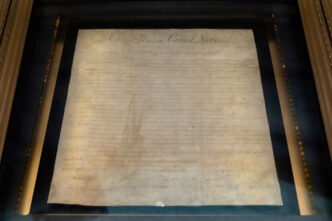
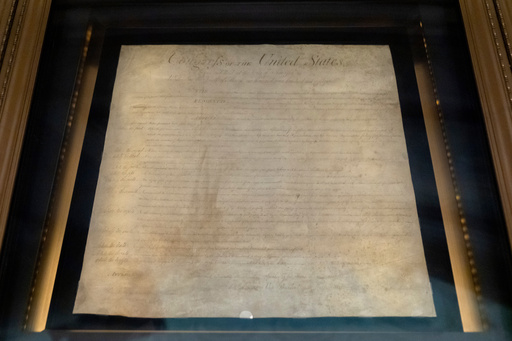
The Fifth Amendment is a constitutional protection against self-incrimination during questioning by law enforcement authorities and Congress.
By invoking it, witnesses are not acknowledging any criminal liability at all, and many people who profess their absolute innocence choose to exercise their right to remain silent. Witnesses who do so are able to avoid testimony they think could be damning or that they fear could be used against them by zealous interrogators or prosecutors determined to use their own words against them.
In the case of Fauci, for instance, some Republicans have talked openly about their desire to see the doctor prosecuted, and in opting to invoke his rights, Fauci cited his concern that Republican Sen. Rand Paul would try to elicit testimony that “could vindicate his repeated public pledges that I end up, in his words, quote, behind bars, unquote.”
Many scientists believe the virus most likely emerged in nature and jumped from animals to people, coming to light when it spread at a wildlife market in the Chinese city of Wuhan.
There’s no new scientific information supporting that the virus might instead have leaked from a laboratory, a theory Paul champions. A GOP-led subcommittee that studied the question in 2024 did not find any evidence linking Fauci to wrongdoing.
Fauci has long said publicly that he was open to both theories but that there’s more evidence supporting COVID-19’s natural origins, the way other deadly viruses, including coronavirus cousins SARS and MERS, jumped into people.
Fox News reporter Trey Yingst, who’s based in the Middle East, said in an on-air segment that he spoke with Trump on Wednesday and the president told him the United States will hit back hard in response to the attacks in Jordan from Iran.
Iran launched a barrage of missiles at American forces in the region early Wednesday.
Sen. Gary Peters of Michigan, the ranking Democrat on the panel, says Paul’s hearing is a partisan exercise and that the chairman has denied the minority access to some of the evidentiary record he’s cited.
Paul called that “categorically false.”
Peters tried to pivot to the Trump administration’s cuts to the federal work force and the departure of career scientists from the government’s public health programs.
The senator said Trump’s policies have slowed the response to the ongoing cyclospora outbreak and added that “cuts to global health programs and international partnerships have greatly reduced our ability to contain dangerous diseases.”
That’s more important than “relitigating the past,” Peters said.
“We should be asking how to strengthen our bio defense efforts to deter our adversaries and prevent biological attacks against our country,” while assessing “how our government can better coordinate and communicate during public health emergencies,” Peters said.
In his remarks at the top of the hearing, Fauci accused Sen. Paul of having an “obvious obsession with calling for my prosecution.”
“The only conclusion that I can reach is that the sole reason he is calling me before this committee is to get me to say something, anything, that could vindicate his repeated public pledges that I end up, in his words, quote, behind bars, unquote.”
He said he would refrain from answering questions upon advice from his attorneys.
A draft of the 85-year-old’s opening statement shows he won’t be getting into the details Sen. Paul wants to discuss.
Anyone under oath has the right to cite the Constitution’s Fifth Amendment that ensures no person can be compelled to give self-incriminating testimony.
Fauci’s decision diminishes the potential for fireworks between Fauci and the chairman. But it also could give Paul a relatively uninterrupted platform to frame his arguments on the pandemic, its origins and the federal response.
The senator is trying to build the case that Fauci and other officials helped produce the COVID-19 pandemic by approving funding of research on virus mutations and then covered up their complicity.
Fauci’s lawyers and his supporters vehemently deny those accusations.
Paul said Fauci should admit that “funding this research in China” was “a mistake” and that he made false statements during the pandemic — including to Congress — that the virus was not conceived in a laboratory.
“Your primary concern was hiding the fact that you had approved funding for this dangerous research,” Paul said.
The senator called Fauci’s “categorical public denials indefensible” and said he has “destroyed trust.”
The Senate Homeland Security and Governmental Affairs Committee has opened its hearing with Fauci.
The physician and immunologist who helped lead the U.S government response to the COVID-19 pandemic is expected to face aggressive questioning from Republican members, especially Chairman Rand Paul of Kentucky.
Paul has for years questioned the origins of the COVID virus and federal health officials’ accounts.
The senator already has released reams of Fauci’s diary entries during the pandemic and said that what scientist “wrote privately and what he told the country are two different stories.”
Federal officials involved in the prosecution of James Comey misled judges, submitted false statements and withheld key facts during the course of the investigation, according to new defense filings that seek the dismissal of a case charging the former FBI director with threatening Trump on social media.
Lawyers for Comey made the allegations of misconduct in motions filed late Tuesday that also call the case a vindictive and selective prosecution, request access to transcripts of grand jury proceedings to expose what they say are “irregularities” in how the indictment was secured, and describe “unlawful” surveillance of Comey by the Secret Service.
Taken together, the new motions, along with an earlier one this week that called Comey’s social media post protected speech and not a threat, represent a multiprong defense effort to dismantle a case defense lawyers say exemplifies a Trump administration retribution campaign targeting one of the president’s most vocal critics.
Roughly six weeks before the first midterm ballots are mailed out, the U.S. Postal Service is emerging as a pivotal player in an election season that will determine control of Congress.
Trump is seeking greater control over mail balloting through an executive order while a change to how the agency processes mail is leading to criticism that it’s failing to deliver ballots on time.
Democratic officials have raised concerns over the past week about how quickly the Postal Service will process ballots after tens of thousands of them in California and hundreds in Wisconsin arrived at local election offices too late to be counted in elections earlier this year. The top election offices in Kansas and Michigan are urging voters who want to cast their ballots early to avoid the mail and instead drop them off in person.
The Postal Service replied to those concerns Tuesday by saying it remains “committed to fulfilling our role in the electoral process.”
Dr. Anthony Fauci, the U.S. scientist who helped lead the nation’s COVID-19 pandemic response, is set to face off — again — with a Republican senator probing the origins of the coronavirus.
Sen. Rand Paul of Kentucky subpoenaed Fauci to appear before a Senate committee Wednesday. It’s part of Paul’s yearslong accusations that the now-retired infectious disease expert had lied about the pandemic, something Fauci has called “preposterous.”
Leading up to the hearing, Paul released more than a thousand pages of Fauci’s personal diary covering the pandemic years. Pointing to some notes about early efforts at understanding how the virus emerged, Paul wrote on the social media platform X that what Fauci “wrote privately and what he told the country are two different stories.”
But they’re likely to further inflame a partisan divide that, years after the pandemic, still makes Fauci a target of vitriol from people who blame him for mask mandates and other policies they believe infringed on their rights as hundreds of thousands of people were dying.