

GAUR, Nepal (AP) — The young mother’s breath had grown ragged. Inside her mud home in rural Nepal, she hunched over in agony, pain pummeling her pregnant belly, her swollen legs scarcely able to support her.
Kabita Mukhiya was in the midst of an emergency, but didn’t know it. For weeks, she’d suffered at home, because there was nobody around to tell her to rush to a hospital. The aid workers who once regularly visited her village to help pregnant women had stopped coming, after foreign aid cuts by the United States shuttered a program aimed at saving mothers’ and babies’ lives.
Kabita was uneducated and impoverished, and she did not know what was happening to her body. In desperation, she turned at last to her aunt for help, who hauled her off to the hospital, where both women wept as the doctors said things neither could understand.
Which is why Kabita — confused and confined to her hospital bed — turned to something she could understand: prayer.
“Please save the baby,” she begged God through her tears. “Please save me.”
Then, through the chaos, came the words that Kabita finally grasped, but could not bear: It was too late. Her baby was dead.
And her own life was now hanging by a thread.
___
This story was funded by a grant from the Pulitzer Center. The Associated Press is responsible for all content.
___
One baby at a time, the world is marching toward a grim milestone: Because of global cuts to foreign aid, the Gates Foundation has predicted that 2025 will be the first year this century where child deaths will increase.
For many experts, the health of a country is measured by the health of its smallest: Children under the age of 5. And while global child mortality data for 2025 won’t be available for several months, health officials are already bracing for a surge in deaths among the world’s youngest and most vulnerable.
The decision by U.S. President Donald Trump’s administration to dissolve the United States Agency for International Development — once the world’s largest humanitarian donor — gutted maternal and neonatal care, decimated nutrition programs for millions of pregnant women and children and left scores of birthing centers devoid of equipment, medicine and staff. The U.S. cuts, followed by foreign aid cuts from several other countries, forced 60% of women’s organizations to reduce their services, according to the World Health Organization.
The U.S. government has repeatedly insisted that no one — and, particularly, no children — have died because of its funding cuts. But the AP has documented the deaths of women and children from Myanmar to Nigeria.
A study published in The Lancet journal, meanwhile, said the U.S. cuts could lead to more than 14 million deaths, including more than 4.5 million children under age 5, by 2030.
“It’s heartbreaking to see what’s happening. It’s decades of progress being washed away,” says Rajat Khosla, executive director of WHO’s Partnership for Maternal, Newborn and Child Health.
In a statement to The Associated Press, the U.S. State Department said the Trump administration had reinvigorated its assistance programs to focus on efficiency, effectiveness and partnership. The department also said the U.S. spends more on health and humanitarian assistance than any other country, and still supports programs in Nepal aimed at improving maternal and child health.
“The rest of the world needs to contribute more and share the burden,” the department said.
In Nepal, cuts to nutrition and reproductive outreach programs have already increased pregnancy complications and deaths, according to health workers, government officials, aid workers and families interviewed by the AP.
“The number of deaths of mothers, young mothers, during delivery has really increased,” says Mona Sherpa, country director for the aid group CARE Nepal, which lost more than half its funding from the U.S. cuts. “The expected number within a year is happening within four to six months.”
Maternal and child health programs are perhaps the clearest foreign aid example of small, relatively cheap interventions leading to the greatest good. Packets of fortified peanut paste that cost less than a dollar each can bring a malnourished child back from the brink of death within weeks. Clean birth kits that cost a few dollars slash the risk of mothers and newborns dying from infections.
In Nepal, a five-year, $35 million program canceled by the U.S. cuts reached more than 100,000 women and girls in its first three years. The program equipped birthing centers and trained nurses, midwives and outreach workers known as female community health volunteers. These workers regularly visited pregnant women’s homes, explained the warning signs of complications and urged them to attend prenatal appointments, often escorting them there.
When the program was canceled, many pregnant women were left to navigate a medical system they struggle to trust or understand, Sherpa says.
The consequences can be found in the dusty, sun-scorched villages of Nepal’s Rautahat district, home to Kabita’s family and one of the poorest and least-literate parts of the country. At a birthing center in Rautahat’s municipality of Dewahi Gonahi, the number of women coming for prenatal checks has halved since the funding cuts, says the officer in charge, Kishori Shah. Because of that, women aren’t identifying complications fast enough, he says, leading to emergencies.
“There would have been a decrease in complications if the USAID program was still running,” he says.
In the village of Prempur Gonahi, it took just 10 months — a touch longer than a typical pregnancy — for newborns to begin dying again after the U.S. cuts, says the officer in charge, Sadho Baitha.
Before CARE’s program launched in Rautahat in December 2022, Baitha says, the village averaged 10 to 15 neonatal deaths per year. By 2024, records show, there were zero. But since the program’s cancellation, newborns have begun dying again; the first was in December, and four more followed by March.
Yet many deaths linked to the funding cuts will remain invisible, in part because the cuts themselves left scores of mortality data collectors jobless. In some places, there is simply no one left to count those who died.
This is the case in Dewahi Gonahi, where mortality reporting and recording services have collapsed, says Shatrudhan Singh, executive director of Campaign Nepal, CARE’s partner. Which is why, he says, the government record shows just two infant deaths in the municipality since the funding cuts, despite his group knowing of eight.
“There must be more than that,” he says. “We just can’t identify them.”
The stories of loss are hidden inside the cramped homes of the loved ones left behind and in the vacant eyes of now-motherless children.
From the shadows of her own home, Phula Devi tries to verbalize her loss in a voice so halting and hushed it’s barely audible. She has never spoken of her grief to anyone — not even to her husband.
Like most women in this village a few miles from Kabita’s, Phula never attended school. She knew almost nothing about pregnancy; she does not even know her own age, just that she is not yet 20.
Phula is the type of woman outreach workers say they would have targeted. Instead, one morning in January, an informal village health practitioner came to her home and said the fetal heartbeat was slow. He told her to go to a hospital, then left.
Phula didn’t understand. And she was at the mercy of her relatives, who waited until that night to take her to the hospital.
There, the doctors urged a C-section. But Phula didn’t know what that meant. Terrified, she pushed the baby out on her own. He emerged silent and still, declared dead and whisked away before Phula could hold him, name him or even see his face.
He was overdue, hospital records show, a risk factor for stillbirth. Nurse Guddi Rahami, who remembers Phula’s case, says the region’s uneducated families often resist C-sections because they believe the operation is somehow bad.
From inside her darkened home, Phula hides her tear-streaked face behind a scarf.
“I think of my baby all the time,” she murmurs.
She would have done anything to save him, she says. If she’d only known how.
___
Down a winding dirt path peppered with bleating goats, Kabita’s two-room home emerges into view. Outside, women trudge past in a rainbow of saris that cling to their fragile frames, seared by the punishing sun.
This became Kabita’s home at 14, when she married her husband after a life of loss. Her mother died when she was little, and her father soon abandoned her to move to India with his new wife. Her three siblings would later follow him.
Her wedding photo shows her as the child she still was when she married: slender, with wide-set brown eyes, soft cheeks and a shy smile. She struggled to bond with her mother-in-law, who shared their home, but endeared herself to her aunt and neighbor, Shraddha Mukhiya. Shraddha relished Kabita’s innocence and was amused by her constant, occasionally nonsensical, chatter. She came to view the girl as her daughter.
Kabita quickly fell pregnant with a daughter of her own, Sonam. Her second daughter, Anushka, followed a year later, and her son, Yubraj, a year after that.
Her husband, the family’s sole provider, was rarely home, forced to chase construction jobs around Nepal and India that brought the family around 12,000 Nepalese rupees ($80) per month. It was enough to buy rice, lentils and vegetables, but little else.
Despite the difficulties, the 20-year-old Kabita was overjoyed to learn she was pregnant with her fourth; she and her mother-in-law longed for another boy. She scraped together enough money to buy clothes for the baby, whom she planned to name Shivraj, and dreamed that he would one day get the education she was never afforded.
When she was pregnant with Yubraj, she received a U.S.-funded nutritious powder that helped supplement her limited diet. But by the time she became pregnant last year, the funding cuts had eliminated the local birthing center’s nutritional supplements and food for pregnant women, says Punam Mahato, a nurse who treated Kabita.
U.S.-funded nutrition programs were crucial to the region, particularly for children, health workers say. The prevalence of wasting — a life-threatening form of malnutrition — among children under 5 in Kabita’s province was 7.4% before the U.S. funding cuts, according to a survey conducted by the government and the United Nations’ children’s agency. That number rose to 12.3% after the cuts, according to a national malnutrition screening conducted in May by the government and the aid group Helen Keller Intl, which saw its nutrition program halted by the U.S. cuts.
As her pregnancy progressed, Kabita’s belly swelled while the rest of her remained gaunt. Sometimes she only managed to eat two small meals a day. And the mothers’ group meetings she attended while pregnant with Yubraj had ceased.
She missed the recommended first trimester appointment, and made her first visit to the birthing center for a check at 16 weeks. Mahato, her nurse, noticed she was pale. She suggested Kabita get a blood test to check her hemoglobin, which can plummet in pregnancy amid nutritional deficiencies.
But Kabita never got the test, and didn’t seem to understand its necessity; she never mentioned it to her mother-in-law. At 24 weeks, Mahato was worried by Kabita’s pallid complexion and again recommended a blood test. Again, Kabita demurred, likely because she didn’t grasp its importance, Mahato says.
Rajkumari Patel, a community health volunteer who worked under CARE’s now-canceled program, said they would have acted as mediators to explain to Kabita why the test was crucial.
Instead, Kabita returned home. She was tormented by stomach pains that grew increasingly fierce. Her body swelled.
She suffered for weeks. By December, when she was 28 weeks pregnant, Kabita had become so weak she could not walk. Her husband was working in India, so she turned to Shraddha, her aunt, for help. The elder woman took her to the hospital.
Doctors drew Kabita’s blood to check her hemoglobin levels, then handed the results to the women. But Kabita and Shraddha didn’t know what they meant. Nor did they understand the rush of activity and tests and medical explanations that followed.
Their understanding finally came amid the absence of a heartbeat. A test confirmed it: Kabita’s baby was dead.
___
Everything was happening so fast.
The hospital was not equipped to remove the baby’s remains from Kabita’s womb. Staffers urged them to go to another hospital. But with no money and no sense for the danger Kabita was facing, the grieving women returned home.
By the next day, Kabita’s vision was distorted. Her head pounded. She was delirious.
In desperation, Shraddha took her to another hospital with lower fees. The doctors determined that she’d had a seizure from preeclampsia, where dangerously high blood pressure can be fatal if untreated, says paramedic Hridaya Narayan Mahato, who is not related to Kabita’s nurse.
Doctors gave her oxygen while the staff rushed to prepare the ICU.
Kabita’s hemoglobin levels were critically low, leaving her short of oxygen and straining her heart. She lay on her back, shaking and gasping for air. Shraddha sat helplessly at the foot of the bed. “You’ll be OK,” she told her niece through tears.
And then she watched as Kabita drew her final breath.
She was dead before they could get her into the ICU.
___
A short drive from Kabita’s home, Patel, the community health worker, sits outside her home, her words laced with frustration. Deaths like Kabita’s, she says, are precisely what she and her colleagues had been trained to prevent.
Patel used to know every pregnant woman in her village, visiting them at home. She would have done the same for Kabita, she says.
“I would have asked her, ‘Is the baby kicking? When did you last feel movement?’ I would have checked for swelling in her hands and face. I would have looked at her eyes for signs of anemia,” she says. “These are the signs I would have noticed in Kabita and said, ‘This woman needs a hospital today — not tomorrow.’ Maybe we could have saved her life.”
Kabita died from complications of eclampsia, with severe anemia contributing significantly, says Mahato, the hospital paramedic. Both conditions can often be identified and managed through regular prenatal care, he says.
The loss of Kabita and her baby so overwhelmed Shraddha that she couldn’t bear to tell Kabita’s husband. Still working in India, he was oblivious to the crisis until neighbors called him. His bus ride home took so long that he didn’t arrive back in the village until three days after Kabita’s funeral.
In the months since, he has frequently refused to work, lying in the dark crying for days at a time. He speaks only of Kabita, never the baby. Shraddha and his mother, Lachhiya Devi, remind him that they will all starve unless he returns to work. And so he does.
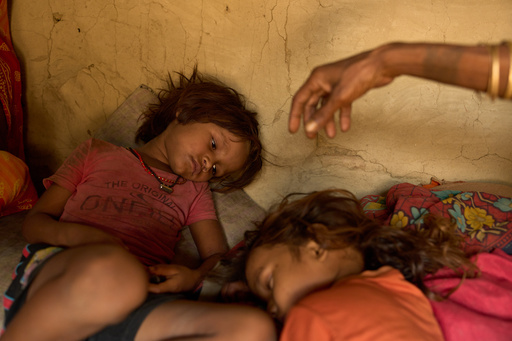
Both in their 60s, Shraddha and Lachhiya worry about how long they can care for Kabita’s little ones. From the bed she shares with her grandchildren, Lachhiya strokes the leg of 4-year-old Anushka, who slumbers next to her in the midday heat.
“How will I feed them? I’m old,” Lachhiya says, her bangles barely clinging to her bony arms. “You can see how desperately I’m trying to get by.”
Their home is quiet now without Kabita’s cheerful chatter or the cries of the baby who never made it home. The last reminders of Kabita’s life — her sparkly green sari, the pink and yellow tapestry she knitted — are packed away in a box that will be given to her children one day.
Shraddha remains tormented by what she didn’t know.
“We don’t have anyone to help us out here, to tell us about these things. If there was someone, we would ask them, follow their advice,” she says. “It would have saved her life.”
She looks at Kabita’s children and aches for their mother, who was barely beyond childhood herself.
“She was too young to die.”
___
Journalist Tulsi Rauniyar contributed to this report.