

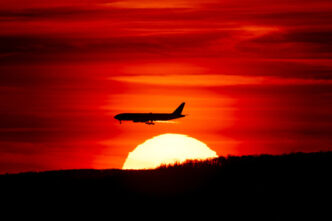
NEW YORK (AP) — Flight attendants and pilots are at the highest risk of dying from radiation-related cancers — even more than people who work with radioactive materials, according to a new study.
Cosmic radiation comes from space. Only a small amount reaches the Earth's surface, but exposure is greater for people flying at high altitudes.
There’s been limited evidence from small studies suggesting that the exposure translates to higher cancer death rates among people who fly often — particularly pilots and flight attendants. The new study “brings important new evidence to bear on this question,” two Australian radiation experts who weren't involved in the research wrote in an accompanying commentary.
The latest study, published Monday by JAMA Internal Medicine, used national data from more than 12 million death certificates that included information about occupations. The authors looked at death rates from cancers that are tied to radiation exposures, including leukemia, lymphoma, multiple myeloma, and cancers of the skin, breast, thyroid, prostate and central nervous system.
Among more than 500 occupations, flight attendants had the highest percentage of deaths from radiation-related cancers, and pilots were second, the researchers found. For those two occupations, the odds of dying were unusually high for each type of radiation-related cancer.
Neither group showed higher-than-normal death rates from cancers that aren't tied to radiation exposure, noted the commentary writers, Catherine Olsen and Ken Karipidis. That fact “supports the hypothesis that occupational radiation exposure, rather than lifestyle or socioeconomic factors, underlies the observed excess,” they wrote.
The researchers found that flight attendants had about 50% higher odds of dying from a radiation-related cancer than the general working population, and pilots had about 36% higher odds.
In terms of absolute risk, about 6.9% of flight attendant deaths were from these cancers — roughly 1 in 14. Among pilots, it was 6.7%. For the general working population, it was 5%, said the study's first author, Dr. Vishal Patel of Harvard Medical School.
The authors acknowledged some limitations in their study. They do not know how much exposure each flight attendant and pilot got in the air or from other sources. It's also possible occupations were misclassified on some death certificates.
They also could not account for another possible contributor specific to the professions: Cancer risk can be worsened by frequent disruption of the body’s internal clock, which can be affected by jet lag, crossing time zones and irregular work schedules.
The Federal Aviation Administration has acknowledged that aircrews are exposed to ionizing radiation, but the government does not set federal dose limits or require monitoring, the authors noted.
“You can't manage an exposure you've decided not to measure,” Patel said in an email.
Sara Nelson, who leads a union representing 55,000 flight attendants, said the report reinforces that radiation exposure needs to be taken seriously, as the union has suggested for years.
“The risk is known, but crew are not educated or informed. And, no one is taking responsibility,” said Nelson, president of the Association of Flight Attendants-CWA.
Annual skin examinations may be warranted for all people working on high-altitude flights, and women in those jobs may want to get mammograms earlier or more frequently, Olsen and Karipidis wrote. Doctors who care for pilots and flight attendants also should have a “heightened index of suspicion” for cancer when evaluating these patients, they said.
___
The Associated Press Health and Science Department receives support from the Howard Hughes Medical Institute’s Department of Science Education and the Robert Wood Johnson Foundation. The AP is solely responsible for all content.