

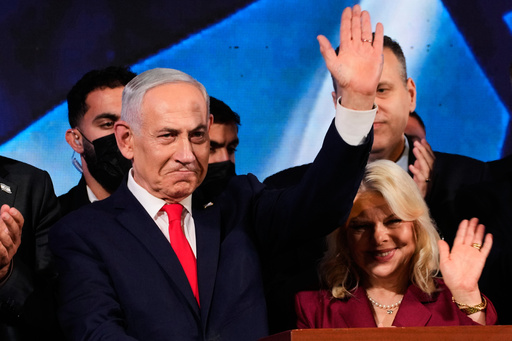
JERUSALEM (AP) — Israelis faced political uncertainty Wednesday after no clear winner appeared to have emerged from a high-turnout election. The path to forming a government is fraught for Prime Minister Benjamin Netanyahu and his main opponent, and another round of elections cannot be ruled out.
The first elections since Hamas' Oct. 7, 2023, attack were seen as a pivotal moment in Israel's history, serving both as a referendum on Netanyahu's nearly unbroken 17-year rule and a choice between different visions for the country's future.
The initial results show a deeply divided electorate with multiple fault lines.
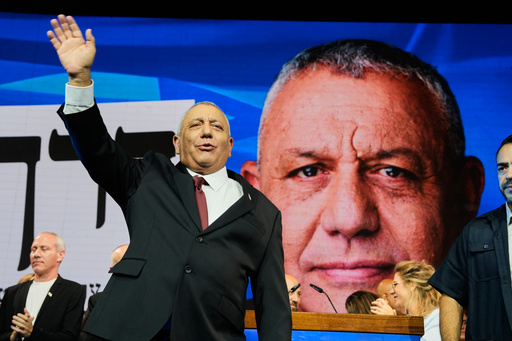
Netanyahu lost support but could remain in office. His main opponent, former military chief Gadi Eisenkot, would most likely have to partner with Arab-led parties to unseat him, a politically costly move that could alienate other opposition factions.
They could also partner with Netanyahu in a broad-based unity government, but that would be seen as a major betrayal by many of their voters after they put his ouster at the heart of their campaigns.
Final, official results are expected on Thursday or Friday, but there will likely be weeks of negotiations before a prime minister is declared — or new elections are called.
Here are the main takeaways:
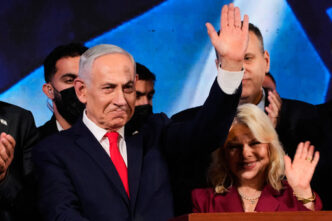
Initial results show Netanyahu's religious and ultranationalist coalition falling short of a parliamentary majority of 61 seats, after reaching a peak of 68 seats in the previous parliament. Netanyahu's right-wing Likud also appears to have been whittled down from 32 seats to around 27.
That could reflect growing disillusionment with his long rule, anger at his handling of the Oct. 7 attacks and their aftermath, and his support for the exemption of ultra-Orthodox Jews from military service, an intensely divisive issue as the country is embroiled in multiple wars.
But Likud still appears to have emerged as the largest party, putting Netanyahu in the best position to be tasked first with forming a government.
He would need support from at least one opposition party, or several defectors from that side, to rule. Most have promised not to partner with Netanyahu, but the Israeli leader, a savvy political operator, could offer them concessions. He is also likely to argue that a broad-based government under his leadership is preferable to one relying on Arab-led parties — or another round of elections.
He can already claim a victory of sorts by having retained much of his support even after the deadliest security breakdown in Israel's history unfolded on his watch.
Netanyahu “manages to overcome situations that I can’t see anyone else managing to overcome,” said Tamar Hermann, senior research fellow at the Israel Democracy Institute, a Jerusalem think tank. “Politically, he is a magician.”
Initial results indicate that parties opposed to Netanyahu won a parliamentary majority. But they include Arab-led factions that have long been politically sidelined, and which some Jewish-led parties have refused to partner with.
In the face of “a politics of supremacy, racism and exclusion, we are offering a totally different alternative,” Yousef Jabareen, the head of the Arab Joint List, said on X. “The change comes through Jewish-Arab partnership, a true and equal partnership. Nothing more, nothing less.”
Only one Arab party has ever joined an Israeli governing coalition, in 2021, and that government only lasted about 18 months. The level of distrust is far higher after Oct. 7 and the resulting wars. Netanyahu is likely to exploit that by casting any partnership with Arab-led parties as illegitimate or treasonous.
Without the Arabs, Eisenkot and his Jewish allies have no clear path to forming a coalition to unseat Netanyahu, and another round of elections might further weaken their hand.
Tens of thousands of Israelis who flew in for this election may not return for another one, and Netanyahu would stay on as caretaker prime minister, giving him a platform to attack his opponents and try to expand his own coalition.
That leaves the prospect of forming a government with Netanyahu — after a campaign in which they blamed him for the failures surrounding the Oct. 7 attack, portrayed him as a threat to Israel's democratic institutions and highlighted his ongoing corruption trial.
The Arab-led parties represent Palestinians with Israeli citizenship, who make up about 20% of the country’s population. Descendants of Palestinians who remained in Israel after its creation in 1948, they are entitled to vote and serve in parliament.
While they hold senior roles in many sectors of Israeli society, they face discrimination, and many Jewish Israelis view them with suspicion because of their general support for the Palestinian cause.
Surging Arab turnout, driven in part by disgust at Netanyahu's far-right allies, may have delivered a historic victory for Arab-led parties, who could win around 19 seats in the 120-member Knesset.
That would give them significant power in any partnership with Eisenkot — potentially making such an alliance less likely. The opposition might also have to partner with hard-line Arab factions that are even more widely rejected among Jewish Israelis.
“With these numbers — there are too many Arabs to lean on, so to speak,” said Aviv Bushinsky, a political commentator and former Netanyahu adviser. “Israeli society is not ready for it, not before Oct. 7 and certainly not after it.”
The elections were an inflection point for Israel after three years of war. But they also highlighted the same divisions that have roiled the country for decades.
Netanyahu's coalition, made up of ultranationalist and ultra-Orthodox parties, supported strengthening Israel's Jewish character. It pushed for more settlement construction in the occupied West Bank and allowed for military draft exemptions for ultra-Orthodox Jews. It also attempted to push through an overhaul of the country's judiciary in 2023 that drew mass protests.
Eisenkot's camp promoted a vision where Israel's Jewish character lives in harmony with its liberal democratic ideals. It promised honest leadership and accountability for Israel's Oct. 7 failures, vowed to bolster the judiciary and end the military draft exemptions. They also promised to fix Israel's international standing, which has deteriorated because of the Gaza war and settler violence in the West Bank.
The apparently stalemated results suggest Israel's divisions are deeper than ever.