

KRAKOW, Poland (AP) — Poland was reeling Monday from a weekend mass shooting in which a gunman opened fire, killing six people and wounding 15 in the city of Krakow before being shot by police.
The gunman, identified as Michał Oksiński, died Monday morning at a hospital, after undergoing several surgeries for critical injuries, police said.
Poland's interior minister said Oksiński held far-right views, but prosecutors said it was too early to determine a motive. Prosecutors said they are investigating the shooting as a terrorist offense.
Police also found the bodies of the suspect's parents and sister at the family home.
Here is what we know about the mass killing that marked a grim first in modern-day Poland:
Police say the 24-year-old attacker, wearing military-style clothing and a bulletproof vest, drove into the city's main square and opened fire on Saturday. The square, in Krakow’s Old Town, is a major tourist destination in Poland’s second-largest city.
What unfolded was a scene of chaos and terror. Videos posted on social media show people running away from the square into narrow streets nearby, as well as first responders trying to resuscitate victims.
Prosecutors said Monday that “tens, if not hundreds” of bullets were fired in Krakow. They also said the attacker had four guns in his possession while in Krakow, including two semi-automatic AR-15 rifles.
Even after Oksiński was wounded by police officers, he continued firing, Krakow police spokesperson Katarzyna Cisło said.
Four women and two men were killed in the square.
Three of the women and one man were Polish, Krzysztof Jan Klęczar, the Malopolska regional governor, said on Sunday. A man from the United Kingdom and a woman from Austria were also among the dead. The wounded included people from Britain, Portugal, Russia, Germany and Austria.
The two police officers who stopped the gunman, in actions authorities described as heroic, remain in the hospital. They were both conscious on Monday.
After the shooting, authorities on Saturday night paused St. Mary’s Trumpet Call — a traditional five-note melody that is played every hour from the highest tower of St. Mary’s Basilica on the main city square — in tribute to the victims.
It was the first time the call had been missed since World War II.
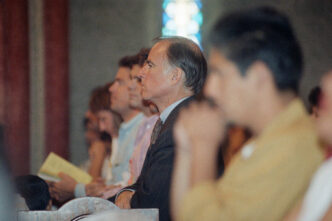
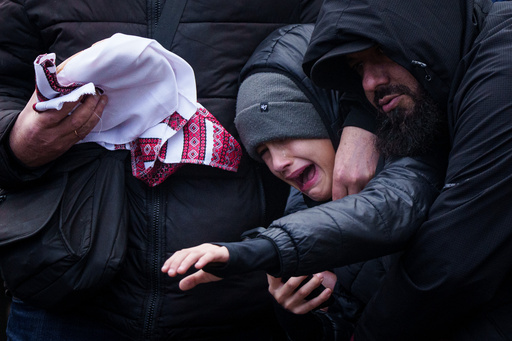
On Sunday afternoon, St. Anne’s Church in Krakow filled with mourners attending a service for the victims.
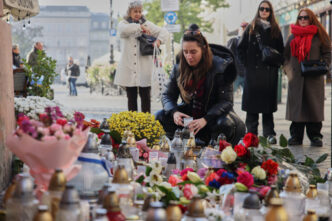
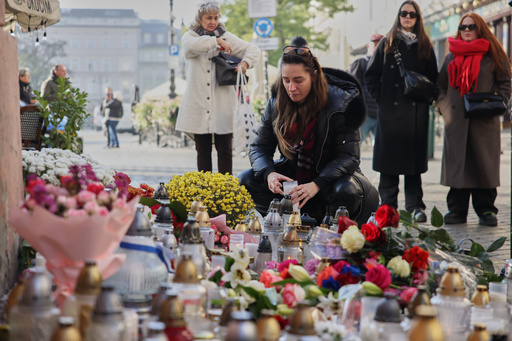
The square reopened Sunday evening with mourners gathering to lay flowers and candles in honor of the victims.
Interior Minister Marcin Kierwiński described his views as radical and ultranationalist, and said evidence indicated he had a fascination with far-right ideologies.
Prosecutors said they had opened an investigation into murder and attempted murder, including attacks on police officers, describing the shooting as a terrorist offense.
At the suspect's home in Ostrowiec Świętokrzyski, about 150 kilometers (93 miles) northeast of Krakow, authorities said they discovered the bodies of the suspect's parents and sister. They said the three likely died from gunshot wounds and they were likely killed either during the night before the square attack or on Saturday morning.
The suspect’s dead sibling was a young artist studying at the Krakow Academy of Fine Arts, which confirmed that Magdalena Oksińska was a third-year student.
“Magdalena Oksińska, 21 years old, a queer person, was an absolutely talented painter, photographer, poet and writer,” architect Pavko Krajka wrote on social media, in a post accompanied by images of the artist’s paintings. “Her death is a great loss for Krakow, Polish, European and queer culture.”
Another painter, Izabela Woźna, a mother of four, was among the victims.
Police found four firearms at the scene of the attack. They were recovered from the attacker or from his car. Two were semi-automatic rifles and two pistols.
Local officials said seven weapons were also seized from the family home, bringing the total number of firearms recovered to 11.
They said both father and son had gun permits. The attacker had permits for a semi-automatic rifle and a pistol since March, they said. Neither father nor son was known to authorities.
The Swit shooting club in Starachowice, where the attacker is believed to have trained, issued a statement Sunday saying it offered only “static shooting,” which involves firing from a fixed position at a stationary target.
The suspect, it said, “was never trained in our club in the areas of dynamic, tactical or combat shooting.”
Mass shootings are uncommon in Poland, a country of 37 million people where about 411,000 people hold gun permits. Interest in gun ownership has been rising, however.
Kacper Rekawek, a researcher at the International Center for Counterterrorism in The Hague, Netherlands, said the attack resembled incidents of “lone wolf” attacks in Europe over the past years.
Prosecutors said they found a yellow flag bearing a black snake, known as the Gadsden flag, hanging on the wall of the attacker’s room. The flag originated during the American Revolution and was later adopted by the U.S. Tea Party movement.
Tomasz Safjański, a security expert, told Rzeczpospolita newspaper that Poland had experienced its first case of an “active shooter” — someone actively killing people in a public place — and that the gunman was Polish, even as authorities remain focused almost exclusively on external threats such as Russia’s hybrid warfare.
“We are failing to address the radicalization of young people,” he said. “By focusing on an external enemy, the state overlooks the threat that is growing within our schools, our neighborhoods, and online.”