

The skies from the Black Sea to Moscow buzzed overnight with hundreds of Ukrainian drones, keeping Russia’s air defenses busy for hours.
By daybreak Monday, the military said it shot down 1,336 drones. That marked the largest number of them brought down since the start of the full-fledged invasion of Ukraine in February 2022.
The Russian military, in turn, ramped up its missile and drone attacks on Ukraine’s power grid, seeking to disrupt electricity and heat as winter sets in.
The surge in aerial attacks follows a week that saw little progress in the first U.S.-mediated talks in nine months.
Here's a look at Russia’s air defenses as it fends off challenges posed by Ukraine’s attacks:
Russia has more land than any other country in the world, and protecting that vast space is a major challenge despite its massive arsenal of defensive systems.
“Russia’s air defense system, like many air defense systems around the world, is not necessarily designed to protect the entirety of Russia’s territory and the air approaches to the country,” said Thomas Withington, an associate fellow with the Royal United Services Institute.
While Ukrainian drones cruise at about 150 kph (about 95 mph), they fly very low, making it harder for radar to spot them.
Their range allows them to strike deep inside Russia. In one recent attack, they hit an oil refinery in Omsk in eastern Siberia, about 2,500 kilometers (about 1,550 miles) from the border. While their payload of about 50 kilograms (110 pounds) is relatively small, their precision allows them to inflict massive damage to such facilities and other infrastructure.
Ukraine also has used long-range Flamingo cruise missiles, capable of reaching up to 950 kph (590 mph), carrying a much heavier payload. Kyiv has fewer of these missiles than drones.
Like in previous attacks, the number of Ukrainian drones reported downed by Russia early Monday couldn’t be independently verified, and official reports haven’t said how many actually got through air defenses to hit their targets.
Withington noted that as a general rule of thumb, 10% get through and hit their targets.
“It’s a game of averages," he said, so launching more drones means that more get through.
He said Russia's air defenses, like most integrated air-defense systems around the world, are designed to shoot down aircraft, air launched weapons and ballistic missiles, and thus could struggle to engage drones.
“Drones are a very different calculus, and because of it, the performance of those systems is never going to be as optimal as it would be against a conventional threat," he said, adding that while air defenses shoot down or jam most of them, some will always get through.
While Russian air defenses around key facilities such as refineries have been bolstered, Ukrainian drones have continued to set them ablaze.
The large size of the targets makes them more vulnerable, Withington said, adding that Ukraine has learned a lot about the operation of Russia's air defense systems, enabling the military to polish its tactics and find loopholes.
“All of Russia’s air defenses, all of the systems they deployed, by and large have given up their secrets” after years of fighting, he said. “The more of that information and data you are armed with, the easier it becomes to defeat Russian air defenses."
In June, a Ukrainian drone set ablaze an oil terminal in St. Petersburg and also hit a nearby naval base, casting a cloud over President Vladimir Putin’s showcase economic forum in his hometown. Putin acknowledged the damage from the attacks, saying Russia would strengthen its air defenses.
On Monday, a Ukrainian drone damaged the well-protected Kerch Bridge linking the mainland and the Crimean Peninsula that Moscow illegally annexed in 2014, temporarily disrupting car traffic. The bridge has been attacked repeatedly over the years.
“Our air defense systems keep operating very effectively,” Kremlin spokesman Dmitry Peskov said. “The system is working, but, unfortunately, no system in the world can provide 100% protection for various facilities against such massive strikes.”
From the early stages of the conflict, Russian authorities have prioritized protecting Moscow.
Media reports said additional air defense systems have been put on the outskirts of the capital, and some could be seen on top of some of the Moscow buildings, including the Defense Ministry’s headquarters facing the Gorky Park across the Moskva River.
While Moscow Mayor Sergei Sobyanin repeatedly claimed that the bulk of the drones were downed, it's impossible to independently verify his claims.
Despite the dense protection around the capital, Ukrainian drones have managed to pierce the shield. Russia scaled down the annual May 9 Victory Day parade, fearing Ukrainian drone strikes. Days later, a massive drone attack on Moscow’s suburbs killed three people. Successive attacks repeatedly struck the oil refinery on the outskirts of the capital, disrupting its operation.
Another top priority has been to protect Putin’s residence in Valdai in northwestern Russia. In December 2025, Russian authorities reported a massive Ukrainian attack on the residence but claimed that none of the 91 drones hit the target.
Since Soviet times, Russia has developed a broad array of air defense systems, from portable ones to long-range weapons capable of shooting down ballistic missiles.
The S-400 Triumph is the main long-range air defense system capable of spotting and engaging aircraft and ballistic missiles at ranges of up to 400 kilometers (about 250 miles).
The even more potent S-500 Prometheus system that reaches as far as 600 kilometers (about 370 miles) also is available in small numbers. Russia also uses various models of S-300 air defense missile systems, an older but still very advanced and powerful long-range weapon.
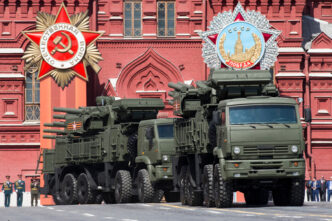
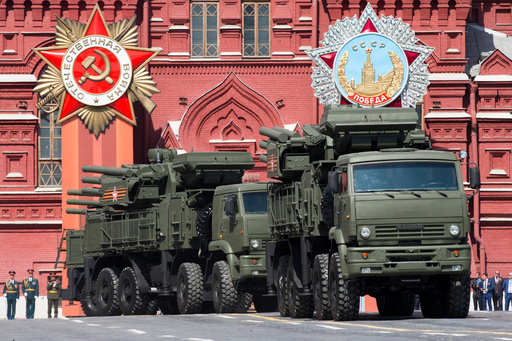
For shorter ranges, the military has relied on the Pantsyr, the Tor and the Buk air defense systems.
While Buk and Tor use missiles to shoot down aerial targets, Pantsyr can use a combination of guns and missiles. A Pantsyr system sits atop the Defense Ministry building in Moscow.
Russia also has deployed teams armed with shoulder-fired Igla and Verba air defense missiles and machine guns for protection of key facilities. Helicopter gunships also are involved.
Withington said Ukraine and Russia could be expected to further ramp up the number of attacking drones to overwhelm air defenses.
“The long-term direction of travel, both for Ukraine and Russia, will be a continued exponential increase in the number of drones that can be launched at any given time," he said.