

HONG KONG (AP) — World shares were mostly higher Wednesday after the U.S. midterm election yielded majorities for the Democrats in both houses of Congress.
U.S. futures edged higher and oil prices retreated.
The future for the S&P 500 was up 0.2% and that for the Dow Jones Industrial Average rose 0.4%.
The results were a decisive rebuke of Republican governance and will bring a new era of congressional resistance to U.S. President Donald Trump.
Markets generally prefer that control of Washington be split between the Republicans and the Democrats. That is seen as offering less risk of sweeping policy changes that could reshape the economy.
“The magnitude of the gains for the Democrats in the midterms does not change too much for the near-term policy outlook, given the party still lacks a filibuster-proof majority in the Senate and President Trump has veto power to block legislation,” Stephen Brown of Capital Economics said in an analysis.
Investors have mainly been preoccupied recently by issues related to artificial intelligence. Markets have been roiled by bouts of selling of technology shares by investors worried that AI-related share prices have shot too high.
In early European trading, the CAC 40 in Paris rose 0.4% to 8,055.02. Britain’s FTSE 100 edged 0.1% higher to 10,646.43, and Germany’s DAX climbed 0.5% to 25,995.13.
The eurozone’s flash consumer price index for October was due to be announced Wednesday. Traders are also watching for an interest rate decision by the Bank of England, due Thursday.
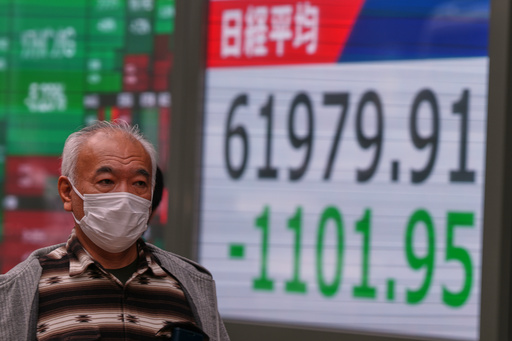
In Asia, Japan’s Nikkei 225 dipped 1.4% to 62,188.63.
Shares of OpenAI investor SoftBank Group dropped 3.2%. Japanese memory chipmaker Kioxia Holdings tumbled 5.4%, paring losses as its guidance for the October-December period missed market expectations.
South Korea’s Kospi index rose 0.6% to 5,683.80, as memory chipmaker SK Hynix edged 0.1% lower, while Samsung Electronics slid 0.7%.
In Hong Kong, the Hang Seng advanced 1.5% to 23,888.46, while the Shanghai Composite index gained 2.2% to 3,686.17, rebounding from its year-low on Tuesday.
Australia’s S&P/ASX 200 fell 0.6% to 8,834.50 after the central bank raised interest rates on Tuesday.
Taiwan’s Taiex lost 0.8%. India’s Sensex climbed 0.3%.
On Tuesday, the S&P 500 rose 0.4%, even though most of the stocks within the index fell. The Dow Jones Industrial Average dropped 197 points, or 0.4%, and the Nasdaq composite climbed 0.8%.
Chipmakers Nvidia and Broadcom were the strongest forces pushing the S&P 500 upward. Also boosting the market were several companies that are spending heavily on AI. Microsoft, Amazon and Meta Platforms all rose more than 2%.
Apple was long seen on Wall Street as a Big Tech company that’s less dependent on AI. But it’s still feeling the effects of the AI boom.
Memory chips for computers have become more expensive because of the demand created by the rush to build AI data centers. Those higher costs are hitting Apple, which said it expects to make less profit from each $1 of its revenue during the final three months of this year.
On the winning side Tuesday were stocks of several companies that reported stronger profits for the summer than analysts expected. DuPont rallied 8.6% for one of the biggest gains in the S&P 500, and Celanese climbed 5%.
Companies are expected to continue to deliver big gains in profits as the U.S. economy keeps chugging along, even with high inflation and elevated interest rates.
An encouraging report Tuesday on the U.S. job market said employers were advertising more job openings at the end of September than economists expected. That helped push the yield on the 10-year Treasury up to 4.96% from 4.91% late Monday.
In other dealings Wednesday, the price of Brent crude, the international standard, rose 0.4% to $103.88 a barrel. U.S. benchmark crude oil gained 0.3% to $96.34 per barrel.
The U.S. dollar fell to 158.17 Japanese yen from 158.69 yen. The euro rose to $1.1242 from $1.1194.