

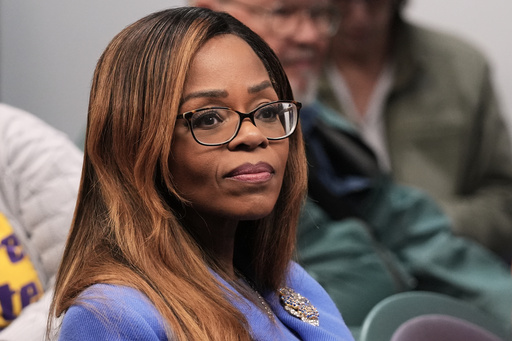
WASHINGTON (AP) — The House Ethics Committee held a rare public hearing Thursday into alleged ethics violations committed by Democratic Rep. Sheila Cherfilus-McCormick of Florida, pushing into the open a yearslong investigation into how she funded her political rise.
Over two years of work, committee investigators say they collected “a mountain of evidence” that the third-term congresswoman committed numerous ethics violations, including failing to follow campaign finance laws, commingling campaign, personal and business funds and using her position to benefit allies. She is also facing federal charges for allegedly stealing $5 million in COVID-19 disaster relief funds. She denies any wrongdoing, and her attorney criticized the House hearing as unfair.
By the end of the nearly seven-hour hearing Thursday night, lawmakers on the panel of four Republicans and four Democrats expressed heavy skepticism at the arguments Cherfilus-McCormick's attorney presented.
“It strains credulity,” said Rep, Mike DeSaulnier, the top Democrat on the ethics committee, responding to the congresswoman's contention that her receipt of millions of dollars was aboveboard.
After the hearing, the panel met in a closed session and planned to later release its judgment. The conclusions could carry significant political repercussions because some Republican lawmakers are threatening a vote to expel Cherfilus-McCormick from the House. Both parties are vying for the ethical high ground before the November elections.
Cherfilus-McCormick, who represents a heavily Democratic district in southeastern Florida, has pleaded not guilty to the federal charges and last year called it “an unjust, baseless, sham indictment.”
Thursday's hearing gave House investigators an opportunity to lay out their findings and make a motion for the panel of lawmakers to conclude that Cherfilus-McCormick committed 27 ethics violations.
Sydney Bellwoar, senior counsel for the House Ethics Committee, told the panel that investigators found “a mountain of evidence” that showed Cherfilus-McCormick violated laws, ethical standards and rules for House members.
Yet to start the hearing, Cherfilus-McCormick's lawyer, William R. Barzee, asked the subcommittee to postpone the proceedings. Barzee had told the committee that if she wants to preserve her Fifth Amendment right against self-incrimination in the upcoming federal trial, “she must remain silent before the committee.”
Cherfilus-McCormick did not address the panel throughout the proceedings, but took notes and at some moments whispered with her attorney and asked him to make a point.
“She is not guilty of these allegations. She is absolutely innocent,” Barzee said, adding, “But she is in between a rock and a hard place right now.”
But the panel declined to postpone the hearing.
Still, Barzee called it a “travesty of justice” for the committee to proceed without allowing him to cross-examine witnesses and submit competing evidence to refute the allegations against the congresswoman.
“At least give her a fair shake and let me cross-examine some witnesses,” he said.
The hearing grew tense at several turns, with Barzee getting into spirited exchanges with lawmakers on the panel. The proceedings centered on a profit-sharing agreement between Cherfilus-McCormick and her family's business, Trinity Health Care Services.
Barzee argued the agreement absolved the congresswoman of guilt. But lawmakers were skeptical of that argument, pointing out that the only evidence presented for it was an unsigned document that appeared to be the basis of transferring millions of dollars to Cherfilus-McCormick. Barzee retorted that Trinity Health Care Services was a family business that made decisions “around the kitchen table.”
Committee investigators have laid out their findings in a 242-page report that concludes Cherfilus-McCormick committed 27 counts of ethics violations.
The report alleges that Cherfilus-McCormick first won a special election in 2022 with a campaign that presented itself as self-financed. But in reality, the campaign was substantially funded through a $5 million overpayment for COVID-19 vaccination services that her family's company had received from the state of Florida, according to investigators.
Barzee said that, regardless of the overpayment, Cherfilus-McCormick was entitled to profits from the business. “There was nothing nefarious or improper about that,” he said.
But investigators laid out an argument that funds were channeled into Cherfilus-McCormick's campaign through a number of business entities that were connected to the congresswoman and her siblings. Bank records also showed a pattern of transferring funds into her campaign accounts shortly before filing deadlines, only to transfer the money out after the deadline. This misled voters about the strength of her campaign, investigators argued.
One of the committee members, Republican Rep. Brad Knott, read from text messages that he said indicated Cherfilus-McCormick was aware of when funds were moved into her account to show a higher balance.
“You and I both know that sometimes evidence speaks for itself,” he said, pointing at Barzee.
The investigation also found evidence that the congresswoman then funded her reelection campaign largely through outside groups run by her friends and family, including a company that was mostly funded by the Haitian government.
Investigators allege that she continued to commit ethics violations in office, including using her position to benefit allies with special favors during the appropriations process and disregarding restrictions on volunteer work by her senior campaign adviser.
Republicans are moving to do just that, although it would require a significant number of Democrats to join them. It takes a two-thirds vote to expel a member from the House.
Democratic leaders have so far declined to condemn Cherfilus-McCormick. California Rep. Pete Aguilar, the third-ranked Democrat in House leadership, said this week that he would not “prejudge” the allegations against her.
“Let’s see what happens in the Ethics Committee,” he said at a news conference Tuesday.
But Thursday's hearing was a rare occurrence that underscored the gravity of the allegations. It has been more than 15 years since a sitting member of the House faced a public hearing, dating to the 2010 ethics trial of Rep. Charles Rangel, D-N.Y., on charges related to his personal finances. The panel also held a hearing that year on allegations against Rep. Maxine Waters, D-Calif., but found insufficient evidence to prove them.
The last member of Congress to be expelled was Rep. George Santos, R-N.Y., in 2023. Santos had not yet been convicted of federal charges, and House Speaker Mike Johnson, R-La., voted against it at the time, expressing concern about setting a precedent of expelling members based on untried allegations.
But a scathing House Ethics Committee report preceded the expulsion vote for Santos. ___
Kinnard reported from Columbia, S.C., and can be reached at http://x.com/MegKinnardAP