

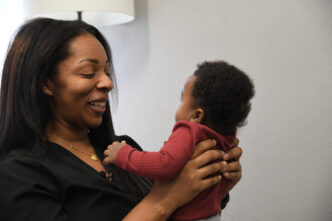
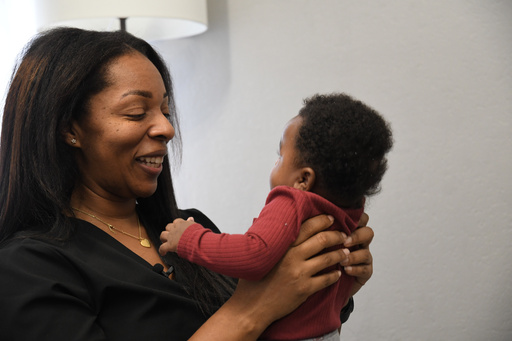
MEMPHIS, Tenn. (AP) — Shaquoiya Stewart held one of her 6-month-old twins on her lap while Shanille Bowens held the other. As the women caught up and the babies stared at each other quietly, Bowens came around to the key question she asks all the mothers she works for: “Do you think there’s anything you need more support with?”
Bowens is a doula, a provider of physical and emotional support before, during and after birth — care that used to be seen as a luxury and was available only to those who could afford it. But doulas are becoming mainstream.
The country's once-reluctant medical establishment is increasingly welcoming the way doulas complement doctors and nurses, and with insurance coverage growing fast, parents from across the economic spectrum can now take advantage.
More than 30 states reimburse doulas through Medicaid or are in the process of implementing such coverage, up from 14 in late 2022, according to the nonprofit National Health Law Program. Private insurers are starting to do the same, with industry giant UnitedHealthcare launching a new benefit this year. Without insurance, costs vary widely but can exceed $2,000.
The changes are being driven by mounting research that shows these trained, non-medical professionals can significantly improve the health of moms and babies. Expanding doula care, experts say, is a relatively inexpensive way to help reduce maternal mortality, which kills Black mothers like Stewart at a rate more than three times higher than white women.
“Doulas can benefit everybody,” said Sierra Hill, maternal care access coordinator for Minnesota’s health department. “And that’s especially true for our communities that are facing a lot of inequities and health disparities.”
Stewart, who has Tennessee Medicaid, said Bowens shepherded her through the jitters of early pregnancy with her twin sons, blood pressure issues during delivery, a C-section and baby blues after birth.
“I felt safe. It didn’t feel like I was just by myself,” said Stewart, a 35-year-old single mother of four. “She was like my homegirl.”
In 2006, 3% of women in the U.S. got care from a doula during labor, according to a survey conducted for the nonprofit Childbirth Connection, now a program of the National Partnership for Women & Families. That figure has doubled or tripled since then, researchers estimate.
When Bowens was pregnant with the first of her six children more than two decades ago, a counselor recommended a doula.
“I’m like, ‘A doula, what is that?’” Bowens recalled.
Bowens was so inspired by the care she received that she ultimately became one herself. In addition to answering moms' questions and connecting them to community services, Bowens helps her clients navigate the health system and advocates for them.
“Oftentimes, we become friends with our clients – lifelong friends. We help connect them with resources in the community,” said Bowens, founder of Naturally Nurtured Birth Services. “We cater to them … so it looks different for each client.”
That help pays off, especially for moms from underserved communities.
Research comparing two groups of socially disadvantaged mothers found that those who used doulas were four times less likely to have a baby with low birth weight, two times less likely to have a birth complication and much more likely to start breastfeeding. Another study published last year found that Medicaid recipients with doulas had a 47% lower risk of C-sections and a 29% lower risk of preterm birth and were 46% more likely to go to a postpartum checkup.
That postpartum finding is key, said April Falconi, a scientist at Carelon Research who co-authored the recent study. More than half of maternal deaths occur during the postpartum period, she said. Causes include infection and excessive bleeding.
These sorts of results led Minnesota to become one of the first states to cover doulas through Medicaid in 2014. A decade later, the state expanded coverage, allowing Medicaid recipients 18 sessions with a doula without prior authorization, more than double what was allowed before.
“The return on investment is huge,” the health department’s Hill said.
There are no mandatory licenses for doulas, but there are state qualification standards to receive Medicaid payments and many doulas seek certification from private entities.
Naturally Nurtured is involved in a pilot project in Memphis in which doula services are paid for under a Tennessee Medicaid program run by UnitedHealthcare. Services are free to members.
UnitedHealthcare commercial clients with a doula benefit, on the other hand, get reimbursed for the care. Doulas are also included in a limited but growing number of other private plans.
“I see doulas becoming more and more integrated and accepted by all within the health care system," said Dr. Margaret-Mary Wilson, chief medical officer at UnitedHealth Group.
That extends to doctors and nurses in hospitals.
Dana Morrison, principal director of Doulas of Duluth in Minnesota, said there “was definitely” resistance to doulas by birth teams when she began her work 10 years ago. That was also true nationally. One point of friction was when doulas advocated for something different from what the medical professionals wanted. And since doulas weren't as integrated into care, they didn't have the time to build trust with doctors and nurses.
Today, Aspirus St. Luke’s hospital contracts with Doulas of Duluth on a grant-funded program, and patients can receive a scholarship to hire a doula through the organization.
Nurse Mallory Cummings, doula coordinator at Aspirus St. Luke's, said people on the birth team accept and appreciate doulas. “What it really comes down to is everyone’s knowledge of what a doula is,” she said.
On a recent afternoon, Mary Bey settled into a chair in a homey room at the Memphis doula center, cradling her sleeping infant, Ca’Mya. Bowens sat beside her, taking notes on her laptop.
After discussing breastfeeding and sleep, they talked about how Bey, 39, has been crying a lot since the delivery.
“What brings it on?” Bowens asked.
“I’ll be scared and I'll just be so protective and treat her like she’s just glass,” Bey replied.
Bey is haunted by a past loss. Before giving birth to her daughter last December, she suffered a stillbirth. Bowens helped her through.
“She was there when I had to push him out. She was there after, when I was healing. She came to the house. She brought groceries,” said Bey, a single mother of four who was connected with Bowens through the same pilot program as Stewart.
When Bey got pregnant again, she texted Bowens: “Hey, can you still be my doula?”
As the pregnancy progressed, Bowens answered all of Bey’s questions and kept her calm. She was there for Bey’s scheduled C-section and supported her when doctors monitored Ca'Mya for jaundice and what they briefly thought was a heart problem.
Later, Bey worried her C-section scar might be infected. Bowens advised her to get it checked out. It was.
Without her doula, Bey said she would never have gotten through either pregnancy as well as she did, physically or emotionally.
“She makes you feel like she’s family,” Bey said. “She was a friend — my best friend — a cousin, an auntie, a sister. All of the above.”
___
The Associated Press Health and Science Department receives support from the Howard Hughes Medical Institute’s Department of Science Education and the Robert Wood Johnson Foundation. The AP is solely responsible for all content.