

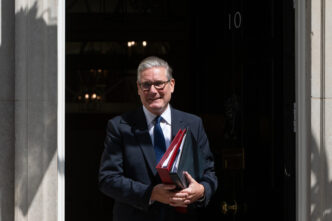
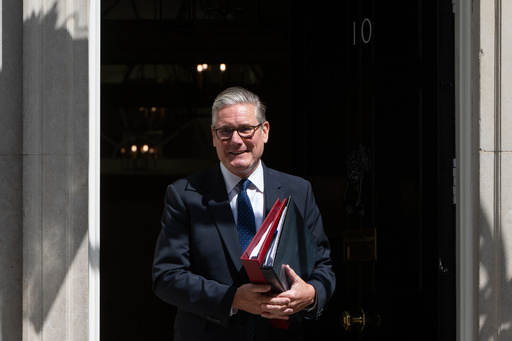
LONDON (AP) — Prime Minister Keir Starmer said that he was leaving the United Kingdom in "better shape than I found it” as he fielded questions, criticism and even a bit of praise from lawmakers in the House of Commons for the last time on Wednesday.
Starmer, who leaves office next week, bid farewell to the boisterous weekly Prime Minister’s Questions sessions where he has traded barbs with opposition politicians and defended his government’s record. On Monday, he will step down as prime minister after losing the support of his Labour Party, handing over power to a new Labour leader, Andy Burnham.
“Every prime minister knows when they take up the torch that the day will come when they have to pass it on,” said Starmer, who has spent six years as leader of the Labour Party and two as prime minister.
“This is the end of my political journey,” he said, though he plans to remain a backbench lawmaker for now.
Britain’s parliamentary democracy allows governing parties to change leaders, and thus prime ministers, without the need for a general election. The next national election doesn't have to be held until 2029.
PMQs is a weekly ritual in British politics, where the prime minister answers questions, from opposition party leaders and others, on topics they don’t know in advance. A test of leaders’ ability to think on their feet, it is derided by some as political pantomime that generates more noise than insight.
Starmer's valedictory session was a gentler affair, mixing seriousness and political criticism with personal tributes and jokes about an upcoming special election pitting Reform UK leader Nigel Farage against the comedy candidate Count Binface.
Starmer opened by saying he was “horrified” at the killing last week of the former lawmaker Ann Widdecombe. Counterterrorism police are investigating it as murder.
Starmer called it “ chilling” that three serving or former members have been killed during his 11 years in Parliament, and urged politicians to “do more to defend our democracy.”
Instead of mentioning upcoming meetings with ministers, as he has every other week, Starmer said that he had “an important appointment with the television” later when England faces Argentina in a World Cup semifinal.
Kemi Badenoch — the fourth leader of the opposition Conservative Party since 2022 — cautioned Labour that changing leaders is no “silver bullet,” and recalled how Starmer had predicted she wouldn't last a year in charge.
“Life comes at you fast,” Badenoch said.
Starmer was elected in a landslide in July 2024, but is quitting after two years in office marred by missteps and judgment errors that eroded his standing with his party and the public.
He struggled to deliver promised economic growth, repair tattered public services and ease the cost of living. And he was hamstrung by repeated missteps, including his decision to appoint Peter Mandelson, a scandal-tarnished friend of Jeffrey Epstein, as U.K. ambassador to the United States.
After Labour was hammered in May’s local elections, Starmer gave in to mounting pressure from the party and announced that he would step down. Burnham, the former mayor of Greater Manchester, is the only candidate in the contest to replace him and will be announced as the new Labour leader on Friday.
On Monday, Starmer will go to Buckingham Palace and announce his resignation as prime minister to King Charles III, who will then ask Burnham to take over.
At Prime Minister’s Questions, Starmer said that he was proud of his government’s domestic policy achievements, including stronger protections for working people, a reduction in child poverty, a law designed to stop official cover-ups after tragedies, and higher defense spending.
“I am proud to leave this country in better shape than I found it,” he said.
Starmer has been lauded for his role on the world stage, especially in repairing relations with Britain's European Union neighbors after Brexit and galvanizing international support for Ukraine's fight against Russia's full-scale invasion.
On Tuesday, Starmer attended Bastille Day celebrations in Paris with French President Emmanuel Macron, who awarded him the Legion of Honor in recognition of his work with France on European security. The two countries have led efforts to assemble an international coalition to underpin peace in Ukraine if there is a ceasefire.
Ukraine's cause has wide political support in Britain, and Badenoch praised Starmer for inviting President Volodymyr Zelenskyy to London immediately after the Ukrainian leader was berated by U.S. President Donald Trump and other administration officials in the White House last year.
Starmer recalled how people had gathered at the gates of Downing Street to see Zelenskyy, and “the moment he got out the car and hugged me, they cheered from the top of their voices, the British people, to tell President Zelenskyy exactly what they thought of him and the way he had been treated” in the Oval Office.
The rambunctious House fell silent as Starmer ended by thanking colleagues, staff, civil servants and all those “who struggle to be seen or heard — you’re the reason I came into politics.”
He said “I love you” to wife Victoria and two teenage children, who were watching from a viewing gallery, before a final: “Goodbye.”
Lawmakers from all sides of the chamber applauded, with many rising for a standing ovation. That drew a reprimand from Speaker Lindsay Hoyle, who reminded them that cheering is allowed in the House of Commons, but clapping is against the rules.