

President Donald Trump said Friday that the U.S. will open a formal investigation into the European Union’s trade practices, claiming the bloc has unfairly levied billions of dollars of fines against Google, Apple and other U.S. tech giants.
The EU, a day earlier, fined Google 890 million euros ($1 billion) for allegedly breaking digital antitrust regulations by corralling consumers toward its own services and apps to the detriment of competitors.
Trump’s announcement comes a day after the White House said it would impose double-digit tariffs on imports from more than 60 countries, accusing them of inadequately enforcing bans on goods produced by forced labor. The new tariffs replace temporary 10% worldwide import taxes that Trump imposed after a stinging defeat at the Supreme Court.
Also, a series of explosions sounded near a military base hosting U.S. forces in northern Iraq and sirens rang out in Bahrain on Friday, hours after the American military said it finished its 13th night of strikes against Iran. The conflict has flared again over the past week, as the U.S. has pounded Iran while Tehran has attacked ships in the Strait of Hormuz and targeted U.S. assets and allies in the region.
Here's the latest:
Trump met Friday with top national security aides to discuss the situation with Iran and whether the administration should maintain the current course or escalate military attacks, according to a U.S. official who spoke on condition of anonymity to discuss internal deliberations.
It was not immediately clear if there had been any decisions made at the meeting, which was earlier reported by The New York Times. The White House didn’t immediately respond to a request for comment.
In an event in the Oval Office on Friday, Trump described negotiations with Iran as “by far the most serious that we’ve seen,” even as the U.S. has launched daily strikes.
“We’re locked and loaded and ready to go, but we’re talking to them,” Trump told reporters, adding that he’s “not in a hurry” to end the war.
___
— By Matthew Lee
American forces disabled the M/T Lavine in the Gulf of Oman on Friday after the ship attempted to run the blockade at least four times, Capt. Tim Hawkins, U.S. Central Command spokesman, told The Associated Press.
Hawkins stressed that the ship’s crew was warned and didn’t comply with commands. The military then fired into its engine room.
It’s the second commercial ship to be disabled since the military reimposed its blockade. U.S. Central Command said it also has redirected 12 vessels.
The Pentagon has nominated a replacement for Gen. Christopher Donahue, who suddenly departed last month as commanding general of U.S. Army Europe and Africa and commander of NATO’s Allied Land Command.
Hegseth announced Friday that he’s selected Lt. Gen. Kevin D. Admiral for the post.
Admiral will not be promoted to general, confirming earlier reports that the Pentagon plans to downgrade the post from a four-star to a three-star position as part of a broader effort by Hegseth to reduce the number of generals in the ranks.
Admiral now is serving as commanding general, III Corps and Fort Hood in Fort Hood, Texas. An Army official, who spoke on condition of anonymity to discuss personnel matters, said Donahue is now on transitional leave pending approval of his retirement.
Asked if Jordan or LeBron James were the best basketball player ever, the president said he golfed with Jordan and “he’s a really good guy.”
“I think LeBron is, maybe he’s a racist,” Trump said. “Maybe he doesn’t like Trump.”
He added, “I like people that like me, so I would say Michael Jordan all the way.”
Trump was also asked about golfer Bryson DeChambeau who reportedly threatened to call the president after being given a controversial two-stroke penalty during the recent British Open.
The president didn’t say if he sees himself as a sports “fixer” after intervening to help get a U.S. red card overturned during the World Cup.
Trump suggested it was more like “me being a judge.” He said of DeChambeau, “I thought it was a tough call against him.”
Asked about a recent comment from Defense Secretary Pete Hegseth saying China and Russian are “enabling” Iran, Trump suggested otherwise.
“President Xi said he will not partake, and President Putin said the same thing,” Trump said in the Oval Office on Friday. “I trust them.”
He added that there “could be some things they do” — without elaborating — but emphasized it “has not been major.”
Earlier on Friday, Trump said that both Xi and Putin had personally promised not to sell weapons to Iran.
“If they did, it would be very bad for them,” Trump said on social media. “Certainly not in their best interests.”
Trump called the latest tariffs his administration announced on 60 economies late Thursday “very standard tariffs” that “follow the line” when asked whether he believes the latest tranche announced this week could overcome legal challenges.
The administration’s tariffs announced this week are based in the argument that the countries targeted have failed to adequately enforce a ban on goods made with forced labor.
Citing the Supreme Court’s decision this summer that struck down the president’s Liberation Day tariffs, Trump said: “I thought the decision by the Supreme Court was not a good one, but we have many forms of tariffs.”
“I’d certainly be willing,” Trump said when asked if he could be doing more to help the Republican-controlled Senate pass a stalled elections bill he wants to sign into law.
Trump said he helped move the bill through the Republican-controlled House by calling a few representatives and getting them on board to send the bill to the Senate.
He said Senate Majority Leader John Thune has “got four or five people that are very difficult,” including some “I put out of office.”
“So I understand how it feels. I mean, they’re doing the wrong thing,” Trump said, asking who wouldn’t be for showing ID and proof of citizenship to vote.
“No Republicans should put us in a position where they don’t approve of something like that,” he said.
The president said, as far as the elections are concerned, “I’m not in a hurry.”
He said he won’t let rising gas prices and inflation continuing to run hot sway his decision on the war in Iran.
“We have to do it right,” Trump said, adding “elections take care of themselves.”
Trump was reelected in 2024 promising to bring down the cost of living but has seen prices rise dramatically in the months since the war with Iran began.
That has complicated things for Republicans hoping to maintain control of Congress.
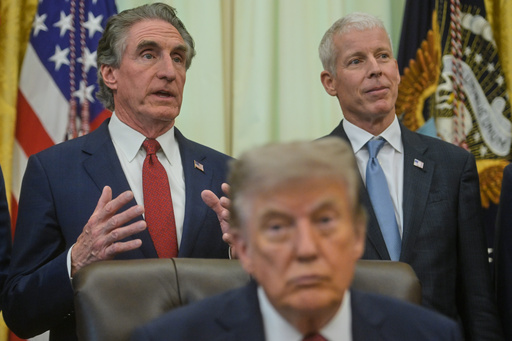
The president hosted executives from nuclear power companies in the Oval Office to celebrate a new milestone in the White House’s push to accelerate the growth of nuclear power in the U.S.
Last year, Trump signed four actions creating a pilot program aimed at having four new nuclear reactors go critical by July 4. Four companies ended up meeting that deadline, Trump said on Friday.
“America is building again, America is dreaming again, and we’re leading the world in pioneering the next generation of nuclear power,” he said.
Asked when it would be safe to eat lettuce again, after a diarrhea-inducing parasite found in lettuce produced in Mexico has affected patients in nine U.S. states, Trump said his government is “going to put a major tariff on tax on Mexico because of the lettuce.”
He added that his administration would also “put a big tariff on Canada because of the smoke” caused by hundreds of wildfires raging across Canada, which has carried smoke by winds into the U.S.
A day after his administration withdrew subpoenas that would have required three New York Times journalists to testify about their sources, Trump said he isn’t retreating.
“We have a long way to go with that case,” Trump said in the Oval Office on Friday.
Trump said he supports the subpoenas, which were issued in response to a story about Trump’s Qatari-gifted Air Force One jet.
“We’re not after journalists, we’re after leakers,” Trump said. “And the way you find them is through the journalists.”
“Sort of everybody” is involved in the talks with Iran to end the war, Trump said.
He said Vice President JD Vance and Secretary of State Marco Rubio and “a lot of people” are talking to Iran.
“We’ll see what comes of it,” the president said.
“We’re talking to them right now,” Trump said. “I think they’re getting more and more serious as the days go by, for maybe the obvious reason. But we are talking to them right now.”
Asked when that the country will hold elections after U.S. forces toppled President Nicolás Maduro, Trump responded, “They’re not really ready for them yet.”
He said the U.S. has brought economic benefits to Venezuela without elaborating, or mentioning the devastation of recent, major earthquakes there.
“They’re not ready yet for the elections, but at some point they will be,” the president added before mentioning the country’s prowess in the Miss Universe pageants once he owned.
Answering questions from reporters, Trump was asked if he considers it a war crime to blow up civilian power plants and bridges, as he has repeatedly threatened to do in Iran.
Trump replied, “I wont respond to that question.”
The president has repeatedly threatened to blow up civilian infrastructure in Iran before backing down.
Democrats on the Senate Armed Services Committee are demanding answers on how the Pentagon is handling the reporting of Iran war casualties.
In a letter Friday, the 12 lawmakers note that the Pentagon’s Defense Casualty Analysis System, or DCAS, “has reported inconsistent casualty figures, raising additional questions about the transparency and reliability of the Department’s public reporting and statements.”
Chief Pentagon spokesperson Sean Parnell argued this week that the system is “regularly updated online” following news reports that information about injuries was being withheld.
However, the system now shows only 14 troops killed, though that total stands at 18. The system also shows only 420 troops have been wounded in the conflict. A U.S. official has told The Associated Press that the total is well over 500.
Parnell blamed “temporary data disruptions” in a social media post Thursday.
The lawmakers are seeking detailed information about the Iran war casualties as well as details about the reporting process of that data to DCAS
The Liberty Justice Center, a libertarian advocacy group that successfully challenged earlier Trump tariffs, filed a lawsuit in the U.S. Court of International Trade in New York, challenging the double-digit import taxes that Trump imposed Friday.
The Trump administration, invoking the Trade Act of 1974, targeted 16 U.S. trading partners with tariffs of 10% to 12.5%, charging that they had failed to crack down on imports produced by forced labor.
But the Liberty Justice Center calls the new tariffs a pretext to allow Trump to maintain a wall of tariffs around the U.S. economy after the Supreme Court struck down big global taxes he’d imposed last year.
The new levies took effect at 12:01 a.m. Friday as time ran out on temporary tariffs Trump had turned to after the Supreme Court defeat.
“The administration allowed one global tariff to expire and immediately replaced it with another under a different statute,” said Sara Albrecht, chair of the Liberty Justice Center. “Changing the statute doesn’t change the law. Every tariff authority has limits, and every administration must respect them.”
Her group represented businesses that successfully challenged Trump’s 2025 global tariffs.
On social media, Trump says he’s OK with Canada’s decision “considering they are paying substantial TARIFFS to the United States.”
Canada alone is celebrating the completion of a new bridge to the U.S. over the Detroit River. The multibillion-dollar Gordie Howe International Bridge will serve as a critical path for trade and casual travel between the U.S. and Canada.
Canada scratched a joint gathering after Trump this week suddenly announced 50% tariffs on Canadian goods entering the U.S.
The president says he’s opening the formal investigation because the bloc has unfairly levied billions of dollars of fines against Google, Apple and other U.S. companies.
Trump made the announcement a day after the EU hit Google with a fine of 890 million euros ($1 billion) after it said the technology behemoth broke digital antitrust regulations by setting up Google Play and its ubiquitous search engine to corral consumers toward its own services and apps to the detriment of competitors.
In a lengthy post on social media, Trump said he has warned the EU about its practice of fining U.S. tech companies. He named Google, Apple, Meta, Amazon and others.
The decision most likely cements a dramatic break from decades of tradition by keeping Iowa and New Hampshire off the top of the calendar and elevating more racially diverse states.
The Democratic National Committee’s Rules and Bylaws Committee weighed competing bids led by South Carolina and Nevada for the first spot. The choice will need to be approved by the full Democratic National Committee, which is scheduled to meet in August.
South Carolina or Nevada had been expected to go first, with each state aggressively campaigning for the coveted spot.
U.S. embassies across the Middle East sent out country-specific travel alerts to Americans, advising them that already limited options to leave the region may become more limited due to escalating tensions between the United States and Iran.
At least 11 embassies in the Mideast released advisories that echo broader “worldwide caution” and regional warnings that the State Department has put out since last weekend. The department was criticized for its messaging to Americans in the Middle East before and during the war that began in late February.
Neither the worldwide alerts nor the country-specific ones being released on Friday say that intensified hostilities are imminent but they note that some airlines have already canceled flights into the region and that others may follow suit.
The 11 embassies to issue the alerts are Bahrain, the virtual embassy in Iran, Iraq, Israel, Jordan, Kuwait, Lebanon, Oman, Qatar, Saudi Arabia and the United Arab Emirates.
Israeli Prime Minister Benjamin Netanyahu plans to travel to the United States for an official visit next week, his office said in a statement Friday. He’ll meet with President Trump in Washington on Tuesday, according to the statement, and also attend the funeral of Sen. Lindsey Graham.
The last time the two leaders met in Washington was in February, just weeks before they launched a joint war against Iran. Since then, tensions have grown between the longtime allies, including over how to prosecute the war.
Israel had opposed Trump’s recent negotiations with Iran, while Trump was upset over Israeli military action in Lebanon, which he saw as a threat to his diplomatic efforts to reopen the Strait of Hormuz.
But with Iran and the United State fighting once again, Israel has also signaled its willingness to rejoin the conflict. In recent days, Israeli officials have said they’re preparing to respond if Iran launches an attack on Israeli soil.
Vance added a message with her social media post thanking the public “for all the good wishes as we settle into life as a family of six.”
She included photos of her larger family seated on a couch, as well as a close-up of the baby.
Vance gave birth Sunday to Alec Neel Vance, her fourth child with Vice President JD Vance. Alec is also the first child born to a sitting vice president in more than 150 years.
He joins older siblings Ewan, Vivek and Mirabel.
When guests arrive for the rescheduled White House Correspondents’ Association dinner Friday at Washington’s Waldorf Astoria hotel, security will be much tighter, the guest list smaller, the partying pared down.
That much, the correspondents’ association can control.
What remains out of its control — and perhaps the biggest question — is what the dinner’s most prominent guest, President Donald Trump, will bring to the table.
Call it White House Dinner 2.0, or Take Two, or, in Trump’s own words, a “HOT ticket.”
The big unknown is whether Trump will bring the fighting words (“rather nasty,” he said) against the press he’d planned to deliver in April — before the event descended into chaos when a gunman stormed a security checkpoint, forcing an evacuation of the room.
Wendy Cutler, a former senior U.S. trade official, said the latest round of tariffs involved “few surprises” since they range just between 10% and 12.5%.
The U.S. Trade Representative’s office spent four months investigating the basis for those tariffs to meet legal requirements under Section 301 of the U.S. Trade Act of 1974.
“Time will tell whether the third attempt to impose tariffs is the charm and this action stands up to legal challenges,” said Cutler, senior vice president of the Asia Society Policy Institute.
These duties are less likely than earlier ones to be overruled by U.S. courts, she said.
Further tariffs may be coming in the fall related to alleged structural excess capacity of trading partners, she noted.
China’s Ministry of Foreign Affairs said it “opposes all forms of unilateral tariffs” in response to the new 12.5% tariffs, reiterating a longstanding statement by Beijing.
“Tariff wars and trade wars do not serve any parties’ interests,” ministry spokesperson Lin Jian told a regular news conference.
Trade tensions have clouded relations between China and the U.S., two of the world’s biggest economies, as Trump’s hefty “Liberation Day” tariffs resulted in a sharp drop in Chinese exports to the U.S.
Trump and Chinese leader Xi Jinping, who agreed to set up new boards of trade and investment at their mid-May meeting in Beijing, are expected to meet again in September.