

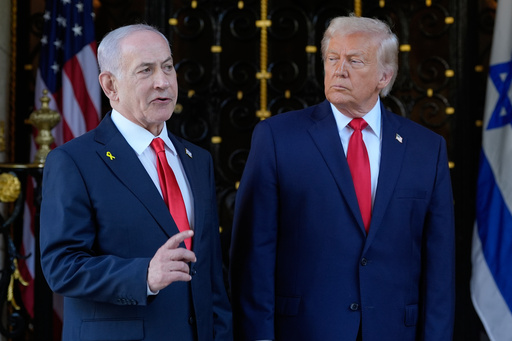
WASHINGTON (AP) — Israeli Prime Minister Benjamin Netanyahu said he had an “excellent” meeting with President Donald Trump at the White House on Tuesday, their first sit-down since launching a joint war against Iran and it offered Netanyahu a chance to smooth out strains in their relationship.
The closed-door meeting lasted nearly an hour and a half and was “positive and productive," White House press secretary Karoline Leavitt said. Trump, in a social media posting several hours after the talks, called it a “very good meeting” where “many important subjects were discussed” but offered no further details.
The face-to-face talks come as both leaders face growing pressures at home. Netanyahu is up for reelection and is embattled in part because of his deteriorating relationship with Trump. Trump is under pressure to end an unpopular war that has wreaked economic havoc and driven prices higher ahead of midterm elections this November.
Later on Tuesday, Iran shattered a brief period of calm in the war by launching multiple ballistic missiles at U.S. forces in the Middle East, the U.S. military said, adding that all of the Iranian missiles were successfully intercepted.
An Israeli official briefed on the White House meeting said Netanyahu made it clear to Trump and his Cabinet that if Iran were to attack Israel, they would respond, but that beyond that, they would trust the judgment of the president regarding next steps. The official spoke on the condition of anonymity to share details of a private meeting.
Despite signs of tension between the two before the meeting, Netanyahu was effusive afterward in a post on Instagram, noting that the meeting included Trump's “entire senior team.”
Vice President JD Vance, who has had critical words for Israel and in June warned Israeli officials that Trump was their only friend among world leaders, was among those in the meeting.
“When I say excellent, I don’t mean it in a superficial way,” Netanyahu said in Hebrew. “A conversation with full partnership, with mutual support, with an understanding of the common goal of ensuring that Iran does not have nuclear weapons, and other goals as well.”
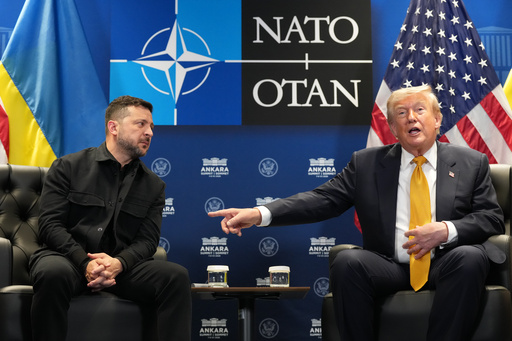
Netanyahu later joined Vance and Trump at a funeral for Sen. Lindsey Graham, where the Israeli leader was seen speaking to Ukrainian President Volodymyr Zelenskyy, who met with Trump earlier in the day.
Trump revealed some tension with Netanyahu ahead of their meeting, complaining about reports that the Israeli leader planned to discuss intelligence on Iranian activities at Pickaxe Mountain, a potential nuclear site that the U.S. president has threatened repeatedly to bomb.
“I know exactly what’s going on at Pickaxe,” Trump told “Fox & Friends.” He insisted that whatever Iran is doing is “not a big problem” and that “Bibi’s telling me that because he wants me to stay involved.”
“Why do you have to announce to the world?” Trump added, flashing his frustrations with his ally.
The Israeli official said that Netanyahu reiterated to Trump during the meeting that Israel will always share its intelligence with the U.S. but that it also understands that Washington has its own timeline and considerations to factor in, including other allied countries in the region that would be affected if Washington were to escalate militarily.
Trump has had a hot-and-cold history with Netanyahu over the years, but upon his return to the White House last year, their alliance seemed stronger than ever. When they started the war together in February, it was with a united front, touting their respective militaries as acting in lockstep to take out Iran’s leadership and pave the way for a government more friendly to the West.
But as Iran fought back — sending drones and missiles slamming into U.S. bases and high-rises in cities in the Gulf, and choking off the Strait of Hormuz — Trump came under immense pressure both at home and by allies in the region to end the conflict.
Since then, Netanyahu, who wanted to continue the fighting in Iran and against its ally, Hezbollah, in Lebanon, has been sidelined as Trump sought a deal with Tehran. Disagreements with Trump and Vance have burst into the open over the war in Iran and more.
“The Americans are making it clear to the Israelis they are the ones who are running the war,” Israeli journalist and political analyst Amit Segal wrote Monday in the daily newspaper Israel Hayom. “It is clear to everyone that Israel has been put in the back seat.”
Of Trump, Netanyahu said Sunday that “many ways, it’s his decision” on how to move forward. “If he can do so without returning to intense military fighting, that’s fine. Why not?”
“But one way or the other, they have to end their nuclear program,” Netanyahu told Maria Bartiromo on Fox News Channel’s “Sunday Morning Futures” about Iran.
The Israeli official said the two leaders also discussed the framework agreement that the U.S. and Israel signed with Lebanon over the Israel-Hezbollah war and the expansion of the Abraham Accords, which have Arab and Muslim-majority nations normalize ties with Israel.
Netanyahu also needed to persuade Trump that he won’t play spoiler to U.S. diplomatic and reconstruction efforts in Gaza and Lebanon, where the president has previously complained that “too many people are being killed” by Israeli strikes.
In Lebanon, where the Israeli military occupies much of the south, Israel agreed to allow the Lebanese army to deploy to some villages as part of a “pilot program” testing its ability to secure areas where Hezbollah once operated. The U.S. State Department says the next round of talks between Israel and Lebanon will take place next week in Rome with a focus on expanding the program.
On Gaza, Israel’s security cabinet green-lit on Sunday a measure that would, in theory, grant entry to the first members of an international stabilization force outlined last year in a U.S.-backed ceasefire deal between Israel and Hamas.
Few countries have pledged troops, however, and Israel would approve their entry into Gaza on a case-by-case basis. The troops — including from Morocco and Uganda — would only be allowed to operate in a small, desolate area in Rafah in the south, where the plan is to vet and house some displaced Palestinians.
The Israeli military continues to carry out strikes it says target militants but that have also killed civilians.
Israel has lost a significant amount of bipartisan support in the United States, particularly over Gaza. An AP-NORC poll published this month found a dramatic erosion of support among American adults for Israel.
Near the White House, a small group of protesters chanted, “Netanyahu, you’re a tyrant” and “Bibi, you’re not welcome here,” referencing the prime minister’s nickname.
___
Cunningham reported from Jerusalem and Amiri reported from New York. Associated Press writers Melanie Lidman in Tel Aviv, Israel, Darlene Superville and Seung Min Kim in Washington, Edith M. Lederer at the United Nations and Bill Barrow in Atlanta contributed to this report. Cunningham reported from Jerusalem.