

HALBERSTADT, Germany (AP) — A small organ in eastern Germany is the headliner of the world’s slowest concert. It has been playing the same piece of music by composer John Cage at a glacial pace for nearly 25 years.
A rare chord change on Wednesday — from seven notes to eight — represented the completion of about 4% of the 639-year endeavor of the John Cage Organ Project Halberstadt.
It was a historic moment inside the medieval Burchardi Church, in Halberstadt, Germany, that reflected the past, present and future of the project, as well as those who are following its — albeit very slow — progression.
“As fast as our world is developing, I think it’s a wonderful place to be and to come to yourself and just to be touched by this ‘being there,’"said Anneli Borgmann, chairwoman of the John Cage Organ Project Halberstadt’s board of trustees.
While the project commenced in 2000, the performance began Sept. 5, 2001 — Cage’s 89th birthday — with a silent pause that lasted until Feb. 5, 2003, when the first chords could actually be heard.
The composition — called “ORGAN²/ASLSP (As SLow aS Possible)” — is scheduled to finish on Sept. 4, 2640.
An electric-powered blower system sends wind into the organ to create a continuous sound. A chord change, done manually, means that the sound of the organ pipes changes either because new sounds are added or existing sounds end.
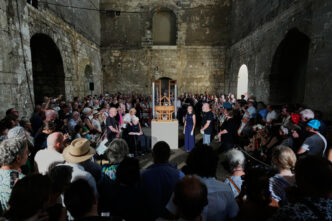
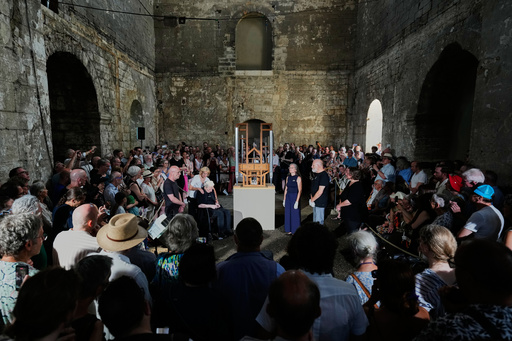
More than 150 people squeezed inside the church Wednesday to witness what was the piece’s 17th chord change, with dozens more watching a livestream outside.
For three minutes, the crowd listened to the “old” chord with its seven pipes. Then, an eighth pipe was slotted into the small organ, bringing with it a new sound that reverberated throughout the church. The spectators listened for another three minutes — some filming with cellphones, others taking it all in with their eyes closed and heads bowed — before breaking out into applause and cries of “bravo!”
“It’s a very subtle difference,” said Jeffrey Lependorf, executive director of the John Cage Trust in New York. “There’s a higher sound that’s a little more prominent.”
Cage, an American avant-garde composer, was born in Los Angeles in 1912 and died in New York in 1992. He was also a renowned music theorist, artist and philosopher whose only direction for this piece was to play it as slowly and as softly as possible. He initially composed it for the piano in 1985 and updated it for the organ in 1987. It was reimagined into the 639-year project after his death.
The interpretation of the composition in Halberstadt has resulted in the smallest unit being one month long. Other units — as well as silences — can last years.
The project has transformed the Burchardi Church, which was left largely in ruins before money was raised for a new roof and other fixes to make the piece a reality. The sound there envelopes visitors throughout the church and gives them new experiences to hear as they move through the empty space.
“I think it really is the organ playing the church and not the other way around,” Lependorf said. “You move two inches in any direction and it sounds not subtly different — very different.”
The piece will last 639 years, from 2001 to 2640. The time frame was chosen to be a tribute to a historic organ in Halberstadt that dates back to 1361, or 639 years before the project was initiated in 2000, according to Borgmann.
The time frame allows the project’s stewards and visitors to contemplate not only Cage’s legacy but their own as guardians of an organ that will outlive them as each chord change depends upon a new generation of musicians, volunteers and craftspeople to keep the piece going.
Cage fan Michael Barnett, 55, from Glasgow, in Scotland, said attending the chord change was a bucket list item.
“This is just one of those things, one of those unique things in the world of music,” he said. “It comes up and you think ‘I just want to do this thing once.’”
Barnett and other enthusiasts also debate what the world will look like by the end of the piece.
“You just wonder what will be left here in 600-odd years time,” Barnett said. “Who will come to the last performance? Will the building still be here? Will the organ still work? What will the world be like?”
The organ, at least, is built to last.
Organ builder Johannes Hüfken said the pipes he’s crafted for this will last at least another 500 years.
“This John Cage project is a good example of thinking ahead for the next generation — thinking outside the box, beyond the completely normal and traditional,” he said.
The next chord change will take place on Oct. 5, 2027, when the overall sound will be reduced by releasing the E4 pipe.
Inheritable “final tickets” for the Sept. 4, 2640, finale are already being sold for 2,640 euros ($3,045).
___
Markus Schreiber contributed to this report.