

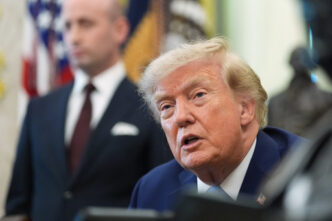
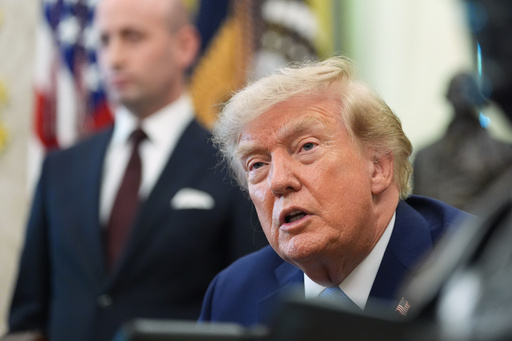
WASHINGTON (AP) — President Donald Trump said Thursday that he is once more trying to limit the number of people who are born in the country who can become American citizens, in a sign that even after his first attempt at limiting birthright citizenship was rejected by the Supreme Court, he's ready to try again.
The president said he was signing two executive actions on immigration, including one limiting the number of people eligible for U.S. citizenship after being born in the United States, while another focused on stopping people from coming to the U.S. to give birth.
The written executive order released later Thursday was narrower in scope than the previous one shot down by the Supreme Court and appeared to focus on restricting automatic citizenship to specific categories of people, including children born to adults with connections to foreign embassies or organizations as well as anyone considered an “alien enemy” of the United States.
It also aimed to restrict birthright citizenship to anyone whose parents “engaged in fraudulent activity to obtain citizenship."
A second order seeks to curb what Trump called “birth tourism” by increasing restrictions on visitors to the U.S. who want to obtain visas to give birth while in the country.
It was not immediately clear how successful the president's most recent attempt to restrict birthright citizenship would be. Trump said he thought his latest actions would be constitutional and his drive to reopen the question reflected the administration's zeal to restrict who gets to become an American.
“I thought we were going to win it at the Supreme Court. Unfortunately, we had a bad decision, very unfair decision. Our country suffers because of it and we’re ending it a different way,” Trump said.
The Migration Policy Institute noted in a 2026 article that it’s already considered fraud and grounds to restrict a visa if someone seeks a visa specifically to come to the U.S. and obtain citizenship for a child. Previous administrations have also sought to prosecute so-called “birth tourism" schemes that helped women hide their pregnancies while traveling to the United States to give birth.
Birthright citizenship has become a key rallying point in the president’s second term anti-immigration agenda, with the president and supporters arguing it makes the country a magnet for immigration and that American citizenship should be reserved for those who truly value it, as opposed to just being given to anyone born here.
But immigration advocates and many legal experts say that the Constitution is clear in outlining who is considered a citizen. They've also argued that birthright citizenship is a benefit to the U.S. by giving everyone an equal stake in the country's future and that restricting who can become a citizen would create a second-class of people in America.
The Trump administration has painted birth tourism as a widespread problem. There's no official estimate of how many births can be considered “birth tourism” births, but an estimated 26,000 might fall into that category out of the roughly 3.5 million births in the U.S. every year, MPI wrote in its 2026 article.
In June, the Supreme Court rejected Trump’s previous efforts to declare that children born to people in the U.S. illegally or temporarily aren’t American citizens, and upheld a broad conception of birthright citizenship.
The American Civil Liberties Union predicted that Trump's second attempt would also be rejected.
“The Supreme Court already decided this issue: Birthright citizenship is guaranteed by the Constitution. No additional executive order can change the meaning of the Constitution. Any executive order that tries to rewrite birthright citizenship will meet the same fate as the last one,” said Cody Wofsy, deputy director of the ACLU’s Immigrants’ Rights Project, in a statement Thursday.
On Trump’s first day in office of his second term, he signed an executive order aimed at ending birthright citizenship, which allows anyone born in the United States to automatically become an American citizen.
Trump’s administration was immediately sued by opponents who said the executive order went against the 14th Amendment, adopted after the Civil War, which makes anyone born in the country a citizen, with very limited exceptions.
The executive order was blocked by several lower courts and never took effect.
In June, the Supreme Court struck down Trump’s order by a 6-3 vote. But the vote was too close for many immigration advocates and legal observers who felt the legal question of birthright citizenship was a long-settled issue.
When it came to the legal question of whether birthright citizenship was protected by the Constitution, the vote was even narrower. Only five justices said it was enshrined in the Constitution, while Justice Brett Kavanaugh rejected the executive order, but did so specifically on the grounds that federal law conveys birthright citizenship.
__
Santana reported from Sacramento.