

JERUSALEM (AP) — As the U.S.-created Board of Peace pushes ahead with plans to rebuild Gaza, it has said there’s no place for the U.N. body that for decades has provided support to displaced Palestinians. But the agency’s last chief says that behind the scenes, board members and others have been more open to working with the U.N. agency for Palestinians than it seems.
Israel wants the agency known as UNRWA out of Gaza and has repeatedly accused it of being infiltrated by Hamas militants, allegations the International Court of Justice says have not been substantiated. And yet UNRWA remains the territory’s largest aid provider, playing a key role in health and education.
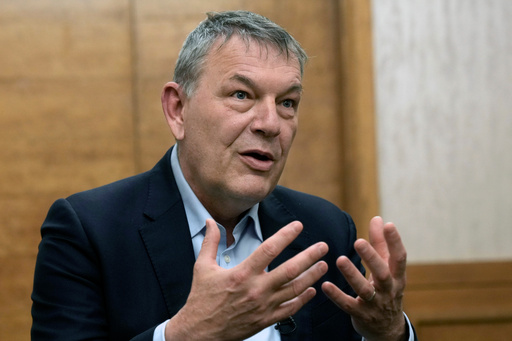
Philippe Lazzarini, who led UNRWA until earlier this year, told The Associated Press in an exclusive interview — his first since stepping down — that members of the Palestinian technocratic committee want to work with the agency. Another U.N. official shared minutes from meetings where UNRWA and the committee discussed collaborating on plans for Gaza.
A Board of Peace official confirmed that board members had met multiple times with UNRWA officials.
And while the agency’s days are over, its programs “may persist if they are serving Gazans well,” the official added, speaking on condition of anonymity because they were not authorized to talk to the media.
Israel's Foreign Ministry did not comment.
There’s been no reconstruction in Gaza, almost a year since the ceasefire. Israel still prevents the entry of the Palestinian committee chosen by the Board of Peace to eventually govern the strip, saying Hamas must first disarm. The committee says it needs to be inside the strip to activate Gaza plans.
That's left UNRWA on the ground in Gaza, with far more workers than any other U.N. agency or nongovernmental organization. While Israel’s attacks on the agency neutered its role coordinating aid entry and distribution in Gaza, UNRWA’s core programs have remained.
“They want to get rid of the agency, but on the other hand they know that if you get completely rid of the agency today, it might have a further additional devastating impact on the population,” Lazzarini said.
UNRWA props up about half of Gaza’s public health system, said Lazzarini, whose last working day was March 31.
It still has around 11,000 Palestinian employees in Gaza. They conduct about 14,000 medical appointments daily, maintain water and waste management systems for over a million Palestinians, run digital literacy and math programs for over 280,000 children and staff temporary learning spaces for 60,000 more, UNRWA says.
UNRWA makes sure aid reaches people, Lazzarini said. “If you want the vaccine to end up in the mouths of the children, you still need the workforce, the presence of an agency like ours.”
Publicly, the agency has not been included in the Board of Peace’s planning for Gaza. At the board's briefing to the U.N. General Assembly Wednesday, officials named various U.N. agencies as partners, but not UNRWA.
However, behind the scenes, the Palestinian committee that will eventually govern Gaza acknowledged that UNRWA is necessary for planning, Lazzarini said.
Two senior U.N. officials and the board official told the AP the board had met multiple times with UNRWA since the ceasefire was signed.
The officials, who spoke on condition of anonymity because they were not authorized to brief the media, confirmed at least three meetings between UNRWA officials and the Palestinian committee this year, most recently this month. Two took place during Lazzarini’s tenure.
Shortly before the end of his tenure, Lazzarini said, he spoke to Ali Shaath, who leads the Palestinian committee.
“Basically, he said, ‘I don’t know how I can succeed without you’,” Lazzarini said. Shaath and a spokesperson did not respond to requests for comment.
An internal U.N. description of a Jan. 26 meeting in Cairo, held without UNRWA, said Shaath praised the agency, showed a clear intention to see it back on track and said the Palestinian committee's system would largely build on its work.
The Tony Blair Institute, a Board of Peace partner, also asked for UNRWA’s help and spoke to UNRWA personnel, one senior U.N. official said. In response, the institute said it works with multiple U.N. agencies and NGOs in Gaza "to understand the situation on the ground, the needs of the population and the practical requirements for improving conditions.”
At a pledging conference for UNRWA on June 30, the agency's current acting chief, Christian Saunders, called it “vital” to efforts by the board to move forward with the ceasefire.
But the Board of Peace official painted a different picture, saying the meetings focused on determining how UNRWA’s operations work in order to develop programs that are “far more efficient and accountable.”
“UNRWA’s days are over,” the official said. Still, its employees ”will remain if they pass vetting and are delivering on their mandate and not advancing ideology or Hamas interests.”
Lazzarini said it's an “absurd contradiction" — the Board of Peace says UNRWA is not wanted while U.N. member countries “expect it to deliver.”
“We continue to emphasize that UNRWA is indispensable,” Jordan’s Foreign Minister Ayman Safadi told journalists Thursday, after over 50 countries attended a ministerial meeting on the agency at U.N. headquarters.
UNRWA was established to help Palestinians who fled or were driven out of what is now Israel during the 1948 war surrounding its creation.
In January 2024, Israel claimed, without providing evidence, that hundreds of Palestinian militants worked for the agency and over a dozen employees took part in the Oct. 7 attack.
Lazzarini said that he was never given written evidence to back up the allegations despite asking Israel and UN member states, but that he doesn't regret his decision to fire the employees accused of taking part in the attack.
“I did because it was in the best interest of the agency and the population we were helping," Lazzarini said, adding that he has faced “extraordinary vicious, heinous attacks on social media” as well as being accosted in the streets, "in Geneva and in New York” and shouted at by "pro-Israeli groups.”
In his two-hour interview with the AP, he shared recollections from the Gaza war.
He remembered how Palestinians released from Israeli detention told his staff they'd worn diapers in detention and had spent days sitting in their own excrement. He remembered how a displaced father — staying in a school courtyard with four kids — slept with shoes at his head, in case they needed to evacuate from bombardment.
His book, “A Witness to Gaza: What Cannot Be Erased,” will be published in French in October, with an English version to follow.
___
Associated Press writer Edith M. Lederer at the United Nations contributed to this report.