

IMMOKALEE, Fla. (AP) — It's almost noon, and after playing on the playground, working with clay and washing their hands, the 2-year-olds are ready for lunch.
The eight children and their Head Start teachers pray in English, thanking God for the meal. Then, the adults bring over several bowls.
“Hoy tenemos arroz." In Spanish, the teacher announces the children are having rice. A little boy grabs a ladle and scoops rice onto his plate.
Both English and Spanish are core to daily life in this Head Start preschool in Immokalee, Florida — an agricultural area about 120 miles (190 km) northwest of Miami. The center serves more than 50 children from mostly Guatemalan families, ages six months to 5 years. Most students arrive speaking little or no English.
Children who speak a language other than English at home account for at least a third of the enrollment in Head Start, a federally funded early childhood program serving roughly 700,000 low-income children and their parents. For decades, Head Start has supported these kids by hiring multilingual teachers to teach them English, while using their home languages as a foundation.
But an overhaul of Head Start’s standards proposed by President Donald Trump's administration would amend that approach.
If finalized, the proposal would require Head Start programs to conduct all education in English, though programs could seek waivers and certain Tribal-language instruction would be exempt.
“A firm foundation in the English language” is critical to preparing kids for school, said the Department of Health and Human Services, which oversees Head Start.
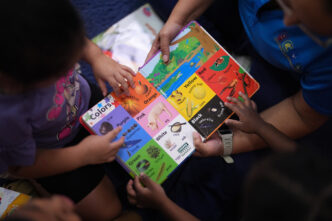
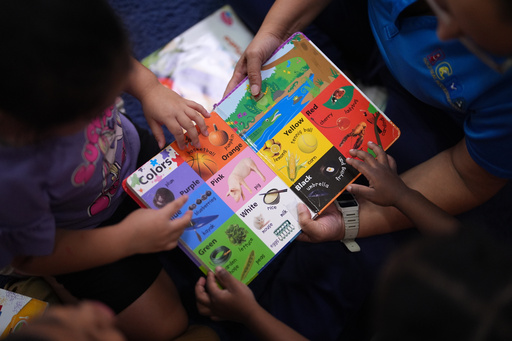
Toys line shelves in the Immokalee classrooms, labeled in English and Spanish — helicopters, airplanes, tower builders. Bilingual signs show shapes in different colors and list children’s birthdays. Every day, teachers sing and read in both languages.
One afternoon, it suddenly grows dark outside and thunder rolls. Noticing the preschoolers look worried, a teacher explains in English, “When you see it, it’s lightning. When you hear it, it’s thunder. What was it?”
“Thunder,” a boy responds. Another answers in Spanish, noting the danger: “Es muy peligroso."
“Si te cae un rayo muy fuerte, te puedes lastimar," the teacher responds. (If a very strong bolt of lightning hits you, you could get hurt.) Then she adds in English: “So we don’t go outside.”
This is part of Head Start’s Planned Language Approach in action. Educators help children learn English while also using the language they speak at home — not simply as an accommodation, but as a teaching strategy.
Research shows skills and knowledge developed in a child’s home language can provide a foundation for learning English. If a child already knows the word for “yellow” in Spanish, she doesn’t have to completely rediscover the concept behind the color when learning the word in English.
Asked for research supporting the proposed English-only requirement, the Department of Health and Human Services pointed to Trump’s executive order designating English as the country’s official language. “The changes set forth in the proposed Head Start rule help achieve these goals by exposing children to English earlier, during a critical time in children’s development,” a department spokeswoman said.
But education studies don't back up the administration's claim, said Michael López, a child psychologist who has led Head Start studies for the federal government.
“There’s really not any credible research basis that suggests that English-only instruction will produce stronger English academic outcomes,” López said. “It’s a mistake. It’s really going back 30 years.”
Dual-language instruction produces better academic outcomes, he said, including in subjects like mathematics.
In the 1970s, Head Start began requiring centers with significant numbers of non-native English speakers to hire at least one staff member fluent in their home language — a regulation still in place today.
The Trump administration wants to drop that requirement, saying it could help centers more easily staff classrooms.
The language changes are part of a broader effort by the Trump administration to eliminate or rewrite many federal Head Start requirements for classroom conditions, curriculum and safety. Instead, state and local regulations — which are often more lenient — would apply.
The proposed changes do not require a vote in Congress, but the administration is required to seek and consider feedback from the public. Thus far, most comments related to the English-only proposal oppose that approach.
At Immokalee, teachers give daily notes to parents when they pick up their children, writing in both English and Spanish.
Beyond these simple reports are monthly parent meetings, plus four in-person parent-teacher conferences every year — two at the children’s homes and two at school. (Those conferences would become optional under the Trump administration proposal.)
In all of these interactions, parents and staff currently speak in Spanish with each other.
The executive director overseeing the Immokalee center said she is unsure what the English-only proposal would mean in practice.
“I don’t know how you’re going to keep people from … speaking Spanish, because it is the home language,” said Isabel Garcia, who, as executive director of the Redlands Christian Migrant Association, supervises 26 Head Start and Early Head Start locations. “It is important that (family members) feel comfortable understanding what is happening with their child.”
HHS told the AP the English-language requirement would apply only to instruction. Head Start teachers could continue using kids’ home languages to explain safety rules or providing comfort, for example — and when communicating and engaging with families, the department said. In fact, the law requires Head Start centers to communicate with parents in a language they understand, “to the extent practicable,” which wouldn't change.
The department acknowledged eliminating requirements for bilingual staffers “may negatively affect communication with non-English speaking families and weaken family engagement."
It suggested using online translation tools.
____
AP Education Writers Alia Wong and Moriah Balingit contributed reporting.
____
The Associated Press’ education coverage receives financial support from multiple private foundations. AP is solely responsible for all content. Find AP’s standards for working with philanthropies, a list of supporters and funded coverage areas at AP.org.