

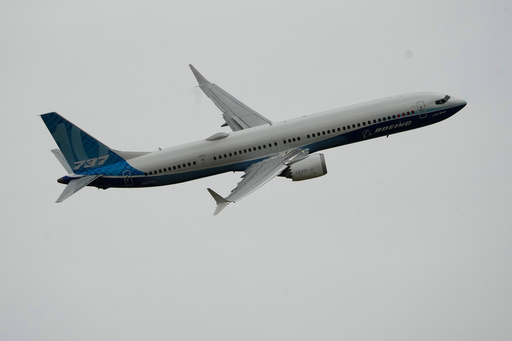
The U.S. government is set to announce Tuesday that it has approved Boeing’s 737 Max 10 airliner for passenger service after years of delays, a Transportation Department official told The Associated Press.
Transportation Secretary Sean Duffy plans to announce the decision Tuesday afternoon during a visit to Boeing's manufacturing plant in Everett, Washington, the official said. The person spoke on condition of anonymity because they were not authorized to speak publicly about the certification ahead of the announcement.
The single-aisle 737 Max 10, which can have up to 230 seats, was introduced at the Paris air show in 2017 to help Boeing compete with rival Airbus. But technical and regulatory hurdles have repeatedly delayed certification of the largest version of Boeing's bestselling 737 family.
Boeing said in its 2020 annual report that it expected to make the plane's first delivery in 2023. The company now expects to begin deliveries in 2027.
The delays have held up a key part of Boeing's business. Speaking at an investors conference last month, CEO Kelly Ortberg said the Max 10 accounted for roughly 30% of Boeing’s 737 backlog. The company’s website lists its total 737 backlog at more than 4,500 aircraft.
The Max 10 is an important piece of Boeing’s effort to regain ground in the narrow-body market. For airlines, the larger plane offers a way to carry more passengers on a single flight, potentially lowering costs per seat. For travelers, it could eventually mean more seats on popular routes, though the impact on fares will depend on how airlines deploy the planes and how much competition they face.
Certification of the Max 10 would complete Boeing’s lineup of four 737 Max models and represent another milestone in the company’s efforts to restore its reputation and financial footing after years of safety, quality and production challenges. The Federal Aviation Administration cleared the smaller Max 7 for airline operations in August.
Boeing’s struggles have been particularly acute since two deadly crashes involving the smaller Max 8 killed 346 people in 2018 and 2019 off the coast of Indonesia and in Ethiopia. In 2024, a panel flew off of an Alaska Airlines Max 9 in midair, renewing scrutiny of Boeing’s manufacturing and safety practices.
The Max 10 is intended to compete with Airbus’s A321neo model family, which entered service in 2017. The largest A321neo can carry more passengers and fly farther without refueling than the Max 10.
Still, Boeing designed the Max 10 to carry more passengers while burning less fuel than older aircraft — a potentially attractive combination for airlines facing soaring jet fuel costs amid the U.S. war with Iran. Those rising costs have put added pressure on airlines to control expenses.
Certification means the FAA has determined that the Max 10’s design meets safety standards, following engineering reviews and flight testing. But Boeing must continue to show it can consistently build the aircraft to the approved design, and each plane must be cleared before it can fly passengers.
In the wake of the fatal Max 8 crashes, the FAA overhauled how it certifies Boeing aircraft. But over the past 18 months, the agency has gradually eased some of its restrictions on the company, increasing the limit on how many planes Boeing can produce. In July, the FAA also said Boeing could once again issue airworthiness certificates for its 737 Max and 787 planes at the end of production, allowing the company to take back some responsibility for determining whether finished aircraft are ready to fly.
Boeing's Everett site offers additional flexibility because the Max 10 is longer than other variants of the 737 Max family. Ortberg said the aircraft could not be arranged nose-to-tail on its production line in Renton, Washington, where Boeing builds the 737, but could be accommodated in Everett. That would allow Boeing to produce a greater mix of longer aircraft as it ramps up production, Ortberg said.
Major customers for the Max 10 include United Airlines, Delta Air Lines, American Airlines and Ryanair. Alaska Airlines joined that list in January, ordering 105 Max 10s, with options for 35 more.