



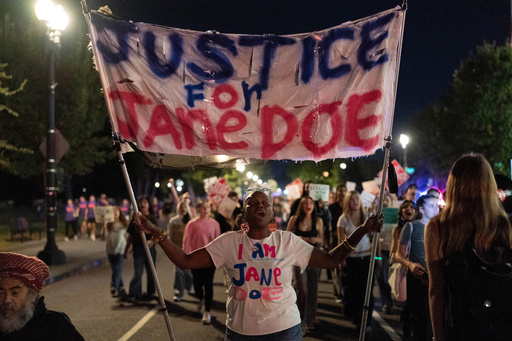
A woman who accused several Cornell students of raping her at a fraternity party says the university’s president questioned why she waited to report the alleged assault, leaving her feeling “unsupported and disbelieved.”
The woman’s secondhand account of Cornell President Michael Kotlikoff’s remark, which the university disputes, comes as faculty prepare for a potential vote of no confidence in the Ivy League school’s leadership. The Associated Press on Tuesday obtained a letter she sent to faculty leaders last week.
The former student’s rape allegations, detailed in a lawsuit last month, have sparked campus protests, renewed scrutiny of Cornell’s disciplinary system and led New York Gov. Kathy Hochul to appoint state Attorney General Letitia James as a special prosecutor leading a renewed investigation of the alleged October 2024 assault.
In the letter, Jane Doe said her sorority president told her that Kotlikoff questioned why she waited until the following month to report being assaulted. The sorority leader, who spoke with Kotlikoff in November 2024, interpreted his remark as casting doubt on her story.
“President Kotlikoff’s initial response was along the lines of, ‘Why did she wait so long to report it?’ ” Jane Doe wrote in the letter. She said the conversation made her less confident that the administration could handle what happened with the sensitivity and fairness she expected.
Cornell’s dean of faculty, however, offered a different account of the conversation. In an email Tuesday to faculty senators and verified by the AP, professor Chris Schaffer said another official who was present for the conversation recalled Kotlikoff asking why bystanders had not reported the alleged assault sooner through the school’s anonymous tip line, especially because the allegations were already circulating on social media.
Schaffer said he waited to share Jane Doe’s letter with faculty senators until he could get another account of the conversation. He said he forwarded the letter to university lawyers, who passed it on to an independent team investigating Cornell’s response.
Schaffer said at a meeting last week that he was against the proposed no-confidence resolution, saying it identified no specific failures or fixes, but acknowledged faculty frustration. “The anger in our community is justified and I share it.”
Kotlikoff did not respond Tuesday to an email inquiry about Jane Doe’s letter. A statement from a university spokesperson also disputed her account of the conversation, saying Kotlikoff was asking about bystanders' actions rather than Jane Doe.
Her letter, transmitted through her attorney and first reported by The New York Times, comes as Cornell faculty consider a resolution declaring no confidence in the university administration’s ability to address what some faculty members have described as an “ongoing crisis” of sexual assault on campus.
Faculty members began debating the resolution at a meeting last Wednesday, where Kotlikoff faced pointed questions about the school's response to sexual assault allegations and its oversight of fraternities. The Faculty Senate is expected to resume debate on Oct. 28 before holding an electronic vote.
In her letter, Jane Doe said she wanted faculty members to have information that might be relevant to their deliberations. She emphasized that she was not trying to tell them how to vote.
“My intention is not to prescribe how the Senate should interpret this account, but rather to provide information that its members may wish to consider or investigate further,” she wrote.
Messages seeking comment were left for Jane Doe’s lawyers, Thomas Giuffra and W. Whitney Seals.
Noah Tamarkin, an anthropology professor and co-sponsor of the no-confidence resolution, said Tuesday he was still processing Jane Doe’s letter, but that it reinforced his belief that Cornell needs fundamental changes to rebuild trust.
“I continue to feel that the current administration hasn’t yet shown the capacity to do this,” Tamarkin wrote in a text message.
He said what stood out was Jane Doe’s account of how the conversation affected her and the apparent lack of a clear way for her to be heard or receive support.
“We need leadership that understands how much that matters," Tamarkin wrote.
Also Tuesday, the former Justice Department official leading Cornell’s independent investigation, Sally Yates, sent a letter to the university community outlining the scope of her review, which she said is expansive.
In addition to conducting a detailed examination of Cornell’s response to Jane Doe’s allegations, Yates wrote that her team is reviewing the university's sexual harassment and assault prevention and discipline practices, the role of campus police and other law enforcement agencies, the supervision of fraternities and sororities, and oversight by university leadership, including its board of trustees.
“We understand that some may be skeptical of our independence — I assure you that our independence is not a formality,” Yates wrote. The university, she said, has pledged complete autonomy and the resources “an independent review of this significance needs and deserves.”
“We will follow the facts wherever they lead with unwavering candor and principled judgment so that this community — and the public — can have confidence in the integrity of our findings," Yates, the former deputy attorney general, added.