

Iranian forces “are waiting for the arrival of American troops on the ground to set them on fire and punish their regional partners forever,” the country’s parliament speaker Mohammad Bagher Qalibaf said.
Qalibaf added: “Our firing continues. Our missiles are in place. Our determination and faith have increased.”
The comments came as regional powers met in Pakistan to discuss how to end the fighting in the Middle East as about 2,500 U.S. Marines arrived in the region and Iranian-backed Houthi rebels entered the monthlong war.
The war has threatened global supplies of oil and natural gas, sparked fertilizer shortages and disrupted air travel. Iran’s grip on the strategic Strait of Hormuz has shaken markets and prices.
The Houthis’ entry could further hurt global shipping if they again target vessels in the Bab el-Mandeb Strait off the Red Sea, through which about 12% of the world’s trade typically passes.
Here is the latest:
1. Israel’s military said on Monday morning that it was striking ‘military infrastructure’ across Tehran.
2. Bahrain sounded its missile alert sirens twice on Monday.
3. At dawn Monday, Israel’s military said Iran had launched missiles at the country. It was the first such launch from Iran of the day. Sirens went off in the area near Israel’s main nuclear research center, a part of the country that has been targeted repeatedly over the past days.
Australia has halved its taxes on gasoline and diesel and removed a tax on heavy vehicles to counter the economic impacts of soaring fuel prices.
The government announced on Monday it expects the tax reductions will cost federal coffers 2.55 billion Australian dollars ($1.74 billion) over three months.
Taxes on gasoline and diesel will be halved to 26.3 Australian cents a liter (68.2 cents a gallon) from Wednesday. The heavy vehicle road user charge of 32.4 Australian cents per liter of diesel (84.1 cents a gallon) that truck and bus operators pay to compensate for the added damage they cause roads will be removed.
Tasmania state introduced free public transport on Monday to reduce private vehicle use and Victoria state will remove public transport fees from Wednesday.
“Many long sought after targets have been taken out and destroyed by our GREAT MILITARY, the finest and most lethal in the World,” U.S. President Donald Trump wrote in a post on his Truth Social website, without elaborating.
Brent crude was just over $70 a barrel when the war started on Feb. 28. Prices have spiked by over 50% since.
Kuwait said early Monday an Iranian attack on a power and desalination plant in the small, oil-rich nation killed an Indian worker there.
The statement carried by the state-run KUNA news agency did not identify the plant targeted.
Authorities said power and water supplies remained constant despite the attack.
Desalination plants remain crucial to water supplies in the Gulf Arab states. Iranian attacks already have damaged some facilities.
U.S. President Donald Trump has raised the idea of American forces seizing Iran’s Kharg Island, its main oil terminal in the Persian Gulf.
The comment by Trump came in an interview published early Monday by The Financial Times.
“Maybe we take Kharg Island, maybe we don’t. We have a lot of options,” Trump told the newspaper. “It would also mean we had to be there (on Kharg Island) for a while.”
Asked about Iranian defenses there, he said: “I don’t think they have any defense. We could take it very easily.”
The U.S. already launched airstrikes once it said targeted military positions on the island. Iran has threatened to launch its own ground invasion of Gulf Arab countries and new attacks if U.S. troops land on its territory.
U.S. President Donald Trump says that Iran’s parliament speaker authorized the passage of oil tankers through the Strait of Hormuz, the narrow mouth of the Persian Gulf.
The comment by Trump in an interview published early Monday by The Financial Times is the latest signal by the Americans of Mohammad Bagher Qalibaf’s importance within Iran’s theocracy.
“They gave us 10” Pakistani-flagged tankers, he said. “Now they’re giving 20 and the 20 have already started and they’re going right up the middle of the Strait.”
“He’s the one who authorized the ships to me,” Trump told the newspaper about Qalibaf. “Remember I said they’re giving me a present? And everyone said: ‘What’s the present?’ … When they heard about that they kept their mouth shut and the negotiations are going very well.”
Qalibaf has maintained a combative personality through his X account in the war, mocking the Americans and issuing threats. But the former Revolutionary Guard commander has seen his profile rise as senior members of its theocracy have been killed.
U.S. President Donald Trump said that Iran had agreed to allow 20 ships carrying oil through the Strait of Hormuz starting Monday morning and continuing over the next few days “out of a sign of respect.”
“I would only say that we’re doing extremely well in that negotiation but you never know with Iran because we negotiate with them and then we always have to blow them up,” Trump told reporters Sunday night board Air Force One as he flew to Washington.
Trump was asked if Iran had responded to the 15-point ceasefire plan the U.S. has proposed and he said, they did and added: “They gave us most of the points. Why wouldn’t they?”
But Trump didn’t offer details when asked about Iran, by his telling, appearing to make major concessions.
“They’re agreeing with us on the plan,” Trump said.
He also said Iran’s new Supreme Leader Ayatollah Mojtaba Khamenei “may be alive but he’s obviously, very seriously in trouble. He’s seriously wounded.”
A U.N. peacekeeper was killed and another critically wounded when a projectile exploded in their position near a village in southern Lebanon, UNIFIL said in a statement very early Monday.
The statement said the “origin of the projectile” was unknown.
The hilly frontier zone where the UNIFIL force patrols has seen decades of cross-border violence.
Israel and Lebanon’s Hezbollah militants fought a full-scale war in 2024 and are fighting again since Hezbollah joined Iran at firing into Israel in the current war. Israel has moved thousands of troops across the border into Lebanon.
Israeli soldiers shot at two men who they assessed were posing a threat to them in separate incidents in the occupied West Bank overnight, killing one and “neutralizing” the other, Israel’s military said early Monday.
According to the military’s statement, one man armed with a knife ran toward soldiers near Dura, in the southern West Bank, and was killed. Another accelerated toward them in his vehicle near a village just north of Jerusalem, and troops also fired at him.
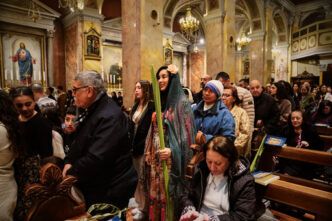
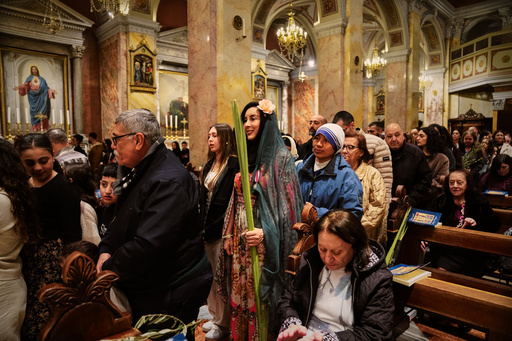
Israel’s police said it had approved a “limited prayer framework” to open worship at the Church of the Holy Sepulchre in Jerusalem as the sacred season of Holy Week gets underway.
Major sites holy to Christians, Jews and Muslims in Jerusalem’s Old City have been closed during the Iran war because of safety considerations. Earlier this month, shrapnel from the interception of an Iranian missile fell on a rooftop just steps from the church, which Christians revere as the place where Jesus was crucified.
But criticism surged from around the world Sunday after the police prevented a tiny group of Catholic faith leaders from entering the church in order to celebrate a private Mass on the Christian holiday of Palm Sunday.
The police announcement said authorities had worked with a representative of Cardinal Pierbattista Pizzaballa, the Latin Patriarch whose entry they had barred, and more details on what activities would be permitted would be forthcoming.
Israel’s military said that its air force had intercepted two drones launched from Yemen early Monday morning.
The Iranian-backed Houthi rebels claimed responsibility for launching their first attack in the current war — a missile fired at Israel, which was also intercepted — early on Saturday morning.
Iranian media reported early Monday that one of the facilities of Tabriz Petrochemical was struck in a northern province of the country. They said no hazardous materials had been released.
The company takes oil or natural gas and processes them into chemical products used to make everyday materials like plastics and chemicals.
Iran’s joint military command spokesperson declared on Sunday that the private residences of U.S. and Israeli officials have now become legitimate targets for Iran, as the war in the Middle East enters its first month and continues to widen across the region.
The threat was aimed at U.S. and Israeli military and political officials living in the Middle East, including Israel.
Ebrahim Zolfaghari said that this decision has been made after the U.S. and Israel have targeted residential homes of Iranians in various cities across Iran.
Israel’s military on Sunday night said Iran had launched another salvo of missiles at the country. Sirens went off in the Beersheba area, which has been targeted repeatedly in the last days.
Late on Sunday, Israel’s military said that over the past 24 hours its fighter jets had dropped more than 120 munitions in Tehran, targeting sites used for weapons research, development and production.
Around the same time, Iran’s state television said power was back in areas of Tehran that had experienced outages.
The U.N. nuclear watchdog said Sunday that satellite imagery confirmed severe damage to the Khondab heavy water production plant near Arak
The International Atomic Energy Agency added that the installation has no declared nuclear material. Iran’s Atomic Energy Organization reported on Friday that the facility was hit and Israel claimed responsibility for the strike.
Since the war began a month ago, several strikes targeted nuclear sites across Iran.
The foreign ministers of Turkey, Saudi Arabia and Egypt departed late Sunday night for their respective capitals after attending a meeting convened by Pakistan to review progress in bringing the United States and Iran to the negotiating table to end war in the region, the ministry of Foreign Affairs said.
It gave no further details.
Pakistan earlier said that top diplomats from Egypt, Turkey and Saudi Arabia would visit Islamabad from March 29 to 30 for in-depth discussions on a range of issues, including efforts to de-escalate regional tensions.
An agriculture company that produces pesticides in southern Israel said it suffered damage to a warehouse on Sunday.
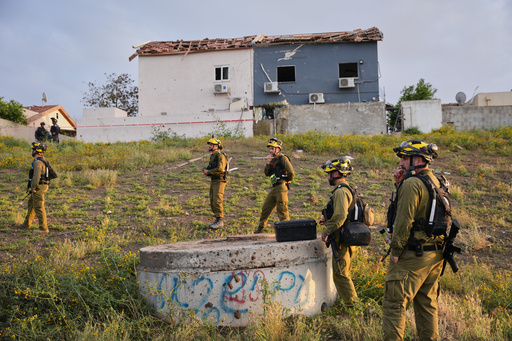
Israel’s Fire and Rescue Services responded to a massive blaze that began around 3:30 p.m. from an Iranian missile or shrapnel fragments. The company, ADAMA, said the damage accorded at its Makhteshim plant in the town of Ramot Hovav, on the outskirts of Beersheba, and there was no damage to production facilities.
ADAMA said its workers evacuated according to instructions from the emergency services. Israel’s Fire and Rescue said the evacuation included the immediate plant as well as a nearby highway and the evacuation was lifted after about an hour.
Dramatic footage after the strike showed pillars of smoke and billowing flames reaching high into the sky. There were no injuries, according to Israel’s rescue services.
In a message attributed to Iran’s Supreme Leader Ayatollah Mojtaba Khamenei, he expressed his appreciation to senior religious authorities in Iraq for their supportive stance toward Iran during the war, according to two semi-official Iranian news agencies.
Since he was named third supreme leader of Iran, Khamenei has made no public appearance, but has conveyed only rare messages.
Iran-backed militias in Iraq have claimed responsibility for several attacks on U.S. bases in the country in solidarity with Tehran.
The U.S. Embassy in Baghdad, in a statement posted on X Sunday, warned that Iran and allied militias “may intend to target the American Universities in Baghdad, Sulaymaniyah, and Dohuk, along with other universities perceived to be associated with the United States,” after Iran threatened American universities across the Middle East.
The statement added that Iran and affiliated militias have already carried out “widespread attacks on U.S. citizens, targets associated with the United States throughout Iraq” and the “Iraqi government has not prevented terrorist attacks against the United States and regional countries from Iraqi territory.”
It reiterated a warning for U.S. citizens to leave the country.
Many universities around the region have already moved to teaching online since the U.S. and Israeli attacks on Iran triggered the ongoing war in the Middle East.
Iran’s energy ministry says power was cut in Tehran and Alborz provinces after attacks on electricity facilities. The state media reports late Sunday did not say who attacked.
Pakistan’s foreign minister says Islamabad soon will host talks between the U.S. and Iran.
Foreign Minister Ishaq Dar made the announcement Sunday. He did not specify whether the talks would be direct or indirect. There was no immediate word from the U.S. or Iran.
“Pakistan is very happy that both Iran and the U.S. have expressed their confidence in Pakistan’s facilitation” of the talks, which will happen in the “coming days,” Dar said in a televised speech after top diplomats from regional countries met in Islamabad.
He said the foreign ministers of Turkey, Egypt and Saudi Arabia endorsed Pakistan’s peace efforts. The ministers are expected to meet again Monday.
Pakistan has emerged as a mediator, having relatively good ties with both Washington and Tehran. Pakistani officials have said their public effort follows weeks of quiet diplomacy.
The announcement from the university in the heart of the Lebanese capital comes as American universities and schools across the Mideast fear strikes that may target their facilities.
President Fadlo Khuri in an announcement Sunday said it was a precautionary measure and that there was “no evidence of direct threats” to the prestigious university and its renowned hospital.
“The American University of Beirut has stood for the peaceful emancipation and progress of the people we educate and serve for more than a century and a half,” said Khuri.
The threat from Iran’s elite Revolutionary Guard comes after comes after recent U.S. and Israeli strikes on two campuses in the Islamic Republic.
The head of the U.S. oil and natural industry’s top lobbying group says “the only real solution” to rising energy and consumer prices as a result of the war with Iran is to get the Strait of Hormuz open.
“If we can do that this week with targeted regime actions, I think we have to take that opportunity because it’s only going to get worse over time,” said Mike Sommers, president and CEO of the American Petroleum Institute.
Sommers told Fox News Channel’s “The Sunday Briefing” that “that artery has to be reopened and fast” because “the longer this goes on, the higher prices are going to go.”
Sommers is also troubled by the entry of the Iranian-backed Houthi rebels.
“If the Houthis start attacking ships going through the Red Sea, that could really put us on the cusp of a major energy crisis throughout the world. That is a top concern this week, as well,” he says.
Over 3,500 people were also wounded since the start of this latest military escalation, according to the Lebanese Health Ministry. Among the killed are 52 health workers.
Israel launched intense airstrikes over Lebanon after the Hezbollah militant group fired rockets toward northern Israel in solidarity with Iran on March 2.
Since then,towardne milltowardanese have been displaced as Israeli ground forces continue an invasion into southern Lebanon.
Prime Minister Benjamin Netanyahu announced Sunday that Israel will widen its invasion of southern Lebanon.
Netanyahu said Israel would expand what he called the “existing security strip” in Lebanon as Israeli forces continue to target the Iranian-backed Hezbollah militant group.
“We are determined to fundamentally change the situation in the north,” he said on a visit to northern Israel, adding that “Hezbollah still has residual capability to fire rockets at us.”
There were no immediate details.
In Lebanon, officials say more than 1,100 people have been killed in the fighting since the Iran war began.
The Houthis joined the war over the weekend with a missile attack on Israel. Their entry has raised concerns that they could resume attacks on vessels in the Red Sea further disrupting the global shipping industry and sending oil prices much higher.
Nomi Bar-Yaacov, fellow at the Geneva Centre for Security Policy, said the Houthis’ potential disruption of oil export in the Red Sea will create a “point where we have not been before.”
At this time, both the Homuz and Bab al-Mandab straits will be closed, she said.
“All eyes are on the mediation, but the oil crisis is, I think, at an unprecedented state,” she said.
Kuwait’s Foreign Minister Sheikh Jarrah Jaber Al Sabah said Sunday that what the region is witnessing is “systematic pattern of undermining regional stability led by Iran”, as the monthlong war continues to destabilize the region.
In a statement reported by the state-run Kuna news agency, Al Sabah said that Iran is destabilizing the region through “exploiting chaos and terrorism as tools of influence.”
Kuwait’s Armed Forces said Sunday that projectile attacks injured 10 members of its forces, and its Defense Ministry said that the warehouses of a private logistics company were hit, resulting in only material damage, as the country intercepted 26 other Iranian missiles and drones over the past 24 hours.
Also on Sunday, Qatar and Bahrain said that they intercepted missiles and drones launched toward them.
Ukrainian President Volodymyr Zelenskyy arrived in Jordan Sunday, part of his tour of Gulf Arab states as Kyiv continues to offer its drone expertise to help governments blunt Iranian attacks during the war in the Middle East.
“Security is the top priority, and it is important that all partners make the necessary efforts toward it. Ukraine is doing its part. Important meetings ahead,” Zelenskyy wrote on his social media channels, alongside a video that showed him arriving by air.
Jordan’s state news agency reported that Zelenskyy would meet with King Abdullah II for talks on regional developments and bilateral relations.
Nearly a thousand people gathered in central Istanbul Sunday afternoon despite heavy rains to protest the ongoing conflicts in Iran, Lebanon and Palestine.
Organized by several religious conservative NGOs, the rally featured slogans like, “Resist, Gaza will prevail” and “Muslims don’t bow to oppression,” as well as signs saying, “Killer Israel, Killer United States” and criticizing the Israeli closure of Al-Aqsa Mosque.
“We are here for all the oppressed in the world. Lebanon, Iran, Palestine, yesterday it was Venezuela, tomorrow it will probably be Cuba, we are here for all of them,” protester Mehmet Yilmaz told The Associated Press.
“When Iran launches a missile, despite claiming no one can hurt them with their Iron Dome, they (Israelis) all scurry into their holes like mice the second the sirens blare,” Ekrem Saylan told AP. “What do the Iranians do? They take to the streets. This is about belief, faith. If they (Israelis) had faith they wouldn’t be afraid of death.”