


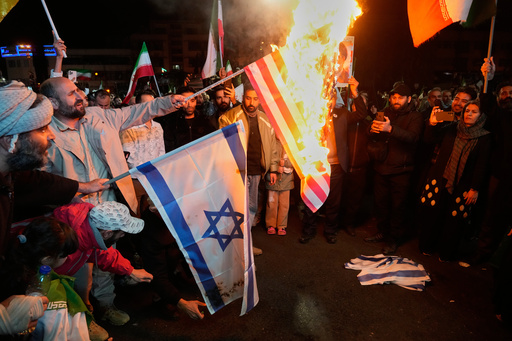
Iran, the United States and Israel said they reached a deal for a two-week ceasefire, with Tehran saying it would negotiate with the United States in Islamabad beginning Friday.
Trump initially said Iran proposed a “workable” 10-point plan, but he later called the plan fraudulent without elaborating.
Trump’s threats to launch devastating strikes on Iran hit a new extreme hours before the ceasefire when he warned, “A whole civilization will die tonight, never to be brought back again," if Iran failed to make a deal that included reopening the vital Strait of Hormuz.
In a statement Wednesday morning, Israeli Prime Minister Benjamin Netanyahu’s office said it supports Trump’s decision to suspend strikes against Iran for two weeks, but that it doesn’t include the war with Hezbollah in Lebanon, where more than 1,500 people have been killed.
Here is the latest:
Oman Foreign Minister Badr Al-Busaidi said his country, which has long mediated between Iran and the U.S., will provide support to negotiations following the two-week ceasefire between the U.S., Israel and Iran.
Al-Busaidi said serious negotiations are required to establish a lasting regional peace.
“For now the world has stepped back from disaster,” he wrote on X. “But there’s no room for complacency.”
Diplomats in the Middle East and Europe are offering assessments of the two-week ceasefire and the work that remains ahead.
Anwar Gargash, an adviser to United Arab Emirates President Mohammed bin Zayed Al Nahyan, said his country has to manage a “complex regional landscape.”
Gargash argued on social media that the UAE will have “greater leverage, sharper insight, and a more solid capacity to influence and shape the future.”
The European Union’s top diplomat, Kaja Kallas, described the ceasefire in the war in the Middle East as a “step back from the brink.”
The agreement has created “a much-needed chance to tone down threats, stop missiles, restart shipping,”
Kallas wrote on X. “The Strait of Hormuz must be open for passage again.”
Jan Engeland, secretary general of the Norwegian Refugee Council, an international aid group, said the two-week ceasefire will allow scaling up of assistance for millions of refugees and displaced people in Iran.
He called for more funding to humanitarian operations.
“But we have only some funding from Scandinavians,” he wrote on X. “How come there are easily billions for war, but no funding for the victims of the war?”
Mahmoud Ali Youssouf, chairperson of the African Union Commission, said the ceaseire between the United States, Israel and Iran presents a critical opportunity to ease the suffering of populations affected directly and indirectly by the war.
Youssouf said the agreement reflects commendable leadership and a shared commitment to the de-escalation that the union has consistently called for.
He added that diplomacy guided by the United Nations Charter remains the only viable path to resolving international crises.
German Chancellor Friedrich Merz said he supports the ceasefire, adding that the goal now must be to end the war.
Negotiations must protect Iran’s civilians and ensure security in the region, as well as avert a global energy crisis, the chancellor said in a statement.
New Zealand Prime Minister Christopher Luxon said Wednesday that news of a ceasefire in the Middle East was “incredibly encouraging” after weeks of destabilizing conflict.
“The events of the past six weeks have been incredibly destabilizing and deeply concerning for the world. We all want to see an end to the Middle East conflict, which is affecting every country in the world, including New Zealand,” Luxon said in the capital Wellington.
Earlier, New Zealand Foreign Minister Winston Peters also said on X that his nation welcomed the effort to end the war, while noting “significant important work” remained.
Israeli opposition leader Yair Lapid lashed out at Israeli Prime Minister Benjamin Netanyahu over the two-week ceasefire between the U.S., Iran and Israel.
“There has never been such a political disaster in our entire history. Israel was not even at the table when decisions were made concerning the core of our national security,” Lapid wrote in a Wednesday morning post on X.
Lapid and other opposition party leaders in Israel have expressed support for the war against Iran while criticizing its “management.”
Lapid said in the post hours after the agreement was announced that “the military did everything asked of it, the public displayed incredible resilience, but Netanyahu failed politically, failed strategically, failed to meet any of the goals he himself set.”
British Prime Minister Keir Starmer is traveling to the Gulf on Wednesday to support a newly announced ceasefire and wider efforts to end the U.S.-IsraeIi war on Iran.
The ceasefire “will bring a moment of relief to the region and the world,” but it must be turned into a “lasting agreement,” Starmer said in a statement.
The U.K. has been involved in international efforts to restore freedom of navigation to the Strait of Hormuz, hosting international diplomatic and military meetings in the past week to work on a post-conflict security plan for the key waterway.
Starmer will hold talks with regional leaders and meet British troops based in the region on the trip, which was planned before the ceasefire was announced.
Protesters stormed the Kuwaiti Consulate in the southern Iraqi city of Basra late Tuesday.
Kuwait said in a statement it condemns the action by protesters opposed to the U.S. military’s use of numerous bases in Kuwait for launching attacks against Iran.
“Kuwait holds Iraq fully and directly responsible for this assault and for any shortcomings in taking the appropriate measures to protect diplomatic and consular missions on its territory,” the statement said.
Kuwait said it would “negatively impact bilateral relations” between the countries, which share a border.
“The State of Kuwait affirms that it is not a party to any regional or international conflict and that it has not and will not allow its territory to be used to launch an attack against any country, in accordance with its foreign policy,” the statement added.
The Iraqi government condemned the incident and said it will launch an investigation. Saudi Arabia, Qatar, the United Arab Emirates and Bahrain issued statements supporting Kuwait.
Oman said it welcomes the U.S.-Iranian ceasefire agreement and praised Pakistan’s mediation efforts to bring about the 14-day cessation of hostilities.
Prior to the war, Oman was a key mediator in its capital Muscat and in Geneva.
“The Sultanate of Oman emphasizes the importance of intensifying efforts now to find solutions that will end the crisis at its roots and achieve a permanent cessation of hostilities in the region,” the Omani Foreign Ministry said in a statement.
Israel hit parts of southern Lebanon, with many of the strikes targeting areas near the coastal city of Tyre, Lebanon’s state-run National News Agency reported.
A residential building was struck at dawn, killing four people in Tyre, where a drone strike targeted a car, although it was unclear who the intended target was in the vehicle.
Elsewhere, Israel hit a post of the Islamic Health Committee paramedics, one of various social programs operated by militant group Hezbollah, NNA reported.
Israeli Prime Minister Netanyahu said Lebanon and Israel continue to trade fire because Lebanon is not part of the two-week ceasefire agreed by Washington and Tehran. The statement contradicted information released by Pakistan, which served as a mediator for the agreement.
Hezbollah has not issued a statement on the developments.
Benchmark U.S. crude oil sank 13.3% to $96, while brent crude, the international standard, dropped below $95 on Wednesday.
The oil prices fell while Asian benchmarks rose in Wednesday trading after the U.S. and Iran agreed to a two-week ceasefire that includes reopening the Strait of Hormuz.
Shares jumped in early trading in Japan, Australia, South Korea and China in reaction to the ceasefire.
A recent spike in prices was a response to the war effectively blocking passage of much of the world’s oil supply through the strait.
Lebanon’s Crisis Management Unit has urged displaced people not to travel south following the U.S.-Iran ceasefire agreement.
The unit’s statement came as many displaced people packed their belongings and started moving south, thinking the agreement also included Lebanon, where Israel and the Hezbollah militant group are at war.
Pakistan, which mediated the agreement, said the two-week cessation of hostilities agreement included Lebanon, but Israeli Prime Minister Benjamin Netanyahu said it did not.
Hezbollah did not immediately comment.
More than 1 million people in Lebanon have been displaced in just over a month.
Malaysia’s Prime Minister Anwar Ibrahim said Wednesday that the two-week ceasefire in the war in Iran “augurs well for the restoration of peace and stability, not only to the region but also the rest of the world.”
Indonesia also welcomed the latest development as an effort to keep the door open for diplomacy in order to promote de-escalation.
Yvonne Mewengkang, spokesperson for Indonesia’s Foreign Affairs, said: “The Indonesian government will always support any constructive diplomatic efforts, including those that have the potential to lead to a more permanent resolution, with the protection of civilians as our primary focus.”
South Korea’s Foreign Ministry in a statement praised mediation efforts by countries including Pakistan and called for a swift restoration of peace and stability in the Middle East. It said it expects the “prompt and safe” resumption of free passage through the Strait of Hormuz for all vessels, including South Korean ships.
Trump in a social media post declared the ceasefire agreement a “big day for World Peace” and that the U.S. “will be helping with the traffic buildup in the Strait of Hormuz.”
“There will be lots of positive action!” Trump predicted in his post.
“Big money will be made. Iran can start the reconstruction process. We’ll be loading up with supplies of all kinds, and just ‘hangin’ around’ in order to make sure that everything goes well. I feel confident that it will.”
Trump’s message on his Truth Social website signals Washington’s concern about Iran maintaining its chokehold over the narrow mouth of the Persian Gulf, through which 20% of all oil and natural gas passes in peace time.
Bahrain sounded its missile alert sirens Wednesday morning, hours after the U.S. and Iran say they reached a two-week ceasefire in the war for negotiations.
Bahrain’s Interior Ministry announced the warning.
It wasn’t immediately clear from the ceasefire when it would begin.
Iran has fired missiles on the Gulf Arab states and Israel after the announcement.