


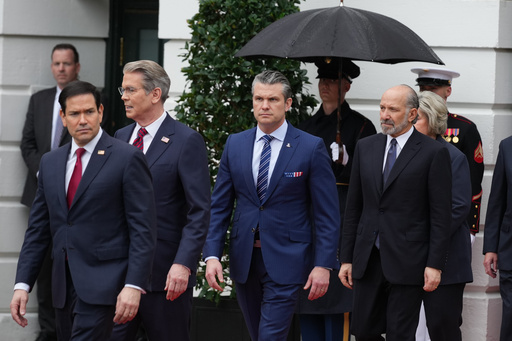
Defense Secretary Pete Hegseth faced nearly six hours of questioning Wednesday from House lawmakers for the first time since President Donald Trump’s administration launched the war against Iran, which Democrats have contested as a costly conflict of choice waged without congressional approval. He’ll return tomorrow to face the Senate.
Trump, meanwhile, told Axios that he’s rejecting Iran’s proposal to reopen the Strait of Hormuz in exchange for a lift of the U.S. blockade — a plan that would postpone discussions of Iran’s nuclear program.
Until now, Hegseth has avoided public questioning from lawmakers about the war, although he and Chairman of the Joint Chiefs of Staff Gen. Dan Caine have held televised Pentagon briefings. Hegseth has mostly taken questions from conservative journalists, while citing Bible passages to castigate mainstream outlets.
Democrats quickly pivoted to the ballooning costs of the Iran war, the huge drawdown of critical U.S. munitions and the bombing of an elementary school that killed children. Some lawmakers have also questioned how prepared the military was to shoot down swarms of Iranian drones, some of which penetrated U.S. defenses and killed or injured American troops.
Republicans have said they will keep faith in Trump’s wartime leadership, for now, citing Iran’s nuclear program, the potential for talks to resume and the high stakes of withdrawal. Still, GOP lawmakers are eager for the conflict to end, and some are eyeing future votes that could become an important test for the president if the war drags on.
Here's the Latest:
The world’s largest aircraft carrier had been at sea for more than 300 days, including participating in the war against Iran and capture of former Venezuelan President Nicolás Maduro.
The Ford will be leaving the Middle East in the coming days and returning to its home port in Virginia in mid-May, according to two U.S. officials, who spoke on condition of anonymity to detail sensitive military movements.
The ship broke the U.S. record this month for the longest post-Vietnam War deployment, a nearly 10-month span after leaving Naval Station Norfolk in June.
— Konstantin Toropin and Ben Finley
The president leveled the new threat that he may reduce the U.S. military presence in Germany as tensions grow with German Chancellor Friedrich Merz over the Iran war.
“The United States is studying and reviewing the possible reduction of Troops in Germany, with a determination to be made over the next short period of time,” Trump said in a social media post.
Merz on Monday said the U.S. was being “humiliated” by the Iranian leadership and criticized Washington’s lack of strategy in the war. Trump attacked Merz in a social media post Tuesday, saying the German chancellor “thinks it’s OK for Iran to have a Nuclear Weapon” and “doesn’t know what he’s talking about!”
In his first term, Trump also moved to cut U.S. troops in Germany because he said it spent too little on defense.
In the absence of substantive negotiations, Iranian Foreign Minister Abbas Araghchi has been busy shoring up moral and rhetorical support in his country’s staring contest with America and Israel.
He spent Wednesday conducting a string of phone calls with the foreign ministers of India, Kenya and Poland, along with the president of the International Committee of the Red Cross Mirjana Spoljaric and Nabih Berri, the speaker of the Lebanese parliament.
Official reports of these chats contained few details, but the Iranian government account of the meeting with Indian Foreign Minister Subrahmanyam Jaishankar said Araghchi “informed his Indian counterpart about the situation in the region and the consequences of the continued illegal actions of the United States in threatening the freedom of international navigation, as well as the latest developments related to the negotiations to end the imposed war against Iran.”
Earlier this week, Araghchi conducted a whirlwind diplomatic tour, visiting Oman and Pakistan on Sunday then Moscow on Monday for a sit-down with Russian President Vladimir Putin.
The vice president, in an interview airing Wednesday on Fox News Channel, was responding to a report in The Atlantic that said he, in private, has repeatedly questioned the Pentagon’s depiction of the war and the depletion of U.S. missile stockpiles.
Vance was dismissive of the reporting but said, “Of course I’m concerned about, you know, our readiness because that’s my job to be concerned.”
He praised the military, Defense Secretary Pete Hegseth and Chairman of the Joint Chiefs of Staff, Dan Caine, but said, “It’s of course my job to ask these questions. It’s of course my job to make sure that we’re on top of every issue.”
Hegseth is exiting the House Armed Services Committee after a nearly six-hour hearing.
The hearing showed the partisan divide on Capitol Hill over the war with Iran. As Democrats questioned him on the economic costs and strategy of the war, Hegseth fired back that lawmakers were being “feckless” in their questioning. Republicans mostly stood behind the defense secretary, although a few questioned his reasoning for removing several top officials.
“At the end of the day, the Iran war is the biggest issue that we face,” said Rep. Adam Smith, the top Democrat on the committee.
Hegseth will be back on Capitol Hill tomorrow for a hearing before the Senate Armed Services Committee.
Hegseth told lawmakers that he ordered the names of two female and two Black officers from a promotion list.
Hegseth was asked the question because Army Secretary Dan Driscoll previously testified before a congressional committee that he refused to strike the officers’ names because of their exemplary service.
Hegseth, who has been criticized for the firings of top military leaders, said that he did it.
“Every officer serves at the pleasure of the president,” Hegseth said. “And when they need to be removed in order to ensure we have the right leadership in those services, I will make those calls, regardless of what you might say from the dais.”
Hegseth told lawmakers that, as of yesterday, the Pentagon is allowing $400 million of Ukraine aid to be spent after months of delay.
The admission comes a day after Republican Sen. Mitch McConnell called out the Pentagon for withholding the funds in an editorial with the Washington Post.
“The Ukraine aid we passed months ago is now collecting dust at the Pentagon,” McConnell wrote in the Post.
Jay Hurst, the Pentagon comptroller, told lawmakers the funds can now be spent, but when the aid will actually reach Ukraine “depends on what they buy with the money.”
“We’re going to take the advice of the (European Command) commander” on how to use the funds best, Hurst added.
Iran’s Foreign Minister Abbas Araghchi and his Indian counterpart Subrahmanyam Jaishankar held a telephone conversation discussing rising regional tensions and diplomatic efforts, Araghchi’s official Telegram channel said in a post.
Araghchi said insecurity in the Persian Gulf and the Strait of Hormuz stems from what he described as aggressive actions by the United States and Israel, adding they should be held accountable for global security and economic consequences. He also warned of the impact of U.S. actions on freedom of international navigation.
During his recent Moscow visit, Araghchi said Washington was seeking talks after failing to achieve its objectives. His regional tour included Pakistan and Oman, amid attempts to revive stalled negotiations between Tehran and Washington.
An armed group in the Gach Berin area in the city of Iranshahr opened fire upon encountering a police patrol, prompting officers to respond with heavy gunfire that stopped the group’s vehicle and killed two people, according to provincial police, as reported by the semi-official news agencies, Tasnim News Agency and Fars News Agency. Both Iranian outlets are close to state institutions.
Two others were wounded in the exchange, the police said.
The police added that a Kalashnikov rifle and ammunition were recovered from the vehicle after it was searched.
Iranshahr is in southeastern Sistan and Baluchestan province, bordering Afghanistan and Pakistan. The province has been the site of occasional deadly clashes involving militant groups, armed drug smugglers and Iranian security forces. It is one of the least developed provinces of Iran.
Americans saw the largest monthly jump in gas prices in six decades during the war with Iran. Yet, Defense Secretary Pete Hegseth refused to engage on that issue and instead pointed to typically higher gas prices in California.
Democrats on the House Armed Services Committee have asked Hegseth several times about the rise in gas prices. When Rep. Maggie Goodlander asked whether Hegseth knew the current nationwide average price for a gallon of gas, he responded that it’s “much higher in California.”
Republicans routinely lambast California’s higher gas prices that result from higher state taxes and environmental regulations in the Democratic-led state.
Goodlander responded that the current average is $4.23 a gallon and argued the defense secretary is ignoring the “impacts of this war on the American taxpayer.”
The president said the oil-rich nation’s decision to leave OPEC and OPEC+ on May 1 could help calm the volatile oil market shaken by the Iran war.
“I think ultimately it’s a good thing for getting the price of gas down, getting oil down, getting everything down,” Trump said in an exchange with reporters in the Oval Office.
Trump said Putin, during a phone call Wednesday, renewed his offer for Russia to serve as a third country that could deal with Iran’s 970 pounds of enriched uranium that the U.S. leader is demanding Tehran must surrender.
“He told me he’d like to be involved with the enrichment — if he can help us get it,” Trump said Putin told him. “I said, ‘I’d much rather have you be involved with ending the war with Ukraine.’ To me, that would be more important.”
The House Armed Services Committee hearing touched on a debate over how U.S. military members should evaluate whether orders they have received are lawful and should be followed under military protocol, especially as the military has carried out strikes on boats allegedly carrying narcotics.
The question, which came as the hearing reached over four hours, was asked by Rep. Chris Deluzio, a Democrat who was part of a group of lawmakers investigated by the FBI last year after releasing a video reminding U.S. military members to defy illegal orders. Deluzio asked the Joint Chiefs of Staff what commanding officers should do if an enemy is trying to surrender.
Caine declined to discuss the issue in detail, saying that it would take him into a “partisan place,” but added that “officers and enlisted service members always follow lawful orders. There’s a checklist for them to do that.”
Dangerously high blood pressure and losing about 44 pounds (20 kilograms) rapidly have placed Narges Mohammadi’s life in “imminent danger,” according to a report by her foundation.
Mohammadi, an Iranian human rights activist and Nobel laureate, has been imprisoned for several periods since 2016 over her opposition to the death penalty and compulsory veiling. She is back in prison after being sentenced on Feb. 8 to 7 1/2 years on charges including collusion against state security and propaganda. The foundation said she suffers from persistent chest pain. She also experienced high blood pressure over the past three days, without responding to medication.
Despite confirmation from Iran’s medical examiner that she needs at least one month of specialized cardiac care, Tehran prosecutors have refused to grant a temporary suspension of her sentence, the report said. It added that her legal team, after a recent visit, said her condition has reached a critical point.
Democratic Rep. Pat Ryan criticized Hegseth over the deaths of six American soldiers who were stationed in Kuwait and killed by an Iranian drone.
Ryan pressed Hegseth on whether intelligence showed the location was high on Iran’s target list and was indefensible from aerial attack.
“Yet you sent our soldiers from the 103d Sustainment Command there anyway. Is that true or false?” Ryan asked.
Hegseth said the military took proactive measures to protect American forces and that the soldiers who died are remembered every day.
Ryan quoted survivors of the attack who told CBS that they weren’t prepared to defend against a drone attack. The congressman also accused Hegseth of downplaying what happened and said he should resign.
Ultra-orthodox Jews are protesting Israel’s draft law throughout Israel this week, including in Jerusalem, where police used stun grenades to disperse demonstrations on Wednesday.
The draft remains a political powder keg in Israel. The Ultra-Orthodox make up 13% of the population and oppose enlistment because they believe studying full-time in seminaries is their most important duty. Courts have demanded the government enforce a law mandating conscription. Prime Minister Benjamin Netanyahu — facing elections this year — relies on ultra-Orthodox parties to maintain his coalition.
The arrest of yeshiva students accused of draft dodging kindled this week’s demonstrations, including in Ashkelon, where ultra-Orthodox protesters broke into a military commander’s yard Tuesday, prompting condemnation from Netanyahu.
“It is unacceptable what they are doing to yeshiva students as if they were the worst criminals,” protestor Menahem Adri said in Jerusalem. “All we want is to sit and study Torah.”
Russian President Vladimir Putin discussed the Iran war in a phone call with Trump on Wednesday, with the Kremlin stressing the “dire consequences” if hostilities resumed.
Speaking to journalists, presidential adviser Yuri Ushakov said that Putin had told the U.S. president that a ground operation on Iranian territory would be completely “unacceptable and dangerous.”
Houlahan pressed Hegseth on why he fired the Army’s top uniformed officer, Gen. Randy George.
Hegseth refused to answer and didn’t deny the Democratic representative’s suggestion that he fired George via text.
Hegseth said he wouldn’t talk about the removal out of respect.
“However, I will note it’s very difficult to change the culture of a department that’s been destroyed by the wrong perspectives,” Hegseth said.
“So, Gen. George destroyed a culture?” Houlahan asked.
Hegseth said the department “needed new leadership.”
The congresswoman responded: “You have no way of explaining why you fired one of the most decorated and remarkable men who’s ever served this nation?”
“We needed new leadership,” Hegseth said. “That’s my answer.”
“And so your answer is a very immature way of responding to my request,” Houlahan said.
The testimony before the House Armed Services Committee has been going on for about three hours.
Four House Democrats are getting their first opportunity to publicly question Hegseth after they were part of a group of Democratic lawmakers who the FBI investigated after releasing a social media video last year that urged U.S. service members to follow military protocol and defy any illegal orders.
Reps. Chrissy Houlahan, Jason Crow, Chris Deluzio and Maggie Goodlander, who all previously served in the military or intelligence agencies, now sit on the House Armed Services Committee.
Houlahan, who was the first Democrat in the group to question Hegseth, reminded the defense secretary that “Democrats, even Democrats in Congress, are patriots as well” and “admire and love our uniformed services.”
Still, they confronted Hegseth with tough questions about how long the U.S. would be at war with Iran and how he has led the Pentagon.
Democratic Rep. Chrissy Houlahan asked Hegseth, “How many more months, just by order of magnitude, do you think that you’re going to need to be able to conclude operations successfully? And how many more billions of dollars do you think you’re going to ask this body for?”
Hegseth refused to answer the question, saying that the U.S. military would never tip its hand to an adversary about how long it would be committed to the mission.
The president told Axios on Wednesday that he’s rejecting Iran’s proposal to reopen the Strait of Hormuz in exchange for a lift of the U.S. blockade. Iran’s proposal, shared with U.S. leaders this week, sought to postpone discussions around Iran’s nuclear program.
Trump told Axios he doesn’t want to lift the blockade until Iran addresses its nuclear ambitions.
“The blockade is somewhat more effective than the bombing,” Trump said. “And it is going to be worse for them. They can’t have a nuclear weapon.”
The White House did not immediately respond to a request for comment.
Republican Congressman Don Bacon criticized the defense secretary over his ousting of admirals, generals and other top Pentagon officials. They’ve included Navy Secretary John Phelan and the Army’s top uniformed officer, Gen. Randy George, and several others.
“We had a huge bipartisan majority in here that had confidence in the Army chief of staff and the Secretary of Navy,” Bacon said. “And I would just point out … you may have the constitutional right to do these things, but it doesn’t make it right or wise.”
Hegseth says that two months after a deadly strike on an Iranian elementary school killed more than 165 people, including many children, the incident remains under investigation.
That answer came after California Democrat Ro Khanna pressed the defense secretary on the costs associated with the strike.
Hegseth replied that “that unfortunate situation remains under investigation” but that he “wouldn’t tie a cost to that.”
Hegseth told reporters last month that the military assigned a general from outside of U.S. Central Command to investigate the strike. Still, he refused questions about what led to it while arguing that the U.S. does not target civilians.
Those comments came just days after The Associated Press reported that there was growing evidence that pointed to U.S. culpability for the Feb. 28 strike, which hit a school adjacent to a Revolutionary Guard base in Minab, Iran.
The defense secretary faced intense questions from Rep. Ro Khanna, a California Democrat, about what American households would have to pay due to the economic repercussions of the war with Iran.
“Do you know how much it will cost Americans in terms of their increased cost in gas and food over the next year because of the Iran war?” Khanna asked.
Pete Hegseth retorted, “I would simply ask you what the cost is of an Iranian nuclear bomb.”
Khanna then accused Hegseth and the Trump administration of failing to live up to the president’s campaign promises of lowering the cost of living for Americans. He argued that Iran’s blockade of the Strait of Hormuz would cause American households to pay thousands more dollars for gas and food.
“I’m sad for all the people who voted for Trump. I’m sad for them because you betrayed them,” Khanna said.
The defense secretary pushed back on Democratic criticisms that the Trump administration has led Americans into a “quagmire,” pointing out that the conflict is only two months old and asserting it has had great success against the Islamic Republic. The U.S. wars in Iraq and Afghanistan dragged on for years, he said.
Trump said in early March that operations are likely to last four to five weeks but that he was prepared “to go far longer than that.”
The U.S. and Iran do appear to be locked in a stalemate. Trump seems unlikely to accept Tehran’s latest offer to reopen the strait if the U.S. ends the war, lifts its sea blockade and postpones nuclear talks. The Iranians seem unwilling to give up their nuclear ambitions before ending the conflict.
He said the Pentagon “looked at all aspects” of the risk that Iran would blockade the strait. The claim came after Rep. Seth Moulton, a Democrat from Massachusetts, asked Hegseth if he considered “Iran closing the Strait of Hormuz winning.”
“I would say the blockade that we hold that doesn’t allow anything to come in or out of Iranian ports,” Hegseth replied.
So “we’ve blockaded their blockade,” Moulton said — that’s “like saying tag, you’re it.”
Caine declined to say if the risk of Iran closing the critical waterway was considered, but said the military always offers “a full range of military options that are carefully considered with the associated risks.”
The heated exchange was the latest between Hegseth and Democrats who have used the hearing to ask broader questions on the strategy behind the war in Iran and the Trump administration’s use of the military. Meanwhile, House Republicans have largely used their time asking very specific or detailed questions about the Pentagon’s budget and spending.
Climate activists protested outside a TotalEnergies petrol station in Paris on Wednesday after the French energy giant reported $5.4 billion in adjusted first-quarter profit, up 29% from a year earlier, as it “captured higher prices” despite production challenges due to the war in Iran.
The 350.org group said about 30 activists from several environmental organizations unfurled a banner reading, “TotalEnergies profits, we foot the bill.”
The group said war-related price spikes have cost French consumers and businesses more than $2.3 billion so far, urging the French government to “show political courage” by permanently taxing excess fossil fuel profits.
“While families watch their bills skyrocket, TotalEnergies posts some of its best financial results without even paying its fair share of taxes,” 350.org country manager Fanny Petitbon said in a statement. “We are witnessing an obscene transfer of wealth: the war enriches shareholders as it impoverishes citizens.”
The hearing has resumed, with a heated exchange between Democratic Rep. John Garamendi and Hegseth.
The secretary said the American people have supported the war’s mission of depriving Iran of a nuclear weapon, “despite your loose talk and words like quagmire.”
While an AP-NORC poll from March found that about two-thirds of U.S. adults said it’s “extremely” or “very” important to prevent Iran from obtaining a nuclear weapon, other polling suggests that most Americans disapprove of how Trump is handling the issue of Iran more broadly.
Garamendi had lambasted Hegseth and Trump for the Iran war, calling it “a political and economic disaster at every level.”
That’s nearly one in four of the population analyzed, according to the latest Integrated Food Security Phase Classification (IPC) analysis released by Lebanon’s Agriculture Ministry with the UN’s Food and Agriculture Organization and the World Food Program.
The figures are projections and it remains unclear how the estimates were reached. The report notes that the current crisis follows seven years of compounded economic collapse and conflict.
“Compounded shocks are undermining agricultural livelihoods and impacting food security, highlighting the urgent need for emergency agricultural assistance to support farmers,” said Nora Ourabah Haddad, FAO Representative in Lebanon.