

EVIAN-LES-BAINS, France (AP) — President Donald Trump is not known to be a fan of international gatherings of world leaders, but he changed his tune at this year's G7 summit at a French Alpine resort, where he was buoyed by support from his counterparts for his tentative agreement with Iran to end the war.
It was an about-face for Trump, who weeks ago had sharply criticized his counterparts for refusing to join the United States and Israel in bombing Iran to force it to abandon its nuclear aspirations — and who last year spent only a day at the G7 summit before cutting out early and going back to Washington.
“We found a great deal of unity here at the G7,” Trump told reporters at the end of the meeting. He said he had heard only positive comments from G7 leaders, who are anxious to see global oil prices drop in the wake of hostilities.
“This meeting could not have come at a better time,” he said.
Here are some takeaways from Trump's trip this week:
Trump famously likes to take credit when things work out and avoid blame when they don’t. In the case of the Iran deal, he pointed to Vice President JD Vance as being most likely to be held responsible if things go south.
While Trump was at the G7, Vance was on a media blitz promoting the agreement, which he helped negotiate. He was expected to represent the U.S. at a ceremonial signing in Switzerland on Friday.
Trump was asked by a reporter if there is a scenario in which he looks like a “genius” if he sends Vance to sign the deal and things work out — or he blames his No. 2 if things with Iran ultimately don’t work out.
“I like that idea, sure,” Trump said. “This way, if it works out, I’m going to take the credit. If it doesn’t work out, I’m blaming JD. You better be careful, JD.”
The G7 leaders demonstrated notable unity on both Iran and Ukraine, two issues where Trump and his counterparts have been sharply divided.
France’s Emmanuel Macron, Italy’s Giorgia Meloni, Germany's Friedrich Merz and the UK’s Keir Starmer all had criticized Trump’s decision to launch the Iran war without consulting allies. But in a joint statement on the final day of the summit, the leaders welcomed the tentative deal. They even noted “the strong leadership of President Trump” made it happen.
Meanwhile, the Europeans managed to get Trump to join G7 leaders in offering “unwavering support for Ukraine.”
Trump has long claimed Ukraine has “no cards” in its war with Russia, and needs to make concessions to Moscow to bring about an endgame.
But the U.S. president joined his fellow leaders to call on countries “to increase the delivery of air defense capacities, additional systems and interceptors, and long-range capabilities” to Ukraine and commend Kyiv “for its resilience and progress on the battlefield in recent months.”
G7 leaders discussed how China is flooding export markets with subsidized products and destroying jobs in their countries.
Macron said Beijing is a key source of global economic imbalances, citing what he described as China’s industrial overcapacity, excessive subsidies and weak domestic consumption.
After the summit, leaders issued a statement saying they were united. “We seek to deter and stand ready to take actions, where necessary in a coordinated manner, against economic coercion,” the statement said.
But Trump undercut that message when he spent a portion of his closing remarks thanking China and Russia — often allies with Iran — for staying “neutral” in the conflict.
Trump said Chinese President Xi Jinping and Russian President Vladimir Putin “could have made it much more difficult for us” if they got involved. He specifically thanked Xi for not giving or selling weapons to Iran. “I just want to thank them,” Trump said, “because they made it a lot better.”
The “let’s chat” informality that’s been a feature of these gatherings since the first one in 1975 proved its worth — notwithstanding the carbon costs of flying in the leaders and their entourages, the security to protect them, the protests they attract and the inconvenience for local people.
By spending nearly three full days with Trump, U.S. allies had ample opportunity to make themselves heard. And the value of that was possibly most evident in their talks on Russia’s war in Ukraine.
European leaders who now are the chief suppliers of military and financial aid to Ukraine felt they’d made headway in demonstrating to Trump that Ukraine does hold some cards and that Russia isn’t assured of victory — contrary to what Trump had heatedly told Ukrainian President Volodymyr Zelenskyy last year. Macron invited Zelenskyy to participate in the summit.
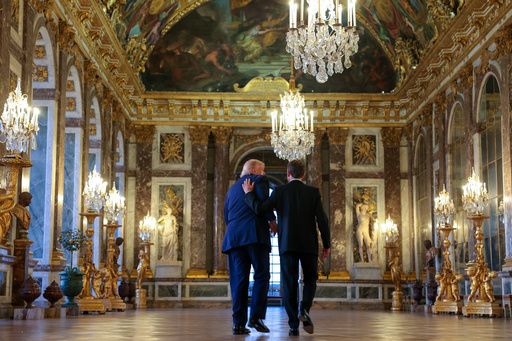
Seems all it took was an invitation to dine at the opulent Palace of Versailles, southwest of Paris, after the summit.
After all, Trump said it himself: He’s a fan of beautiful things and his only plan was to fly back to Washington after the conference anyway.
He left last year’s G7 summit in Canada before it was over, but Macron wanted to keep Trump from doing the same thing to him. Their relationship has weathered several ups and downs.
Macron described the dinner as a “convivial” occasion meant to celebrate friendship between France and the United States.
French officials noted that Versailles is where King Louis XVI pledged military support to Benjamin Franklin and the American revolutionaries in 1778.
Macron hosted King Charles III and Queen Camilla there in 2023 for the palace’s 400th anniversary, including dinner in the Hall of Mirrors, one of the features of the palace’s 2,300 rooms.
—-
Superville reported from Geneva. Associated Press writer Collin Binkley in Washington contributed to this report.