

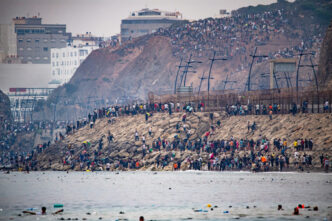
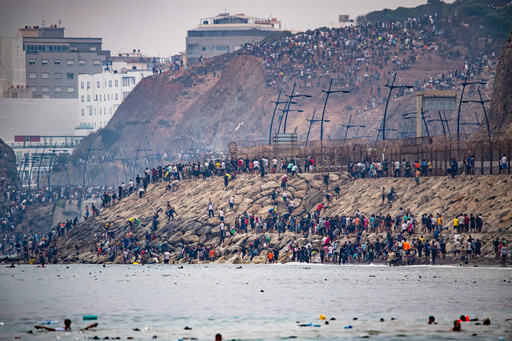
CEUTA, Spain (AP) — Tens of thousands of migrants who crossed into Spain’s tiny Ceuta territory returned voluntarily to Morocco on Friday, a day after the influx triggered chaos in the North African city and reignited the immigration debate in Europe and beyond. At least 57 migrants died on the journey.
Ceuta’s president put the number of migrants at 60,000, which was equivalent to 70% of the territory's population. But most of them soon went back, the Spanish government said, after the sudden arrival of so many people sparked a humanitarian crisis.
Some migrants swam several miles through the sea and faced down authorities who tried to turn them back with water cannons, tear gas and warning shots. Those who died included some who drowned or were killed in a stampede to cross a breakwater barrier near a border checkpoint.
Spain deployed its armed forces and additional police to restore order in Ceuta, which sits on the Strait of Gibraltar at the entrance to the Mediterranean Sea and has been a Spanish possession since 1580. On the Moroccan side of the border, security forces clashed with migrants. The chaos also had ripple effects abroad, with Italy and France pledging to tighten their controls on people arriving from Spain.
“The situation that Ceuta is going through is absolutely unsustainable,” Ceuta President Juan Jesús Vivas told journalists.
Meanwhile, migrants from Morocco also attempted to cross into Melilla, Spain’s other territory at the tip of North Africa, where they clashed with police.
Spanish Prime Minister Pedro Sánchez visited Ceuta on Friday and condemned the border breach, which he described as “a violation of Spain's territorial integrity.”
Sánchez blamed human smugglers for the crisis, saying they “deceive so many young people and ultimately lead many of them to their deaths,” whether in the ocean or in the city.
The Spanish Interior Ministry released its own figures shortly after Vivas spoke, estimating that some 50,000 people had crossed from Morocco since Thursday. It added that 48,300 had already returned to Morocco by Friday evening, with hundreds more going back by the hour.
Rachid Sbihi, who leads a local workers association representing Civil Guard officers, described the situation as a “serious humanitarian crisis,” saying thousands of migrants, including unaccompanied children, were left sleeping in parks and on sidewalks, while others roamed the streets aimlessly.
“It’s chaotic,” Sbihi said.
The Moroccan Interior Ministry did not respond to a request for comment on the migrant figures released by the Spanish authorities.
European Commission President Ursula von der Leyen said the images from Ceuta were “unacceptable.”
“We cannot allow anyone to come to our Union without abiding by our rules,” she said Friday in an online statement. “Dangerous crossings must stop immediately. Smuggling networks must be dismantled. And returns must be swift, as our rules allow.”
Some of the 57 people who died had drowned, Sbihi said, but some were also killed in a stampede to cross the breakwater fence at Tarajal Beach, an urban beach near a border checkpoint with Morocco. The waters near the border fence were littered with buoys, shoes and other abandoned belongings.
Many young Moroccans who crossed into Ceuta told The Associated Press that they had hoped to find better work opportunities in Spain but were returning given the mayhem in Ceuta.
“There’s nothing at home. I’d have to work 12-hour shifts for a meager wage. That’s why I came here,” said 21-year-old Abdulah Buji, who hails from the city of Tetouan. “But I haven’t found any opportunities here either, so I have to go back.”
Moroccan police used water cannons and fired warning shots into the air to prevent migrants from crossing into Ceuta, according to rights groups in Morocco.
Morocco’s ambassador to Spain said the situation in Ceuta had unfolded against Morocco’s wishes.
“We have always prioritized legal, orderly and safe migration for all,” Karima Benyaich said. She did not comment on what prompted the migrants to cross into Ceuta.
To reach Ceuta, on the northern African coast, migrants often swim from the Moroccan town of Fnideq, covering about 3 miles (5 kilometers) to reach Spanish territory. Others attempt the crossing from the nearby town of Belyounech, where the distance is shorter.
Authorities in Ceuta and Madrid have linked the border surge to a recent decision by the Spanish Supreme Court, which ruled that migrants arriving by sea could not be summarily deported, unlike those who cross by land or climb the border fence.
Sánchez said migrant smugglers misinterpreted the ruling.
The interpretation of the Supreme Court’s ruling “spread like wildfire over the past few hours through the networks of human trafficking organizations,” triggering the surge, Sánchez said.
Sánchez has bucked the anti-migration trend that has gained ground across Europe and in the U.S.
Earlier this year, his government moved to give residency and work permits to hundreds of thousands of migrants already living in the country without permission.
Sánchez, a Socialist, argued that it would be good for the economy and the demographics of an aging Spain. Migrants who entered irregularly after Jan. 1 this year were not included.
His critics jumped at the opportunity to attack his policy, saying it encouraged more migrants to come.
“Sánchez allows Spain to be invaded through Ceuta,” Spanish conservative politician Isabel Díaz Ayuso wrote on X.
The U.S. expressed its support for “the people of Spain, and all Europeans, against this egregious violation of their sovereignty and human rights.”
In a post on X, the State Department added that “this unacceptable incident is the direct result of the Spanish Government’s deliberate efforts to enable and facilitate mass illegal migration into Europe.”
Sánchez on Friday defended his migration policy and distanced it from the events in Ceuta.
In the tumult, Italy temporarily suspended its open-border Schengen agreement with Spain, reimposing border controls for air and sea. The Interior Ministry said the decision amounted to a “closure” of the borders, but experts said it was merely a resumption of border controls. The agreement allows travelers to fly between the two countries without presenting passports.
French Interior Minister Laurent Nunez said France would also strengthen border checks with Spain.
The crisis in Ceuta “has nothing to do with the regularization of migrants adopted by the Government of Spain, as is being falsely claimed by some,” the Spanish government said in a statement late Thursday after Meloni's announcement.
Migrants from Morocco also attempted to cross into Melilla, the other Spanish territory at the tip of North Africa.
There was widespread chaos in Bni Nsar, the Moroccan town bordering the Spanish territory, where migrants clashed with police, throwing rocks and setting police vehicles ablaze, according to local media and rights groups. They reported injuries among security forces and the arrest of dozens of people attempting to cross.
Like Ceuta, Melilla is a self-governing Spanish city. Many Moroccans consider both cities to be occupied territory.
___
Naishadham reported from Madrid. Brito reported from Barcelona, Spain. Associated Press journalists Joseph Wilson in Barcelona, Spain; Akram Oubachir in Casablanca, Morocco; and Antonio Sempere in Ceuta, Spain, contributed.