

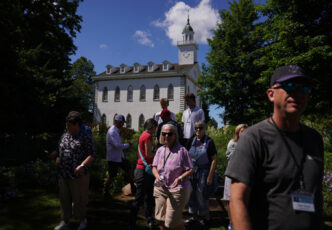
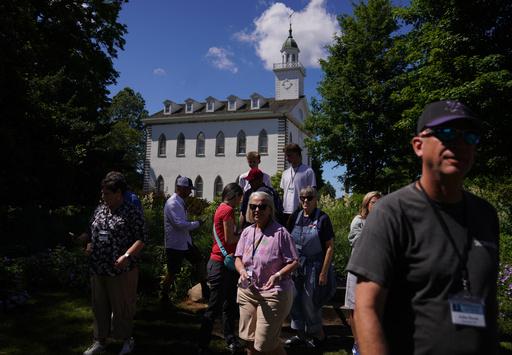
KIRTLAND. Ohio (AP) — Elder Brian Garner led a small group of visitors through the sturdy wooden door of what looked like an ordinary colonial church. But nearly two centuries ago, it was where a radical departure in American religious history took hold.
“Welcome to the house of the Lord Jesus Christ,” Garner said.
The visitors walked through the church's assembly halls and meeting rooms where Joseph Smith gathered in the 1830s with early followers of the movement that became known as Mormonism. They sang a temple-dedication hymn where it was first sung by pioneers in the faith.
The building in this small town near Cleveland is the oldest temple in the Mormon movement, and it’s drawing renewed interest since its purchase by the Church of Jesus Christ of Latter-day Saints two years ago from a historically related church. And that attention to the oldest temple comes as the LDS church prepares to dedicate its newest U.S. temple in a nearby Cleveland suburb.
It was in the Kirtland temple that Smith initiated rituals and proclaimed divine revelations, promising restoration of ancient rites, scriptures and beliefs that varied dramatically from those of neighboring Christian denominations. It’s also where he and others reported seeing visions of biblical prophets, angels — and even Jesus Christ.
“I would like to just give you a moment of silence to consider the fact that the Redeemer of the World was here … not very far from where you’re seated,” Garner told the visitors. Garner is one of numerous missionaries in The Church of Jesus Christ of Latter-day Saints who offer the tours.
Ohio is a lesser-known stop on the Mormon history trail. Better-known are the New York state sites where Smith reported his original divine revelations — or the sites of his followers’ embattled settlements in Missouri and Illinois before their ultimate move to Utah.
But Kirtland, just northeast of Cleveland, has its own landmark status.
The building here is considered the first “temple” in the movement Smith founded — a place with a higher spiritual status than the more numerous meetinghouses where regular worship is held.
The LDS church purchased the Kirtland and other historic properties from Community of Christ, a church that also traces its roots to Joseph Smith.
On a June day in Kirtland, numerous Latter-day Saints filtered in and out of the temple, some on a multistate bus tour visiting landmarks in Mormon history.
“Just to come here and know that this is where Jesus Christ actually stood in the pulpit and spoke to Joseph and the other brethren, it’s a feeling that you can’t really describe to anybody,” said Pauline Anderson of Mansfield, Ohio.
Her husband, Shae Anderson, said Ohio is a “Holy Land,” where many of the church's Scriptures originated.
That same morning, another group of church members gathered about 30 miles (48 kilometers) away in Independence to unveil a new temple. Once it is dedicated on Aug. 16, it will be the first functioning LDS temple in northern Ohio in nearly two centuries. The building, and another being dedicated that same day in Brazil, will be the newest LDS temples, part of an unprecedented global expansion of temple sites.
It features a modern design, but its cupola resembles that of the Kirtland structure — an architectural hat tip to its forerunner.
“It is fitting that today, in the same region where the first temple was built in this dispensation, another temple now stands,” Mathias Held, an official with the church's temple department, said at a media preview event.
Church representatives hosted several open houses for the public to see the new temple’s ornate rooms. After its dedication, the temple will be open only to church members in good standing. There, the faithful will partake of rites such as baptisms on behalf of the dead and marriages deemed as sealing couples for eternity.
The old Kirtland building, in contrast, has remained open to the public as a historic site because it’s not a functioning temple.
More than 53,000 people visited the Kirtland temple in 2025, with others visiting historic homes and businesses used by early church members in and near Kirtland, said Pace Clarke, the Ohio Historic Sites Manager for the church.
“This temple is the origin of all Latter-day Saint temples,” Clarke said. “All of those temples point back to what was first taught here.”
For Reese Anderson of Bountiful, Utah, who was on a multistate tour of the church's historic sites, the appeal of visiting Kirtland was simple: “I felt like I was going home.”
The early LDS presence in Kirtland was dramatic, turbulent and, for Smith and his followers, brief.
As a young man in New York, Smith asserted that he received divine instructions to restore the true teachings of the ancient Christian church.
Kirtland became a hub of early converts. Smith moved there in 1831. Soon church members began work on a temple. Its design reflects the builders’ familiarity with the architectural styles of the time and what they believed was divine guidance, Clarke said.
The first and second floors feature large assembly halls with rows of pulpits on different levels, representing a hierarchy of the priesthood just emerging in early Mormon practice.
The third floor contains meeting rooms where Smith and other leaders inaugurated a rite that involved foot-washing and anointing by oil, and where Smith reported a divine revelation of new teachings.
In 1836, about 1,000 people jammed an assembly hall to dedicate the temple. They sang a new hymn, “The Spirit of God Like a Fire is Burning,” which is now routinely sung at temple dedications.
But the Kirtland church community soon experienced schisms and conflicts over doctrine, money and authority. Smith and many followers ultimately moved west.
Others formed a separate church, now known as Community of Christ, and eventually assumed management of the Kirtland building, operating it for most of its remaining history.
In 2024, the LDS church acquired the temple, other properties and artifacts from Community of Christ for $192.5 million in a transaction that both churches' leaders described as amicable. The acquisition included properties in Nauvoo, Illinois — near the site of Joseph Smith’s 1844 murder by a mob, which preceded his followers’ exodus to Utah.
Community of Christ said the sale boosted its “capacity to pursue our mission priorities.” It continues to hold several meetings at the Kirtland temple each year.
Seth Bryant, the historic sites manager for Community of Christ, said the temple retains deep significance for both churches, even as they evolved separately with distinct views on the role of temples and other theological areas.
“As a historian and somebody who cared for the temple and loves it a great deal, it was very difficult” to see the property change hands, he said. “Whoever has their name on the deed — that isn’t as important to me as the spiritual encounter that happened in that space, as well as what’s happening today.”
___
Associated Press religion coverage receives support through the AP’s collaboration with The Conversation US, with funding from Lilly Endowment Inc. The AP is solely responsible for this content.