

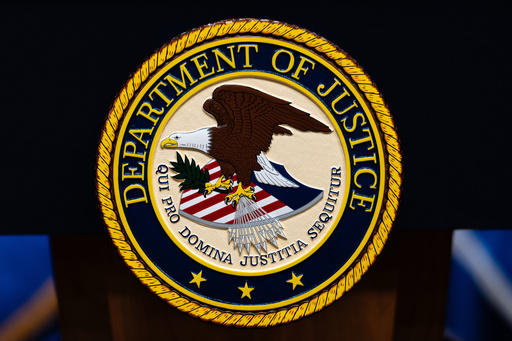
SACRAMENTO, Calif. (AP) — The Trump administration sued California election officials Thursday, asking a judge to bar the state from counting mail-in ballots for next month's midterm elections from people the federal government has identified as “likely” noncitizens until their immigration status can be confirmed.
The lawsuit comes after the Justice Department said California officials failed to meet a 48-hour deadline to review a password-protected thumb drive that contains a list of 20,000 names. The federal government says those are likely noncitizens who were sent ballots to participate in the Nov. 3 election, although the secretary of state said the administration has provided no evidence to support that claim. The state mails ballots to all registered voters.
The lawsuit follows a letter sent earlier this week by a top Justice Department official who threatened potential legal action if California didn't comply.
The federal government didn't specify where the 20,000 voters were concentrated, but the list was sent directly to Los Angeles County Registrar Dean Logan on Tuesday, his office confirmed in a statement. Logan is also named as a defendant in the lawsuit.
The county has roughly 6 million voters, roughly half of whom are registered Democrats, according to the secretary of state's office. Over 23 million people are registered statewide, and there are a handful of competitive congressional races in other California districts that could determine which party has control of the U.S. House for the final two years of President Donald Trump's term.
California Secretary of State Shirley Weber said in a letter to the Justice Department that the federal government hasn't provided evidence to support its allegation that 20,000 names on the state's voter rolls are of noncitizens. She referenced an instance in which the federal government initially alleged nearly 16,000 possible noncitizens were listed on Nevada's voter rolls, but the state determined that all the people flagged were, in fact, U.S. citizens.
She also noted that voting is already underway in the state. Weber, a Democrat, said the Justice Department was “demanding unprecedented measures that threaten thousands of Californians’ right to vote, based on unverifiable information or methodology that you still fail to explain or provide.”
California's elections are in “full compliance” with federal law, she added.
David Becker, an election law expert who heads the Center for Election Innovation and Research, called the Justice Department’s lawsuit “fairly frivolous.”
“If they were seeking to work in good faith to clean up the voter list that they believed had issues, they would have done this months ago in a much different fashion,” Becker said. “However, it does raise questions as to whether or not the sole purpose of this is to set the stage for false claims about elections.”
Logan said his office received the thumb drive along with a “hand written note providing a password” to access the list of alleged noncitizens on the voter rolls. He said he did not consider the thumb drive a secure device. The secretary of state’s office said the password was written “on a sticky note.”
Becker said most election officials’ cybersecurity protocols would not allow them to comply with the Justice Department's request as it was sent.
“Election offices do not just stick thumb drives into their technology, for very good reason,” he said.
The Justice Department's lawsuit says the federal government sought to “work collaboratively” with California to identify noncitizens registered to vote in the state, and “California made no serious effort to do so.”
“The United States thus seeks commonplace election relief when a ballot is called into question,” the lawsuit says. "This Court should enjoin California from presently tabulating vote by-mail ballots from likely noncitizens in the upcoming federal election until the voter’s citizenship status can be determined," the lawsuit says.
Weber, who is named in the lawsuit, suggested the federal government's outreach had not been collaborative.
She said that over the summer, the Department of Homeland Security claimed that California had 190,000 noncitizens on its voter rolls but refused to provide the methodology or data sources when the office asked for them.
In her letter Thursday, she called the recent demands “an emergency of the DOJ’s creation.”
The letter sent by acting Deputy Attorney General Trent McCotter gave the state 48 hours to research the list of the 20,000 people it claims might not be citizens. For those whose citizenship cannot be independently verified, the state is to instruct local election officials to segregate their mail-in ballots until their immigration status can be determined, and to not provide a ballot to anyone who has not yet received one.
California Attorney General Rob Bonta said at an unrelated press conference Thursday morning that state officials would not carry out the federal government’s requests to withhold ballots for the alleged noncitizen voters. He noted that the administration's alleged number of noncitizens on the state's voter rolls had dropped from the 190,000 flagged over the summer by the Department of Homeland Security to the 20,000 noted by the Justice Department.
“What happened to those 170,000? They just got those wrong,” Bonta said.
He also said the Trump administration was violating a federal law that prohibits states from changing voter rolls within 90 days of an election.
“They are in unprecedented, baseless, lawless territory,” he said.
The Trump administration has made the hunt for noncitizen voters a priority this year, even though the problem is exceptionally rare. The Justice Department has charged about 90 people for various types of election misconduct so far this year, including 50 who are alleged to have voted as noncitizens. There were more than 227 million registered voters in the United States during the 2024 presidential election.
Bill Essayli, the first assistant U.S. attorney for the Central District of California, defended the Justice Department’s move to take California to court.
“This is not political or controversial,” he wrote in a post on X. “We will not allow California to dilute the votes of American citizens.”
___
Austin reported from Sacramento, Riddle from Los Angeles and Durkin Richer from Washington. Associated Press writer Ali Swenson in New York contributed.
.