


JERUSALEM (AP) — When Hamas-led militants attacked Israel on Oct. 7, 2023, it looked like Prime Minister Benjamin Netanyahu ’s days in office were numbered.
With the country overwhelmed by grief and anger after the deadliest security breakdown in its history, his resignation seemed like a matter of time.
But the divisive veteran Israeli leader has scratched, scraped and literally battled his way back during a stormy three-year period of nonstop domestic crises and wars across the region. Confounding his critics, he now finds himself in a tight race for reelection on Tuesday.
Netanyahu has been the country’s most dominant politician for nearly two decades, and his legacy is on the line. A poor showing could end the 77-year-old’s lengthy career on a bitter note and open the door to a new era in Israeli politics. A victory would cement his image as the ultimate political survivor.
Former Prime Minister Ehud Olmert, a onetime ally turned rival of Netanyahu, said there has never been so much at stake — from national security to the future of Israel’s democratic institutions and its standing in the world. After a series of wars that have destabilized the region and jolted the global economy, the world is watching closely.
Politicians often say the current election is the most fateful in their country's history, Olmert said, but “this time it really is.”
Netanyahu's opponents, led by former military chief Gadi Eisenkot, see Tuesday as a day of reckoning. They say Netanyahu should be held accountable for Oct. 7 and the failure to turn battlefield victories into diplomatic achievements.
“What he is offering is an eternal war,” Eisenkot, whose son and two nephews were killed in combat, said in a radio interview. “Choosing a leader whose only goal is not to surrender means choosing a leader who will not deliver victories.”
Netanyahu’s supporters say he was betrayed by Israel’s defense establishment and that he has led the country through a remarkable turnaround with devastating strikes against Hamas, Lebanon’s Hezbollah and Iran.
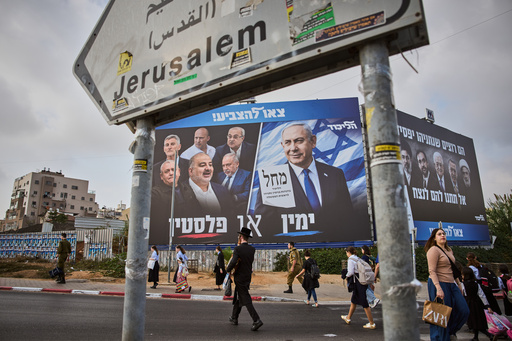
The Israeli leader has also turned to his traditional use of scare tactics. His campaign slogan, “Right or Palestine,” which rhymes in Hebrew, suggests his opponents would establish a Palestinian state alongside Israel, something his main rivals vehemently reject.
A two-state solution, still seen internationally as the only realistic way to solve the conflict, is politically toxic in Israel — another legacy of Netanyahu's long rule.
Nearly every poster, stump speech or televised debate seems to reference the Oct. 7 attack, which has scarred the country and remains fresh in the minds of voters.
Some 1,200 people were killed that day and 251 others taken hostage, the last of whom were returned in a ceasefire deal last year.
Israel responded with a military offensive that has killed over 74,000 Palestinians in Gaza, according to local health authorities, left the territory in ruins and triggered open-ended wars in Lebanon and Iran. Netanyahu faces an international arrest warrant, experts have accused Israel of genocide, and Israel’s image has further deteriorated with a spike in settler violence in the occupied West Bank.
Most Israelis across the political spectrum reject the war crimes and genocide allegations. But Netanyahu's opponents, including many former hostages, refer to his outgoing coalition as the “failure government” and have pledged to launch an official investigation into how Oct. 7 was allowed to happen.
Netanyahu has refused such an inquiry and calls his ongoing — and inconclusive — military campaigns a “war of redemption.”
Boosted by an endorsement from President Donald Trump, Netanyahu has also tried to turn attention to Iran, threatening to resume the war, and vowing to destroy its nuclear program and topple its government.
“Donald, we have a job to finish. You said it and we’ll finish it together,” he said in a conversation with Trump released by his campaign.
Netanyahu's rule has left Israelis bitterly divided over other issues, especially a longstanding system granting ultra-Orthodox men exemptions from military service.
In a country where enlistment is mandatory for most Jewish men and women, these exemptions have always angered the broader public. But resentment has grown as hundreds of young soldiers have been killed in battle and tens of thousands have been pulled away from families and careers for reserve duty.
Netanyahu, who has close ties with politically powerful ultra-Orthodox parties, has resisted attempts to end the exemptions.
He has also outraged many Israelis with his attempts to overhaul the legal system.
Before the war, Netanyahu, who is on trial for corruption charges, launched a controversial plan to weaken the courts. That prompted mass anti-government demonstrations by crowds who accused him of undermining the country’s system of checks and balances to escape prosecution.
Each side has accused the other of weakening Israel on the eve of the Oct. 7 attacks. The plan has been mostly frozen since then, but Netanyahu’s allies want to revive it.
Israelis vote for political parties, not individual candidates. Since no political party has ever captured a 61-seat majority on its own, political leaders must form coalitions.
Netanyahu has been a master at forming coalitions with religious and nationalist partners, but opinion polls suggest a tight race between his bloc and the one led by Eisenkot.
With non-aligned Arab parties campaigning hard, there is a strong possibility that neither of the main Jewish blocs will capture a majority. That could set the stage for weeks or even months of negotiations among around a dozen parties expected to win seats.
Netanyahu’s allies and members of Eisenkot’s bloc both say they will not govern with Arab partners.
Amid so much uncertainty, a number of scenarios are possible — including a unity government between Eisenkot and Netanyahu, or an Eisenkot-led government backed by Arab partners from outside the coalition.
Eisenkot says he will not serve in a Netanyahu government. But politicians have broken promises before. The alternative would be to hold new elections early next year — leaving Netanyahu in office until then.
Largely missing from the Israeli public discourse is any discussion of the dire situation in Gaza or Israel's open-ended military rule over millions of Palestinians.
The Oct. 7 attack, which came after decades of conflict and four previous wars with Hamas, convinced many Israelis there was no partner for peace, while Netanyahu and his allies have largely succeeded in branding the Israeli left as weak or even traitorous.
Palestinians have little hope their lives will improve regardless of whether Netanyahu wins or loses.
Olmert, who led the last serious negotiations with the Palestinians before a corruption scandal forced him from office and Netanyahu replaced him in 2009, said the candidates aren’t discussing the two-state solution because it is not popular with voters.
But given the international outrage over the situation in Gaza and settler attacks, he said it will be impossible for the next government to ignore the issue for long.
“Sooner or later, a new government will have to deal with it,” he said.