

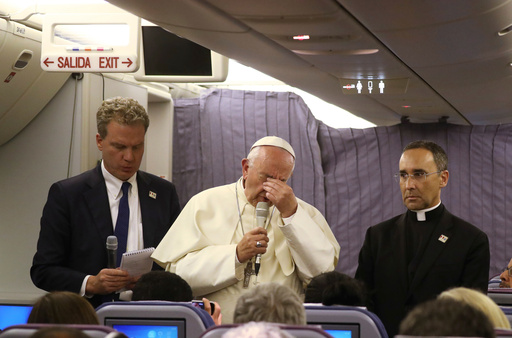
VATICAN CITY (AP) — As papal news conferences go, the one with Pope Francis on the flight home from his trip to Chile in 2018 was unusual in every way.
Turbulence had forced a pause in the questioning, but when Francis returned to his place at the front of the economy section of the papal plane, I picked up where others had left off.
I had a sharp exchange with him about the clergy sexual abuse scandal in the South American country. Like other journalists, I challenged him because he had discredited victims of Chile’s most notorious abuser and seemed completely indifferent to their pain.
Only now, after reading “The Private Diary of Pope Francis,” did I realize how much the Argentine pope had suffered when he understood the depths of the problem in Chile.
In his moving diary, released Tuesday by the Vatican, Francis reveals that after the Chile trip, he saw the “gates of hell” in the Chilean scandal, “Pagan seduction in full force.”
“Devastated because of the situation in Chile and the dialogue with the journalists on the airplane,” Francis wrote in the diary, “I became aware of how serious the problem was. … It was hard for me to admit what happened in Chile; I didn’t think it was so serious.”
In another entry, he recalled that after returning from Chile, he saw the devil and heard him speak.
“I can’t forget the powerful raspiness of his voice,” he wrote.
He later credited his trip and his encounter with journalists with opening his eyes. He commissioned a full Vatican investigation into the scandal, apologized to the victims in person, and demanded the entire Chilean hierarchy offer to resign en masse.
In a 2023 interview with The Associated Press, Francis acknowledged the news conference five years earlier was a turning point. In that conversation, Francis pointed to our exchange as the moment he understood the depths of the abuse scandal.
“I couldn’t believe it. You were the one on the plane who told me, ‘No, that’s not the way it is, Father,’” Francis told me.
“That’s when the bomb went off, when I saw the corruption of many bishops in this,” he said, making a gesture indicating his head had exploded.
Francis had bungled the Chile case because he defended a bishop implicated in the cover-up for Chile's most notorious abuser, Fernando Karadima. Francis had called the victims' claims “calumny” and slander. And over their objections, he appointed the bishop to head a Chilean diocese.
Questioned by reporters on the plane, Francis had insisted no victims had come forward to accuse Bishop Juan Barros of protecting Karadima. But I and others knew otherwise, and challenged Francis about it.
“It’s the victims who are saying this,” I told him.
“I haven’t heard from any victim of Barros,” Francis responded.
“There are! There are!” I insisted. The pope interrupted, but I cut him off, my voice rising. “No! There are victims of Karadima who say that Barros was there!”
“But they didn’t come forward,” Francis replied. “They didn’t give evidence for a judgment. You, with good intentions, tell me that there are victims, but I haven’t seen them because they didn’t present themselves.”
AP reporting subsequently showed that Francis had indeed received a letter from one of Karadima's victims in which he accused Barros of covering up for Karadima's crimes.
Francis' torment over the Chile scandal, and another spiritual crisis he endured in 2021-22, are just some of the revelations in the diary, which was released globally in several languages.
The latter crisis was apparently connected to his own temptations to exercise power omnipotently, and the book suggests he overcame it by entrusting himself entirely to God’s mercy.
The diary is actually authored by Cardinal Víctor Manuel Fernández, the Argentine theologian who heads the Vatican’s doctrine office whose comments contextualize Francis' entries in his journal.
___
Associated Press religion coverage receives support through the AP’s collaboration with The Conversation US, with funding from Lilly Endowment Inc. The AP is solely responsible for this content.