

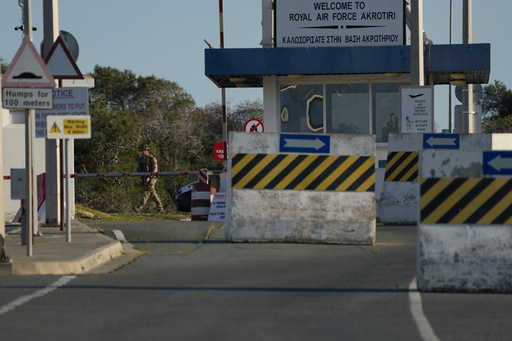
NICOSIA, Cyprus (AP) — Cyprus’ government is upset it was kept in the dark.
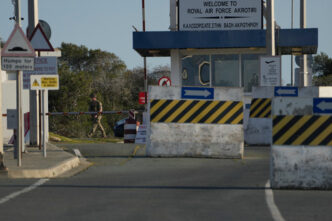
When a Iranian-made Shahed drone struck a hangar at a British air base on Cyprus' southern coastline minutes after midnight on March 2, sirens had already been blaring on the base's grounds, warning personnel to take cover.
But the British had not informed the Cypriot government, and now the east Mediterranean island nation wants to re-evaluate the status of Britain's two bases at Akrotiri and Dhekelia.
The British warship HMS Dragon was on Tuesday making its way toward waters off Cyprus to offer additional protection from any potential attack.
Here's what we know about what could happen with the bases.
On March 1, British Prime Minister Keir Starmer said the U.S. would be allowed to use British bases for the “specific and limited defensive purpose” of hitting Iran’s missile storage and launch sites. The announcement prompted concern among Cypriot authorities, appearing to contradict British assurances they wouldn’t use the island's bases. British officials later specified that the bases in question are located in England and the Indian Ocean, not Cyprus.
The following evening — according to two senior Cypriot officials who spoke to The Associated Press on condition of anonymity because they aren’t authorized to speak publicly about the matter — British authorities gave Cyprus' government no warning of a drone heading toward the RAF Akrotiri base, nor that a nearby village of 1,000 people could potentially be in danger.
The Ministry of Defence in London did not immediately respond to a request for comment.
The experience has prompted President Nikos Christodoulides to call for a “frank and open discussion” with the U.K. government about the future of the bases.
“I’m not going to negotiate publicly, I’m not going to put my request publicly, but we need to open this discussion,” Christodoulides said at the European Union leaders’ summit in Brussels on March 20. “The British bases in Cyprus is something that is a colonial consequence.”
Starmer’s office said in a statement that he had spoken to Christodoulides at the weekend to reassure him that, “as close partners and friends, Cyprus’ security was of utmost importance to the U.K.” Starmer is also said to have reiterated that RAF Akrotiri would not be used for any U.S. strikes on Iran.
Cyprus gained independence from British rule on in August 1960 after a four-year guerrilla campaign which came at a price — Britain retaining two bases spanning 99 square miles (256 square kilometers).
Their creation is enshrined in Cyprus' constitution. The Sovereign Base Areas have their own police force and courts and, in the strictest legal terms, are British colonial territory, according to Costas Clerides, the island's former attorney general.
Nearly 66 years later, many Cypriots — including Christodoulides — regard the bases as reminders of their colonial past. Some 10,000 Cypriot citizens live inside bases' territory and are subject to bases’ authority.
Calls to abolish the bases have been raised previously, particularly when they are used for military action in the region. Peaceful protests against their continued presence have been far smaller than in the past.
While created primarily to monitor shipping traffic through the Suez Canal and secure the flow of Middle Eastern oil, the bases have done far more.
RAF Akrotiri is still home to the famed U2 spy plane that conducts high-altitude surveillance flights over the Middle East. It also served as a key logistical post for the U.S. operation in Iraq in 2003 and, more recently, was used to prosecute the campaign against the Islamic State group in Syria and Iraq. The bases also feature a mountaintop listening post to monitor communications in the Middle East and beyond.
Successive Cypriot governments have said that Britain would inform the authorities of any military action undertaken from the bases, but that's understood more as a courtesy than an obligation.
“We are playing a leading role, with the Republic of Cyprus, in coordinating the increasing capabilities in the eastern Mediterranean, to help that sovereign base to remain as protected as possible in the circumstances and in the face of the Iranian threat,” U.K. Defence Secretary John Healey told Parliament on Monday.
Christodoulides said last week that Cyprus has “a clear approach with regard to the future of the British bases.” He declined to provide any details, but said any negotiation with the U.K. would take place after the end of the Iran war.
The Cypriot government has stated publicly that abolition wouldn't be on the table — at least for now.
Any dialogue would employ a step-by-step approach to secure more transparency of base operations, such as additional information and intelligence gathering, according to the Cypriot officials who spoke on condition of anonymity. They did not rule out a renegotiation of the status of the bases along the lines of the agreement the U.K. struck last year with Mauritius over the Chagos Islands in the Indian Ocean.
The U.K. agreed to hand sovereignty of the Chagos Islands back to Mauritius, and pay an average 101 million pounds ($135 million) annually to lease the base for at least 99 years.
U.S. bombers now use the U.K. base on Chagos' largest island, Diego Garcia, to strike Iran.
On Sunday, Iran said it launched missiles at Diego Garcia.
___
AP writer Jill Lawless in London contributed.