


Iran, the United States and Israel agreed to a two-week ceasefire on Tuesday, an 11th-hour deal that headed off U.S. President Donald Trump’s threat to unleash a bombing campaign that would destroy Iranian civilization. Hours after the announcement, Iran and Gulf Arab countries reported new attacks Wednesday, though it was not clear if the strikes would scuttle the deal.
All sides have presented vastly different versions of the terms. Iran said the deal would allow it to formalize its new practice of charging ships passing through the Strait of Hormuz. Trump said the U.S. would work with Iran to remove buried enriched uranium, though Iran did not confirm that.
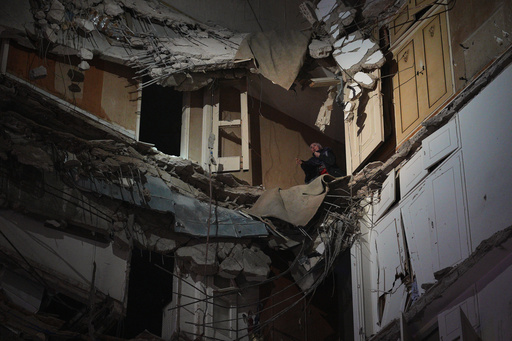
Pakistan and others said fighting would pause in Lebanon, which Israel has invaded to fight Iran-backed Hezbollah militant group, but Israeli Prime Minister Benjamin Netanyahu said early Wednesday that the deal doesn’t cover fighting against Hezbollah. Israeli strikes hit several dense commercial and residential areas in central Beirut Wednesday afternoon without warning, killing dozens and wounding hundreds of people.
Iran closed the Strait of Hormuz again Wednesday in response to Israeli attacks against the Hezbollah militant group in Lebanon.
The ceasefire may formalize a system of charging fees in the Strait of Hormuz that Iran instituted — and give it a new source of revenue. Iranian attacks and threats deterred many commercial ships from passing through the waterway, through which 20% of all traded oil and natural gas passes in peacetime.
Here is the latest:
In unusually strong language, U.N. Secretary-General António Guterres condemned Israeli strikes in Lebanon that killed and injured hundreds Wednesday, according to a statement by his spokesperson, Stéphane Dujarric.
The statement said Guterres “condemns the loss of civilian lives and is deeply alarmed by the mounting toll on civilians,” and added the ongoing strikes pose “a grave risk to the ceasefire and the efforts toward a lasting and comprehensive peace in the region.”
Guterres called on all parties to immediately cease hostilities.
The strikes targeting central Beirut Wednesday killed more than 180 people, and wounded hundreds, making it the deadliest day in the latest Israel-Hezbollah war.
Australian Prime Minister Anthony Albanese told reporters Thursday that the two-week ceasefire announced this week “is an important step forward.”
“Of course it is a fragile peace, but we want it to lead to an agreement,” Albanese said.
“The Australian government also firmly believes that this has to apply to Lebanon as well. We want to see peace in this region,” Albanese added.
Sirens went off early Thursday morning in a few Israeli communities along the border with Lebanon, near the city of Kiryat Shmona, which has been targeted by Hezbollah rockets repeatedly during the war.
In a statement, Hezbollah claimed attacking Manara in northern Israel early Thursday morning with rocket fire.
“This response will continue until the Israeli-American aggression against our country and our people ceases,” it said.
Israeli strikes on Wednesday killed an Al Jazeera correspondent in Gaza, according to the network and health officials there, as well as two Lebanese journalists in that country, according to the Committee to Protect Journalists and one of their networks.
Mohammed Wishah was targeted in a drone strike in west Gaza City. The Israeli military’s Arabic-language spokesperson, Avichay Adraee, said on X that Wishah was a member of Hamas, reposting a 2024 tweet that described him as a “prominent commander” in its military wing, among other positions.
In Lebanon, where Israeli strikes targeting Hezbollah killed more than 180 people Wednesday, Ghada Dayekh, a presenter with Sawt Al-Farah, and Suzan Khalil, a reporter and presenter on Hezbollah’s Al-Manar TV and Al-Nour Radio, also died.
A group of new accounts on the prediction market Polymarket made highly specific, well-timed bets on whether the U.S. and Iran would reach a ceasefire on April 7, resulting in hundreds of thousands of dollars in profits for these new customers.
These bets were made even though, in the hours before a two-week ceasefire was announced on Tuesday, Trump’s rhetoric had escalated sharply and there were few signals that a ceasefire deal was imminent.
An analysis of publicly available blockchain data from Polymarket, using the crypto analytics platform Dune, shows that at least 50 accounts, or wallets, placed substantial “Yes” bets Tuesday before Trump announced the ceasefire in a Truth Social post at around 6:30 p.m. ET.
▶ Read more about polymarket accounts
Israelis marked the Moroccan Jewish holiday of Mimouna, which celebrates the end of Passover, on Wednesday night without worrying about running for cover from of Iranian missiles for the first time in a month and a half.
In the southern resort city of Eilat, a local bar served the traditional fried foods, including the fried dough of mufleta, while wearing Moroccan inspired garb.
“I feel like I can finally go out and celebrate, it’s hard to celebrate anything during the war,” said Tair Elkaim, a 27-year-old personal trainer visiting from Netanya. “I feel more relaxed and happy, but also I’m sad about the families broken up by this war.”
Avi Zion, 30, a municipality worker from Jerusalem, said he was looking forward to returning to his routine and finally sending his kids back to school.
“I’m really happy there’s a ceasefire and we’re here to celebrate this feeling of release.”
Lebanon’s health ministry said that Israeli strikes on Wednesday killed 182 people, the highest single-day death toll in the Israel-Hezbollah war.
Israel launched a barrage of strikes in central Beirut and elsewhere in the country as a shaky ceasefire took effect between the U.S. and Iran. Iranian officials have maintained that the deal was supposed to include Lebanon, while Israel and the U.S. have insisted that it does not.
Another 890 people were wounded in the strikes, the ministry said. Altogether, 1,739 people have been killed and 5,873 wounded in Lebanon in just over five weeks since the outbreak of the war.
The State Department is moving to reduce the U.S. diplomatic footprint in Nigeria due to security concerns related to terrorism and crime even as a ceasefire in the Iran war comes into effect.
The department said Wednesday it had authorized nonessential American personnel and the families of all government staffers at the U.S. embassy in Abuja to leave the country “due to the deteriorating security situation.”
“There is risk of terrorist violence, including terrorist attacks and other activity in Nigeria,” it said. “Terrorists continue plotting and carrying out attacks in Nigeria. Terrorists collaborate with local gangs to expand their reach. They may attack with little or no warning.”
Nigeria is just the latest in a series of U.S. diplomatic missions to draw down staff with either ordered or authorized departures since the war with Iran began at the end of February.
When asked about an oil refinery on Iran’s Lavan Island that Iranian state television said came under attack Wednesday, the U.S. official said the pause in American attacks on Iran that went into effect Tuesday with the ceasefire was still effect.
The official spoke on condition of anonymity to discuss sensitive military operations.
Israeli military spokesman Lt. Col. Nadav Shoshani also said Israel wasn’t involved in the Lavan Island strike.
—- Konstantin Toropin
Speaking to reporters before leaving Hungary, the vice president said Iran questioning the workability of a ceasefire because it disagrees with the U.S. on three key points “must mean there’s a lot of points of agreement.”
Frustration on three issues “actually means that there’s a lot of agreements,” Vance said.
The vice president, who is set to participate in negotiations in Pakistan this weekend, said “ceasefires are always messy” and often feature “a little bit of choppiness.”
It wasn’t all positive, though. Vance also questioned the English skills of Iran parliamentary Speaker Mohammad Bagher Qalibaf and his comments on the fragile nature of the ceasefire.
“I actually wonder how good he is at understanding English,” Vance said “because there are things that he said that just didn’t make sense in the context of the negotiations that we’ve had.”
That’s despite claims from the White House on Wednesday there had been an uptick in the number of ships transiting the strategic waterway since a U.S.-announced ceasefire with Iran.
Windward, a maritime intelligence firm that tracks international shipping, said only 11 vessels transited the strait on Wednesday — roughly the same number from prior days.
Windward said all ships transiting the strait must still coordinate safe passage with Iranian authorities, who are requiring shippers to pay hefty tolls amounting of up to $1 a barrel for outbound oil, paid in cryptocurrency. For context, the largest supertankers carry up to 3 million barrels of crude.
Windward said radio broadcasts from Iran to tankers in the Persian Gulf on Wednesday warned that those transiting without approval would be attacked.
The Israeli military has struck the last direct crossing carrying most of the traffic to the key coastal city of Tyre over Lebanon’s Litani River, the strategic demarcation line separating southern Lebanon from the rest of the country.
The attack late Wednesday on the Qasmieh bridge further isolates southern Lebanon as the Israeli army pushes ahead with its ground invasion and bombardment following the announcement of a ceasefire in the Iran war.
Israel has bombed several bridges over the Litani, accusing Hezbollah of using them to bring fighters and military equipment to the border area. But the crossings are also crucial for Lebanese civilians and for those carrying humanitarian aid.
The strike comes as Israel seeks to create a “buffer zone” that it says is necessary to protect its northern towns from Hezbollah rockets. Lebanese civilians fear long-term occupation and displacement.
Democratic Leader Hakeem Jeffries said they will demand passage of the resolution to halt further U.S. military action in Iran during Thursday’s session, seeking to force Republicans, who have been largely silent on Trump’s strategy, to speak up.
He said in a letter to colleagues that the Democrats will “unleash maximum pressure on Republicans to put patriotic duty over party loyalty and join Democrats in stopping the madness.”
Congress is on recess, but the House and Senate are meeting for perfunctory sessions on Thursday.
Under the proposal, Democrats would seek to have the resolution approved by unanimous consent. But as the minority party, they may not even be recognized by the presiding officer, a Republican.
The center-right government of Bolivian President Rodrigo Paz said Wednesday it has terminated a military cooperation agreement signed with Iran three years ago, during the administration of leftist leader Luis Arce.
The announcement was confirmed by Defense Minister Raúl Salinas, who didn’t provide further details.
It comes on the heels of the Paz administration’s dramatic shift away from the foreign policy maintained by Bolivia throughout the administrations of the Movement Towards Socialism, or MAS, a party that held power for nearly 20 years.
It is also the latest sign of a sharp geopolitical realignment underway in the South American country that was once among the most vocal critics of Israeli policies toward Palestinians.
And that number, representing nearly one-fifth of Lebanon’s population, is expected to rise following the wave of over 100 Israeli airstrikes on the country on Wednesday, the U.N. humanitarian chief in Lebanon said.
Imran Riza told U.N. correspondents in a video briefing that Israeli orders for Lebanese to leave their homes now affect 15.5% of the country’s territory.
He also pointed to rising attacks on health care facilities during the Israeli-Hezbollah conflict, with over 106 incidents reported resulting in 57 deaths and 158 injuries.
The U.N. humanitarian coordinator urged donations to last month’s $308 million U.N. emergency appeal for Lebanon which has only received about $95 million.
Parliament Speaker Mohammad Bagher Qalibaf said Wednesday that a ceasefire and negotiations with the U.S. on ending the war is “unreasonable” as he accused the U.S. violating three of Tehran’s 10 conditions for an end to the fighting.
Qalibaf, a key figure in the Pakistan-brokered negotiations to end the conflict, objected in a social media post to the continuation of Israeli attacks on Hezbollah in Lebanon, an alleged drone incursion into Iranian airspace after the ceasefire was in effect and the Trump administration’s assertion that it won’t accept any Iranian enrichment capabilities as part of an agreement to end the conflict.
It comes as the not yet day old ceasefire appears at risk of fraying over significant disagreements between the parties who each are claiming victory in the conflict. Qalibaf’s comments come an hour after the White House announced that US Vice President JD Vance would lead the U.S. delegation to talks in Islamabad starting Saturday on bringing about an end to the war.
Spanish Prime Minster Pedro Sánchez condemned Israel’s strikes Wednesday on Lebanon, criticizing Israeli Prime Minister Benjamin Netanyahu.
“His contempt for life and international law is intolerable,” Sánchez wrote on X.
The Spanish leader, who has been Europe’s loudest critic of the U.S. and Israel’s military actions in the region, called on the European Union to suspend its association agreement with Israel.
The ceasefire requires a “free” reopening of the Strait of Hormuz, which includes no tolls imposed by Iran, said Leavitt, describing Trump’s thinking.
A regional official had said on condition of anonymity to discuss internal deliberations that the ceasefire plans included allowing both Iran and Oman to charge new fees to ships transiting through the strait.
Leavitt referenced Trump’s Truth Social post from Tuesday in which he said the agreement was conditional on the “COMPLETE, IMMEDIATE, and SAFE OPENING” of the strait. She added that “that’s very plain language and it should be taken at face value.”
At a press conference in Beijing early Wednesday, Abdolreza Rahmani Fazli, Iran’s ambassador to China, requested that its two closest allies and the world body help guarantee Tehran’s long-term security as part of the recent deal to end hostilities between U.S and Iran.
The Islamic Republic has made similar requests in the past but they have not come to fruition.
When asked if China would be willing to guarantee such security, foreign ministry spokesperson Mao Ning demurred Wednesday, telling reporters: “We hope that all parties will resolve their disputes through dialogue and negotiation.”
The vice president’s office gave the update Wednesday as Vance was wrapping up a trip in Budapest.
His office did not offer any details about his planned trip to Islamabad to lead the U.S. negotiating team that included Special Envoy Steve Witkoff and Trump’s son-in-law Jared Kushner.
The president earlier this month said that he was considering withdrawing the U.S. from NATO as he grumbled about the lack of support from members of the alliance in his war of choice against Iran.
The criticism from Trump follows years of complaining that the alliance’s member countries aren’t paying enough for their own defense. Trump is set to host Secretary-General Mark Rutte for talks at the White House later this afternoon.
“It’s something the president has discussed, and I think it’s something the president will be discussing in a couple of hours with Secretary General Rutte,” said Leavitt, when asked if Trump is still considering leaving the 32-member alliance.
The United States demanded Wednesday that Iran immediately reopen the Strait of Hormuz after the Islamic Republic closed the waterway in response to Israeli attacks against the Hezbollah militant group in Lebanon. Iran’s move cast doubt over whether an already precarious ceasefire to end more than a month of war would hold.
The United States and Iran both claimed victory after reaching the agreement, and world leaders expressed relief, even as more drones and missiles hit Iran and Gulf Arab countries. Israel also intensified its attacks in Lebanon, hitting several commercial and residential areas in Beirut without warning. At least 112 people were killed and hundreds were wounded in one of the deadliest days in the latest Israel-Hezbollah war.
The fresh violence threatened to scuttle what U.S. Vice President JD Vance called a “fragile” deal.
Asked about Trump’s threat to annihilate Iranian civilization, Press Secretary Karoline Leavitt defended it as a “very strong threat that led to results.”
“I think it was a very, very strong threat from the president of the United States that led the Iranian regime to cave to their knees and ask for a ceasefire and agree to reopening the Strait of Hormuz,” Leavitt said at a press briefing on Wednesday.
She said any suggestion that Iran had the moral high ground was “insulting.”
Before a ceasefire was announced, Trump had threatened destruction in Iran if it did not reopen the strait, saying “a whole civilization will die tonight, never to be brought back again.”
Leavitt was asked about NATO allies offering to contribute to keeping the strait open, but said the alliance hasn’t done enough to support U.S. and Israel’s war in Iran.
“They were tested and they failed,” Levitt said, reading from a past Trump quote on NATO.
She added: “NATO turned their backs on the American people over the course of the last six weeks.”
Those comments came as Trump was meeting with NATO Secretary-General Mark Rutte at the White House later Wednesday.
Israel’s main airport will resume full operations as of midnight on Wednesday, after the Iran war stranded tens of thousands of people, including both Israelis abroad and tourists inside Israel.
Israel’s airspace has been open but severely limited during the war, limiting flights to once an hour and just 50 people per flight. Israel joins several other countries in the region in reopening its airspace as the ceasefire with Iran appeared to hold.
“His very tough rhetoric and his tough negotiating style is what has led to the result that you are all witnessing today,” said White House press secretary Karoline Leavitt, adding that Iran said they wanted a ceasefire because “they no longer could tolerate being bombed.”
Trump’s threats against Iran escalated over the past weeks, culminating in his Tuesday warning that a “whole civilization” could “die” in the lead up to an 8 p.m. deadline, which was later suspended after an agreement was reached.
“The world should take his word very seriously,” Leavitt said.