

EVIAN-LES-BAINS, France (AP) — President Donald Trump started his visit to the Group of Seven summit on Monday by hailing his agreement aimed at ending the U.S. war with Iran as a potential breakthrough for global security.
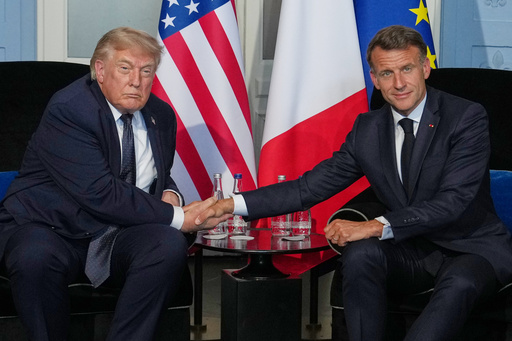
At a meeting with the summit's host, French President Emmanuel Macron, Trump declared it was promising — albeit not a guarantee — that the U.S. was finally turning the page in its relationship with longtime adversary Iran.
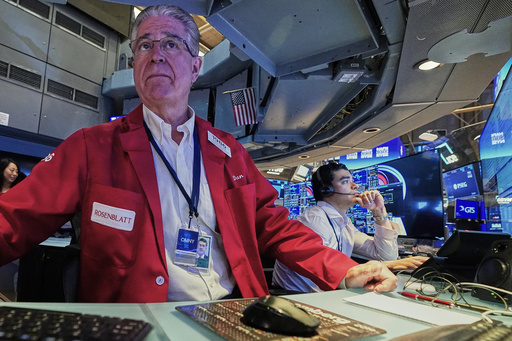
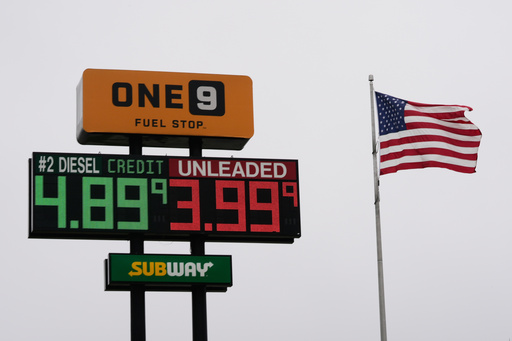
“I think a lot of great things are going to happen in the Middle East right now, and very importantly the oil (price) is plummeting down and the stock market is shooting up like a rocket today,” Trump said. He added, "The Iran deal that we made is going to bring a lot of success to the world.”
With the agreement, the Republican U.S. president made clear that he arrived in Evian-les-Bains with the wind at his back for talks with G7 leaders, including some who've been sharply critical of his managing of the 15-week-old conflict, which has led to a surge in global energy prices.
Polls show American voters largely disapprove of the conflict, which has made some Republicans nervous about the political impacts it could have on November's midterm election.
Neither the White House nor Iran published the final agreement or revealed many details. Trump, however, said the memorandum of understanding would likely be released after it's signed on Friday.
Sealing an agreement before jetting off to the summit might change the dynamic of the three-day gathering for Trump. He's had friction with Macron, British Prime Minister Keir Starmer, German Chancellor Friedrich Merz and Italian Prime Minister Giorgia Meloni over failing to consult them before the decision to go to war.
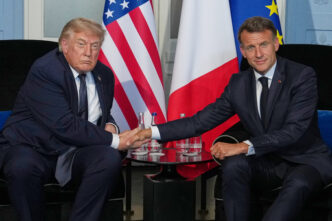
Macron at the start of Monday's meeting congratulated Trump for finding a way to an agreement.
"It’s a very important matter for peace of the whole world,” Macron said.
Trump has pushed back on the four European leaders — members of the NATO military alliance — for their lack of support for the U.S. in the conflict.
He's expected to discuss with leaders the demining of the Strait of Hormuz. Britain and France have expressed interest in assisting with the demining once the conflict is paused. Fear of potential mines is among the reasons tanker traffic has come to a halt during the war, and quickly clearing them will be crucial to regaining the confidence of commercial vessels.
Macron on Monday said France was ready to move within days to deploy assets, including mine-clearing vessels, to the region to help.
As the summit's host, Macron invited the leaders of three nations that aren’t part of the G7 — Egypt, Qatar and the United Arab Emirates — to take part in a session on the Middle East on Tuesday, when Iran is expected to be a central focus.
In a separate development, Trump, ahead of departing for the summit, told the New York Post he's warned Macron the U.S. will “have no choice” but to slap 100% tariffs on French wines unless Paris eliminates its digital tax on American tech companies, renewing a long-running threat from him that dates to his first administration.
Wines and spirits exported to the U.S. from the European Union currently face a 15% tariff.
In an interview with broadcaster TF1, Macron said Monday that it's not “for the United States to decide what European or French law should be.”
Following their meeting, Macron and Trump are to join the other leaders for a working dinner.
Trump had fiercely criticized President Barack Obama for the 2015 nuclear agreement, which Trump argued failed to stop Tehran from advancing toward a weapon and funneled billions of dollars into the Islamic Republic’s coffers.
In 2018, Trump exited the deal, known as the Joint Comprehensive Plan of Action. Britain, China, France, Germany, Russia and the European Union were also signatories to the pact.
Trump in an interview on Sunday with The New York Times pushed back on comparisons to the Obama-era nuclear deal. “We negotiated from strength,” Trump said. “He was basically paying them off.”
But Trump hasn't detailed how his agreement will address some key issues about Iran's nuclear program, including who will be in charge of verifying that Iran is complying with the agreement and who will destroy or remove 972 pounds (441 kilograms) of highly enriched uranium believed to be buried under nuclear sites that were badly damaged by U.S. strikes last summer.
The deal is also expected to include some sanctions relief and economic incentives for Tehran as it meets certain benchmarks aimed at assuaging White House concerns, senior administration officials said ahead of the two sides reaching an agreement.
Some Democrats and hawkish critics say Trump has failed to explain how the financial relief in his agreement will differ from what Obama did in the 2015 nuclear deal.
“For all his critique of JCPOA, we had international observers, we actually had an alliance there that included the Europeans, and Russia and China were all signatories,” Sen. Mark Warner, the top Democrat on the Senate Intelligence Committee, told CBS' “Face the Nation” on Sunday. “Now it is America going alone or going with Israel only, and that does not make us safer.”
Republican Sen. Lindsey Graham, a close ally of Trump and an Iran hawk, expressed skepticism, saying that Congress will need to review and vote on any nuclear deal with Iran, and said he expects Vance — “the architect of the deal” — to present it.
“I am somewhat concerned that Iran’s view of the agreement seems different than what the American negotiating team is claiming,” Graham said on social media.
Macron also invited Ukrainian President Volodymyr Zelenskyy for a working session with G7 leaders on Tuesday to discuss the Russia-Ukraine war.
At the moment, Zelenskyy is not scheduled to hold one-on-one talks with Trump while they're both in France, but Trump on Sunday held separate phone calls with Zelenskyy and Russian President Vladimir Putin.
Russian presidential aide Yuri Ushakov told reporters that Trump emphasized the need to end hostilities with Ukraine and stated his readiness to influence European allies and Kyiv toward that goal, including at the G7.
According to Ushakov, Trump also said that recent strikes on civilian targets in Russia complicate a settlement. The White House did not comment on the call.
Zelenskyy had offered to meet Putin with Trump and European leaders at the G7 gathering, but the Kremlin didn’t reply, a Ukrainian official familiar with the matter told The Associated Press. The official was not authorized to speak publicly about the matter and spoke on the condition of anonymity.
Putin is wanted by the International Criminal Court for alleged war crimes, and France would be obliged as an ICC member to arrest him. The United States and Russia both oppose the court.
Trump suggested that, after an Iran deal, he'll now have greater bandwidth to focus on the Russia-Ukraine war.
"Now that this is finished, we’re going to be focusing on that,” he said, referring to diplomatic efforts to stop the fighting that followed Moscow’s full-scale invasion of its neighbor in February 2022.
___
Madhani reported from Geneva, Superville from Washington. AP writers Samuel Petrequin and John Leicester in Paris; Volodymyr Yurchuk in Kyiv, Ukraine; Collin Binkley in Washington; and Tom Beaumont in Des Moines, Iowa; contributed reporting.