

WASHINGTON (AP) — After democratic socialist Claire Valdez defeated an establishment-backed candidate in New York's congressional primary last week, her elated supporters quickly turned their attention to a new target.
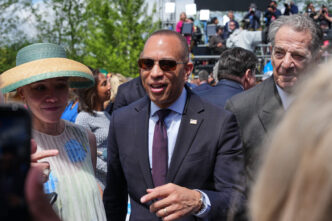
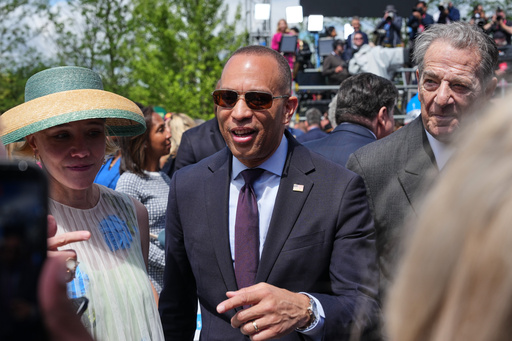
“You're next!” they chanted when an image of House Democratic leader Hakeem Jeffries of New York flashed on the television screens at Valdez's victory party in a renovated Brooklyn warehouse.
The message alarmed Democratic Rep. Gregory Meeks, whose district borders the one that Valdez is poised to represent. Jeffries would likely be the first Black speaker of the House if Democrats regain the majority, Meeks said, and “people died to see something like that opportunity.”
The episode reflects the party's dilemma in a populist age.
As left-wing insurgents make inroads in New York and elsewhere, their campaigns are confronting legacy institutions led by people of color. For a party that prides itself on diversity, the clashes have exacerbated fierce debates over identity politics and long-standing rifts between progressives and moderates.
The outcome will determine who holds power within the Democratic coalition as it battles for control of Congress and prepares for what is expected to be a sprawling and searing presidential primary in 2028.
Although minority-led organizations have historically been viewed as more radical and antiestablishment, some Democratic leaders now view the left-wing surge as driven by white college graduates. Progressives argue that their agenda remains popular within communities of color.
“It’s complicated," said Juan Proaño, CEO of the League of United Latin American Citizens. “But these changes are a real opportunity for our communities, and maybe a passing of the baton to a younger generation of leaders.”
Jeffries brushed off a question about whether he could face his own primary challenge.
“When you ask me a serious question, I’ll give you a serious answer," he told a reporter from Fox Business.
Once the distant dreams of Black and Latino activists, the political machines in many communities of color have become a central part of the Democratic establishment. They were a key driver of the party’s embrace of civil rights and diversity as core values.
Some of the party’s most tenured members and influential dynasties now come from communities of color, and politicians such as Jeffries rose through the ranks of such systems to serve as party leaders.
But such organizations were built in a different era.
“A lot of our communities are anchored in older, more traditional voters, and those older, more traditional voters carry older, more traditional values,” said Dallas Jones, the former Texas political director for Democrat Joe Biden's presidential campaign in 2020. In Democrats' current debates of “people versus elites," Jones said, “you cannot help but find that the Black community is caught up in the middle of it.”
Jones said that yearning for generational change helped topple Texas Rep. Al Green, a progressive seeking his 12th term in Congress, in May. A longtime civil rights activist, Green, 78, was defeated by Christian Menefee, a 38-year-old first-term congressman who is also Black, to represent a majority-Black district anchored by Houston.
The Democratic electorate grew slightly whiter in 2024 as Donald Trump made some gains among Black and Hispanic voters. In addition, white Democrats have become more likely to describe themselves as liberal than are Black and Hispanic Democrats, according to Gallup research from 2022.
Progressives argue that they are challenging longtime lawmakers based on their establishment ties rather than any shift in the party's demographics. They point to progressives recently winning House Democratic primaries for majority-minority districts in Pennsylvania and New Jersey as signs of deeper appeal.
“The point of being a senior Democrat is you’re supposed to be able to deliver more and impact the agenda,” said Regina Monge, a strategist who led a political action committee that backed democratic socialist Zohran Mamdani in last year's race for New York mayor. “People are supposed to feel the benefits of their leadership in the district.”
Senior lawmakers are skeptical that much can be extrapolated nationally from last week's results, where Mamdani successfully pushed a slate of three insurgent candidates.
“Our path to 218” — the number of seats necessary for a House majority — “wasn’t affected by those races that are getting a lot of news,” said Democratic Rep. Pete Aguilar of California, the highest-ranking Latino in Congress. “The mayor made some endorsements, and those individuals won, and I presume that they’re going to come and vote with the Democratic caucus when they get here.”
The new style of challenger often rises from outside the traditional civil rights and organizing structures that characterized some communities for decades.
Valdez, who is Latina and Native American, won the primary to replace retiring Rep. Nydia Velázquez, a former chair of the Congressional Hispanic Caucus who was born in Puerto Rico.
The current caucus leader, Rep. Adriano Espaillat of New York, lost his primary to Darializa Avila Chevalier, another democratic socialist, in a district that includes parts of Manhattan and the Bronx. Espaillat was born in the Dominican Republic; Chevalier’s parents are Dominican immigrants.
“We’re really looking at a moment in time where people are anxious about the future of our country," said Katharine Pichardo, who leads Latino Victory.
Pichardo was a senior adviser to Espaillat's first successful run for Congress, in 2016. She said Espaillat's message “needed to focus more on kitchen table issues” and be “forward looking” if he were to ward off Chevalier.
For incumbents to defeat populist and more ideological challengers, she said, they must “give people a sense of security against the very real anxiety over what’s going on in Washington, D.C.”
Basil Smikle, a former executive director of the New York State Democratic Party who now teaches at Columbia University, said insurgent candidates and their voters see institutions as “inherently flawed.” He said party leaders "would do well to turn with the momentum and not against it.”
“This is an opportunity for Hakeem to turn around and say, ‘Look, I’m with you, I’m not going to stand in your way, let's iron out our differences and make me speaker, get us back to power,'" Smikle said. "That would be the best way to bridge this divide.”
On Saturday, Jeffries took a step in that direction by congratulating New York City's Democratic nominees, including Valdez and Chevalier. He did not mention his ideological disagreements with them or his support for their opponents, instead stressing that they would help "crush far-right extremism."
“The path is different but the work is the same," Jeffries said.
_____
Associated Press writer Anthony Izaguirre in New York contributed to this report.