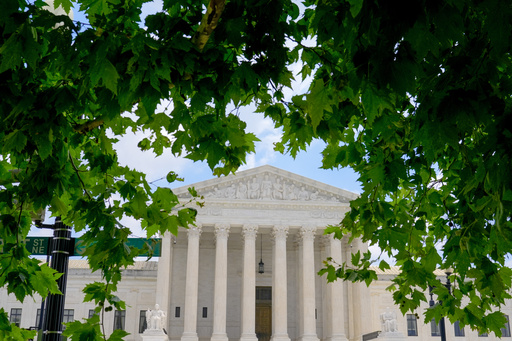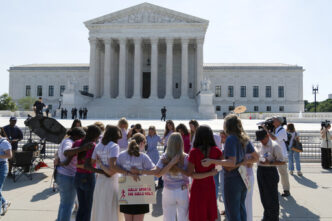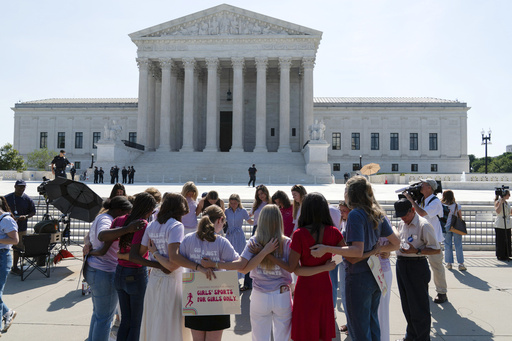
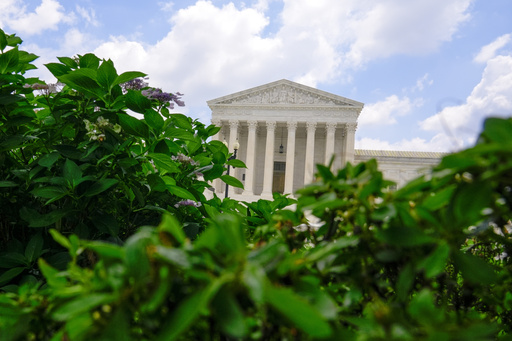
WASHINGTON (AP) — The Supreme Court on Tuesday erased limits on how much political parties can spend in coordination with candidates for Congress and president, striking down a federal election law that is more than 50 years old.
Prodded by a Republican-led lawsuit that includes Vice President JD Vance, the court's six conservative justices were again in the majority of the latest decision that upended congressionally enacted limits on raising and spending money to influence elections. The court’s 2010 Citizens United decision opened the door to unlimited independent spending in federal elections.
The limits on party spending stem from a desire to prevent large donors from skirting caps on individual contributions to a candidate by directing unlimited sums to the party, with the understanding that the money will be spent on behalf of the candidate.
The Supreme Court had previously upheld the limits, in 2001.
But Justice Brett Kavanaugh, writing for the court, said that decision was wrong and should be overruled. “In short, constitutional text, history and precedent establish that the political-party coordinated-expenditure limits violate the First Amendment,” Kavanaugh wrote.
Justice Elena Kagan's dissent for the three liberal justices said the court “ushers in untold harm” by enabling parties to funnel large contributions to individual candidates, far in excess of what donors can give those candidates directly.
National parties now will be able to make direct contributions to candidates’ campaigns,
The decision is likely to give Republicans at least a short-term boost because they maintain a sizable cash advantage over Democrats.
The Republican National Committee and its Senate and House campaign fundraising arms have dwarfed Democrats’ in the months before congressional elections where the GOP is defending narrow majorities in both houses.
At the end of May, the RNC reported having more than $125 million to spend, its highest-ever cash on hand total, according to its most recent Federal Election Commission filing in May. Meanwhile, the National Republican Senatorial Committee had more than $48 million on hand in its most recent report and the National Republican Congressional Committee had more than $81 million.
In the same period, the Democratic National Committee had $14.4 million on hand, while the Democratic Senatorial Campaign Committee had roughly $37 million and the Democratic Congressional Campaign Committee, roughly $73 million.
The Republican committees for House and Senate candidates filed the lawsuit in Ohio in 2022, joined by Vance, then a senator from Ohio, and then-Rep. Steve Chabot.
After President Donald Trump took office for his second term, the Federal Election Commission dropped its defense of the law and joined with Republicans in urging that it be overturned.
Democrats had called on the court to uphold the law, even though there is wide agreement that the spending limits have hurt political parties in an era of unlimited spending by other organizations.
Last year, the coordinated party spending for Senate races ranged from $127,200 in several states with small populations to nearly $4 million in California, the most populous state. For House races, the limits were $127,200 in states with only one representative and $63,600 everywhere else.
Entrenched divisions between liberal and conservative justices over campaign finance restrictions were on display when the court heard arguments in December.
“Every time we interfere with the congressional design, we make matters worse,” said Justice Sonia Sotomayor, a dissenter in Citizens United and the court’s other campaign money cases.
By contrast, Justice Samuel Alito, a member of the Citizens United majority, described the decision as “much maligned, I think unfairly maligned.” The effect of the decision was to ”level the playing field,” Alito said, by expanding the right to spend freely that had previously belonged only to media companies.
___
Associated Press writer Thomas Beaumont contributed to this report.
___
Follow the AP's coverage of the U.S. Supreme Court at https://apnews.com/hub/us-supreme-court.