


The U.S. military has destroyed five Iranian crude oil tankers following attacks on a U.S. warship by Iran’s Revolutionary Guard, U.S. Central Command said in a social media post on Tuesday. The U.S. strikes were in response to two Iranian efforts to hit the warship with ballistic missiles over the past two days, the statement added. It marks the latest tit-for-tat strikes as Washington and Tehran lurch back toward fighting during more than six months of war.
Canada retaliated against U.S. President Donald Trump on Tuesday with tariffs on about $20 billion worth of U.S. goods, in response to the latest round of U.S. tariffs on Canada. Canada’s move to reduce economic reliance on the U.S. will test whether its economy can withstand Trump’s economic pressure and serve as a possible model for other governments.
And Americans’ satisfaction with the quality of K-12 education in the country has hit a low point. Just 32% of American adults say they are “completely” or “somewhat” satisfied with the U.S. school system, according to a new poll. That’s the lowest since Gallup began polling on the subject 27 years ago.
Here's the latest:
Iran has launched missiles toward U.S. targets in Jordan, Iranian state-run media said, following the latest American strikes.
It’s the latest tit-for-tat retaliation after the U.S. military said it destroyed five Iranian crude oil tankers following two attacks on a U.S. warship by Iran’s Revolutionary Guard over the past two days.
U.S. Central Command, when asked about the strikes on the Jordanian air base, said it had no information to offer.
The Iranian tankers destroyed in the attack were the Kivik, Charminar, Horizon 1 and the Riesco in the Gulf of Oman, Central Command said. The U.S. military also destroyed the vessel Derya, which was located near Kharg Island in the Strait of Hormuz.
Central Command said the crews of the five vessels were told to abandoned ship before the attacks.
The strikes come just three days after U.S. forces destroyed three Iranian oil tankers after Iran’s Revolutionary Guards tried to attack a U.S. aircraft carrier and destroyer.
A federal judge in Missouri on Tuesday temporarily blocked the state from using its old congressional districts in the November election, after the U.S. Supreme Court declined to get involved in the twisting and confusing legal battle.
The decisions highlight the confusing nature of Missouri’s redistricting battle, which has spanned more than a year.
The federal court action came just days after the Missouri Supreme Court said the state cannot used a new U.S. House map backed by President Donald Trump in the November election because citizens turned in thousands of petition signatures demanding a statewide vote on it.
The Supreme Court on Tuesday declined to take up an appeal from Missouri’s Republican attorney general, leaving in place the injunction from Missouri’s top court. But moments later, U.S. District Judge Stephen Clark issued a temporary restraining order prohibiting Missouri from using anything other than the new districts backed by Republicans.
The president has directed the U.S. General Services Administration to declare Canadian products ineligible for large, long-term contracts until Canada allows “full and fair’’ reciprocity for American products.
That’s as he struggles to bring an end to the more-than-six-month war with Tehran.
The Trump administration also on Tuesday imposed sanctions on additional elements of Iran’s aviation industry, targeting more than two dozen commercial and private airlines as well as foreign cargo service providers in its new push to isolate Tehran from its remaining trading partners.
Both the U.S. and Iran are seeking to exert control over the Strait of Hormuz, where about one-fifth of the world’s oil passed before the war began.
Rising energy prices are posing political problems for Trump and his Republican Party ahead of the November midterm elections. A barrel of international standard Brent crude briefly climbed as high as $99.46 on Tuesday.
A U.S. blockade of Iranian ports has squeezed the country’s economy by limiting its oil exports, while the American military has been helping a limited number of ships transit through the Strait of Hormuz off Oman.
Edwin Lyman, at the Union of Concerned Scientists, says there’s no evidence the investments being made to restart closed nuclear power plants will return them to the condition where they can operate safely.
The U.S. Energy Department announced a loan of up to $1.9 billion Tuesday to help restart the Duane Arnold Energy Center in Iowa. It’s also investing in restarting nuclear power plants in Michigan and Pennsylvania. Google wants to purchase power from Duane Arnold for data centers.
Duane Arnold shut down in 2020 after a powerful storm damaged portions of the plant including the cooling towers.
Lyman, director of nuclear power safety at UCS, said unless the plant is hardened to better withstand such severe events, it will pose an unacceptable risk.
A call to a Freedom 250 spokesperson was not immediately returned.
Trump has been pushing to reshape how U.S. history is portrayed, affecting entities like the Smithsonian.
Bunch announced his departure Tuesday, expressing mixed emotions and gratitude. He will leave at the end of the year.
Two months ago, a White House report criticized the Smithsonian’s leadership, especially at the National Museum of American History, labeling the leaders as radical activists. Trump has been scrutinizing museum leadership, but he lacks the power to make swift changes.
Prime Minister Mark Carney said Canada will move faster to reduce economic reliance on the United States as retaliatory tariffs took effect on Tuesday on about $20 billion worth of U.S. goods.
“In too many areas, they wanted dependency, not a true economic partnership,” Carney said in a prerecorded video outlining his government’s plan to withstand the trade war.
About 400,000 people crossed the border each day. Now Canadians have sharply cut U.S. travel and are boycotting U.S. goods.
Rubio says Venezuela would be “much better off partnering with the United States” than with other countries that had managed the country's oil fields, such as China, Russia and Iran.
Acting President Delcy Rodríguez agreed last week to give the U.S. control of roughly one-fifth of Venezuela’s oil reserves.
While the deal could eventually generate billions for an economy wrecked by years of mismanagement, many Venezuelans say they believe gaining control of Venezuelan oil was the ultimate objective when Trump ordered U.S. forces to capture then-President Nicolás Maduro.
Trump posted a map showing the U.S. sprawling across all of North America and extending to Greenland and Iceland.
Trump has repeatedly talked of making Canada the 51st U.S. state and taking control of Greenland, Denmark’s self-governing territory. Iceland’s foreign secretary summoned the U.S. ambassador to make it clear that Monday’s Truth Social post was unacceptable, national broadcaster RÚV said.
“The U.S. president still harbors some kind of maximalist vision in his own mind. We need to rein that in,” Danish Foreign Minister Lars Løkke Rasmussen told the national broadcaster DR on Tuesday.
Trump’s post came as the European Union sought to reassure Greenland by promising a stronger partnership and major investments.
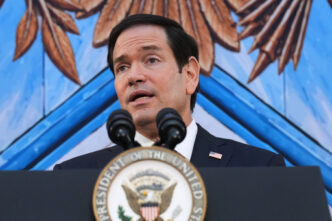
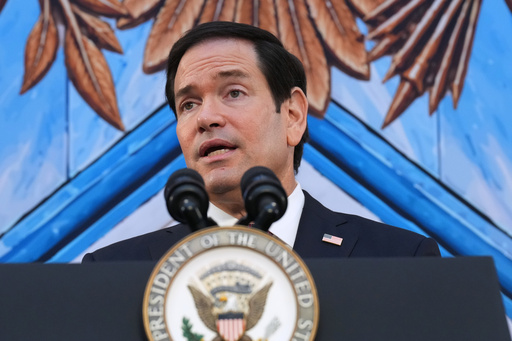
Speaking to reporters before a trip to Latin American countries, Marco Rubio said the U.S. was given a heads-up to the decision by the United Kingdom, which earlier Tuesday banned trade with Israeli settlements in the occupied West Bank, where it says “settler terrorists” are carrying out “ethnic cleansing” of Palestinians.
Israel in response said it would close the British consulate in Jerusalem.
Asked about Houthi attacks in Saudi Arabia that have wounded dozens, Rubio said the U.S. was watching the situation “very closely,” calling Houthis “agents and proxies” of Iran. He deferred more comment to the Pentagon.
Marco Rubio is visiting U.S.-aligned conservative leaders as the Trump administration steps up military operations to combat drug trafficking and seeks further inroads in the Western Hemisphere aimed at improving America’s energy standing and combating illegal migration.
Just a week after sealing a massive oil deal with Venezuelan leaders, Rubio is traveling Tuesday to neighboring Colombia to meet President Abelardo de la Espriella. Colombia’s new leader has embraced Trump’s policies on issues ranging from drugs to immigration and energy.
De la Espriella is one of a new generation of right-wing conservatives to win election and show support for Trump’s muscular approach to a region that had tilted leftward in recent decades.
Russia’s war on the country could drag on for years, and Europe must be ready to sustain its military support long term, U.S. Undersecretary of Defense Elbridge Colby said Tuesday.
“We cannot predict when this tragic war will end,” Colby said as Ukraine’s supporters held an online meeting seeking more air defense systems, arms and ammunition.
“Russia is reconstituting its forces and its defense industrial capacity,” Colby said. “We must be prepared for a protracted conflict and for Ukraine’s requirements to persist in the months and years ahead.”
Ukrainian President Volodymyr Zelenskyy said Tuesday that U.S. envoys who visited Kyiv presented some “very good, worthwhile ideas” for ending Russia’s 4 1/2-year-old war, adding that he hopes to meet with Trump within two weeks.
But Russia remains determined to accomplish its military goals and it believes it is close to winning, Kremlin spokesman Dmitry Peskov said. Ukrainian and Western observers believe that Moscow has been unable to make any significant progress on the front line.
U.S. envoys Jared Kushner and Steve Witkoff visited Moscow and Kyiv for separate talks with Russian President Vladimir Putin and Zelenskyy over the weekend. The meetings appeared to produce no substantial breakthrough on ending the fighting, and both countries resumed their deadly air war after a weekend truce in their capitals for the American visitors.
Vladimir Putin made the assurance during a phone call with Trump on Tuesday, a senior Kremlin official said.
Yuri Ushakov, Putin’s foreign affairs adviser, told reporters that “in view of the speculation about Russia’s alleged hostile intentions toward European countries, it was underlined that we don’t have any aggressive plans regarding Europe.”
Ushakov also said Putin told Trump about the combat situation in Ukraine and Russia’s plans to make battlefield gains and achieve its military goals. He said that Moscow has a positive view of the results of the weekend visit to Moscow by U.S. envoys Steve Witkoff and Jared Kushner.
Canadian jetmaker Bombardier is responding with a reality check to Trump’s threats to ban U.S. purchases unless it makes the planes in the United States.
The manufacturer of private jets is noting that its wings and many other components are made in America, with a supply chain that supports tens of thousands of jobs with about 2,800 companies across 47 U.S. states. The statement from Bombardier says the American aerospace industry is already a “clear winner on trade and exports.”
More than 1,000 of those jobs are in Kansas. A statement from Republican Sen. Jerry Moran says he’s reached out to make sure the Trump administration understands how important the jetmaker is to the Kansas economy.
Cruz warned Tuesday on “Fox & Friends” that Democratic Senate nominee James Talarico is a “talented” candidate with plenty of campaign cash and an energized opposition to Trump.
He said it’s time for Texas Republicans who backed Sen. John Cornyn in the GOP primary to set aside their reservations about the scandal-plagued Paxton.
“Listen, primaries — they’re good, they’re healthy, they’re part of politics. But when they’re over, they’re over,” Cruz said.
“Often moderates in our party, if they win a primary, will tell conservatives, ‘Now shut up and support the moderate. The primary is over.’ Well, this time the shoe is on the other foot,” Cruz continued, “and it’s time to come together. You may think Ken Paxton’s fantastic. He may not be your cup of tea. That’s not the question.”
Texas has not elected a new Democratic U.S. senator since Lloyd Bentsen in 1970.
The political group associated with Trump is spending $10 million on television and digital advertisements in the Texas Senate race, according to a Saturday filing with the Federal Election Commission.
This is the first significant spending in a premier general election contest by MAGA, Inc., and reflects how a once-safe Republican seat in Texas may be viable for Democrats with the candidacy of James Talarico, a 37-year-old state representative.
Texas Attorney General Ken Paxton is the Republican nominee in the race. Trump’s endorsement helped Paxton to defeat the incumbent, Sen. John Cornyn, in a May primary runoff election.
The ads seek to highlight taxes as a dominant issue at a time when many voters have expressed concerns about continued inflation. Talarico has favored higher taxes on wealthier households and the two ads seek to portray him as seeking tax hikes more broadly while claiming that Paxton would give tax breaks to first-time homebuyers and families with children.
Americans’ satisfaction with the quality of K-12 education in the country has hit a low point, driven by a growing political divide and concerns that schools are not preparing children for college and future jobs.
Just 32% of American adults say they are “completely” or “somewhat” satisfied with the U.S. school system, according to an August poll published Tuesday by Gallup and the Walton Family Foundation and shared exclusively with The Associated Press. That’s an 11-point drop over the past two years and the lowest since Gallup began polling on the subject 27 years ago.
At the same time, dissatisfaction has increased to a high of 67%.
Experts on education and school policy say the findings are deeply concerning but not surprising.
The Trump administration has played a role in eroding public confidence by depicting schools as political battlegrounds, raising concerns about what teachers should be allowed to say in the classroom and moving to abolish diversity programs and dismantle the Education Department, said Jack Schneider, director of the Center for Education Policy at the University of Massachusetts Amherst.
Republicans will descend on Dallas this week for a two-day convention dreamed up by Trump to rally his supporters for this year’s midterm elections.
Trump has said he wanted to channel the kind of political extravaganza that each party holds every four years to formally nominate a presidential candidate and showcase their vision for the country. There’s even going to be a huge drop of balloons at the end.
Trump had long floated the idea of holding such a convention and Republicans worked to make his wish a reality.
Midterms are often difficult for the party in power in Washington, and Trump believes the event can juice enthusiasm for the party and boost turnout among his voters.
“Pretend, please, that I’m on the ballot,” Trump said recently in South Carolina. “Just come and vote.”
Republicans said the event will help catapult GOP candidates into November, but it will also showcase the first two years of Trump’s term. Although the president’s poll numbers are sagging, he insists that running on his record will give Republicans their best shot.
Canada struck back at Trump on Tuesday with tariffs on about $20 billion worth of U.S. goods, in response to the latest round of tariffs on Canada.
The outcome could resonate far beyond Canada, showing other governments whether a smaller U.S. ally can withstand Trump’s economic pressure.
Canadian Prime Minister Mark Carney says U.S. demands could hollow out key Canadian industries and limit the country’s independence, and Trump’s threats to Canadian sovereignty have rallied the public behind him.
“Carney and Canada have become symbolic of resistance to him,” Canadian historian Robert Bothwell said. “And what he’ll want to do is make an example of Carney and Canada and theoretically terrify everybody else while in fact showing them that they need to remove themselves even further from the United States.”
The tariffs hit hundreds of American products, including steel, aluminum, cheese, appliances, clothing, cosmetics and farm equipment, at rates of 15%, 25% or 50%.