

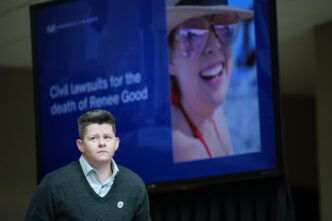
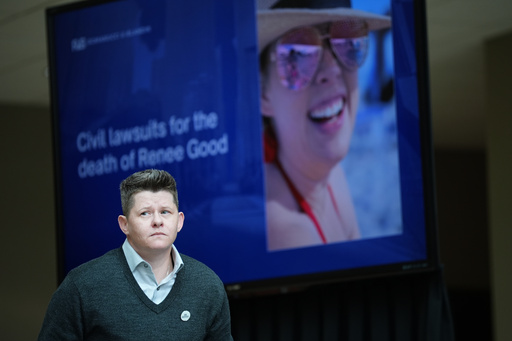
MINNEAPOLIS (AP) — Renee Good's family sued the U.S. government and the architects of President Donald Trump’s immigration crackdown Thursday, saying “the time is absolutely now for accountability” for her killing in January by a federal agent in Minneapolis.
Good’s partner, Becca Good, and her brother Brent Ganger on behalf of her larger family, accused the government and Jonathan Ross, the Immigration and Customs Enforcement officer who shot into her SUV and killed her, of unjustified and excessive use of force.
The Jan. 7 shooting, captured on bystander video, was “the predictable and intended product” of the Trump administration’s crackdown on Somali and other immigrants in Minnesota dubbed Operation Metro Surge, according to one of the two lawsuits.
“She was the love of my life,” Becca Good said at a news conference announcing the lawsuits. “I’m here today because last January, the whole world had to watch as our entire universe was destroyed — as the sunshine who was my amazing Renee was robbed from us, from her children, and from her community.”
The killings of Good, a 37-year-old mother of three, and another U.S. citizen, Alex Pretti, in Minneapolis just weeks later sparked outrage across the country and calls to rein in immigration enforcement. At least 10 people have died in encounters with immigration officers during Trump’s second term.
The crackdown, a pillar of Trump’s second term, has prompted a slew of lawsuits filed by everyone from Chicago-area pastors to more than a dozen states and the cities of Minneapolis and St. Paul. Hundreds of protesters have been arrested, but few have been convicted of any crimes.
“What happened to Rene was completely senseless,” Ganger said. “And the fact that there’s been no accountability, no investigation, no expression of condolence, no change in policy is completely mind blowing.”
The lawsuits — one against the government, the other against Ross and officials including White House Deputy Chief of Staff Stephen Miller, ex-Homeland Security Secretary Kristi Noem and White House border czar Tom Homan — seek unspecified damages for wrongful death, conspiracy and other violations.
“Our government has become a grave and mortal threat to its own citizens,” the family’s lawyer, Antonio Romanucci, told reporters.
The Justice Department has not responded to an email seeking comment.
Renee Good was killed while driving with Becca on a street where masked federal immigration officers were conducting an enforcement operation. They had just dropped their six-year-old son at school. Renee stopped their red SUV in the street and honked her horn to warn people about the operation while Becca got out and started recording video with her cellphone.
Bystander video shows Renee Good in the driver’s seat, her car blocking part of the road, as she repeatedly honks the horn. Two immigration officers get out of a truck, their faces covered, and one orders Good to get out of the car. She reverses briefly, then turns the steering wheel as an officer again demands: “Get out of the car.”
Almost simultaneously, Becca Good, standing in the street, shouts: “Drive, baby, drive!”
The officer standing in front of the vehicle pulls his weapon and fires into the windshield. He lurches back as the car turns away from him. The officer, by then very close to the open window on the driver’s side, fires two more times, fatally shooting Renee Good, according to an analysis of the videos by The Associated Press and others.
Federal officials at the time said the officer acted in self-defense and that Good had engaged in “an act of domestic terrorism.”
Becca and Renee Good were not legally married, according to a family lawyer, but referred to one another as wives. They had only recently relocated to Minneapolis from Kansas City, Missouri.
“I don’t hate the people that took Renee from us,” Becca Good said.
“But what I want them to understand: Every single day they get to look at their children and their wives and their sisters and know what they took from our family. They took a mother away from her children. They know that. And they will carry it forever.”
The wrongful death lawsuit against the U.S. government seeks damages for “the immense suffering” Good endured in her final moments and her family's “profound and permanent" loss.
The other lawsuit, against Ross and top federal immigration officials, paints Operation Metro Surge as a conspiracy to trample the civil rights of immigrants, and accuses the administration of targeting Becca instead of thoroughly investigating Good’s killing.
The government sought to hide evidence of what happened, it said, and officials worried that pursuing a civil rights investigation would undermine Trump’s claims that Good had tried to kill an officer.
The operation, the conspiracy lawsuit said, was a “carefully planned, coordinated effort” to make Somali and Hispanic immigrants “the object of aggression and abduction.” The crackdown used intimidation, violence and the threat of arrest to intimidate neighbors and allies “who observed, documented and warned.”
Other defendants include: Corey Lewandowski, a Trump campaign manager who also served as one of Noem’s advisers; former acting director of U.S. Immigrations and Customs Enforcement Todd Lyons; former U.S. Border Patrol commander Gregory Bovino; and 10 unnamed federal agents.
The news conference announcing the lawsuits was held in the atrium of University of St. Thomas School of Law, and dozens of law students looked on as the family and lawyers spoke.
“The time is absolutely now for accountability for the deep damage done by ICE and others,” Ganger said. “We will not be quiet. We will not go away.”
Good's lawyers acknowledged the complexity of the cases, and legal scholars said they could be challenging to win.
“They’re going to face significant uphill battles,” said Rachel Moran, a professor at the University of St. Thomas law school. “These are both complicated types of lawsuits, and so I can’t predict how they will play out. But I’m sure the government will have many, many types of responses to why the lawsuits should not go forward.”
But she noted the conspiracy lawsuit, in particular, could reveal many unknown details about the crackdown, including the involvement of some of the country's top officials.
“Yes, ICE agents on the ground acted problematically, but that was at the behest, in many ways, of people very high up in the administration,” she said.
___
McCormack reported from Concord, New Hampshire.