

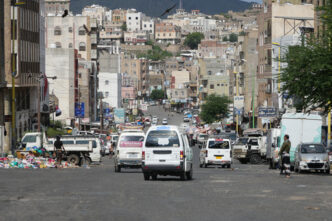
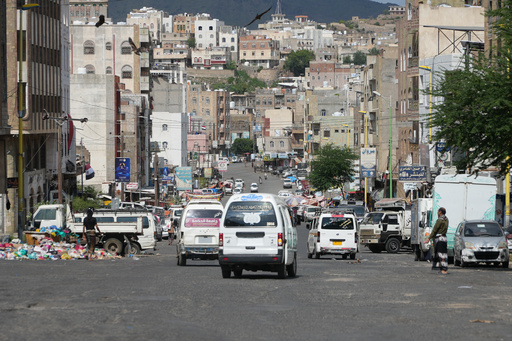
CAIRO (AP) — As word came of Houthi rebels advancing on Taiz, Weam Abdullah and her family decided it was time to leave Yemen’s third largest city. They had survived a yearslong siege by the rebels earlier in their country’s civil war, and they didn’t want to endure that again.
They made it out just in time. Shortly after Abdullah, her husband and two young children left, the rebels captured a key town on Oct. 4, largely encircling Taiz and cutting off most supply routes from government-held areas.
“We already feel dead, there was already despair” in the city, Abdullah told The Associated Press by phone from a province farther south. “We feel as if we are cursed. Everyone is conspiring against us even though we’re not affiliated with any party or politics.”
The Iran-backed Houthis are pushing to capture Taiz, a long-sought prize in Yemen’s 12-year civil war, as they also escalate attacks on Saudi Arabia, including a string of deadly strikes on the airport in the capital, Riyadh.
The assault follows a lightning offensive last month in which the rebels seized Yemen’s Red Sea coast, strengthening their ability to attack Saudi oil shipping and plunging global energy prices further into turmoil.
The advance has triggered fear among Taiz's more than 1 million residents, who live in the rugged mountains of southwestern Yemen. On a recent day, crowds mobbed groceries in the city center to buy up food and other essentials, fearing they will soon run out. Diesel fuel and cooking gas supplies are running low, residents said.
Some residents are collecting cardboard and wood to burn for cooking, while merchants are raising food and water prices, said Shaif al-Gabiri, a child protection consultant at the Civic Center for Advocacy and Support, a local nonprofit group.
“If the siege continues, then these stocks will run out,” he said.
Explosions from fighting between Houthis and pro-government forces echo from the surrounding mountains. Some strikes have hit the city itself, reminding residents of an ordeal they hoped might be over.
Taiz has been on the front line of Yemen’s civil war since 2014 when Houthi rebels seized the north and much of the country’s west, including the capital, Sanaa. Saudi Arabia later entered the war at the head of a coalition backing the internationally recognized government, which had been forced to flee south.
A strategic gateway to the south, Taiz is also one of Yemen’s most important historical and cultural centers. It once served as the capital of several Islamic dynasties and a major center of religious learning. Al-Qahira Castle, a monumental fortress more than 800 years old, overlooks the city from a hill. To the south rises Mount Sabir, more than 3,000 meters (9,800 feet) high, its slopes carved into agricultural terraces.
For much of the war, Houthi forces surrounded most of Taiz and blocked its main roads. Bombardments regularly struck the city center, power cuts were frequent, and residents struggled to find food. The only routes to government-held areas were steep, winding mountain back roads. Bringing in supplies or getting people to hospitals in the southern port city of Aden took hours.
Taiz was “a jungle” at the time, Abdullah said. If people didn’t die “from artillery, then they would die from the siege, malnourished because of lack of food,” she said. After nightfall, “many streets were deserted and looked scary.”
A truce reached in 2022 eased fighting across Yemen and brought some life back to Taiz. Many who had fled returned, and homes were rebuilt. But prices remained high, and residents struggled to get by, Abdullah said. Houthi forces still controlled areas north, east and west of the city and charged “customs” duties on supplies passing through.
The truce ended in August when the Houthis launched a new assault. Last month, they seized the Red Sea coast, capturing the port city of Mocha and several strategic islands. They then began advancing around Taiz.
Abdullah said her family feared a new siege would be worse than the last. Her children were afraid to go outside to play.
“This is why we left,” she said. “The situation was terrible, you couldn’t get essentials, and there’s a shortage in everything … There is no diesel to work water pumps.”
As they fled Taiz, they saw government reinforcements heading toward the city and heard explosions and gunfire, she said. They passed through Turbah, about 40 kilometers (25 miles) south of Taiz, before reaching the government-controlled province of Lahj.
Days later, the Houthis captured Turbah, encircling Taiz and a pocket of government-held territory.
As well as the main roads out of Taiz, some of the alternative mountain routes used in the past are now closed, causing “some confusion and panic,” according to Abdelrahman al-Qaliaa, director of the Taiz branch of the Industry and Trade Ministry. He urged residents crowding stores to only buy what they immediately needed to prevent shortages.
Pro-government forces are fighting Houthis in the mountains southwest of Taiz, trying to break the rebels’ hold.
Ahmed Abdel-Jaber said shelling near his house in a mountain village wounded his 7-year-old grandson in his stomach. The boy was taken to a hospital in Taiz.
Abdel-Jaber moved his family of nine to another village farther from the fighting. “If we decide it’s unsafe there, we’ll flee to another area,” he told the AP by phone.
Growing numbers of government soldiers, women and children wounded in the fighting have been brought to hospitals in Taiz.
“Hospitals could run out of diesel at any point,” said Dr. Fahd Nazary of the Taiz provincial health office. Delivering medical supplies has also become more difficult, he said. “This is a huge catastrophe.”
Al-Gabiri, the child protection consultant in Taiz, described fears that the fighting could worsen.
“Here I am sitting in a coffee shop,” al-Gabiri said, “knowing that at any moment a shell could fall on me or an explosive could come from any direction, hitting any house and any street.”
———
Associated Press freelancer Marzouk Al-Jaberi in Taiz contributed to this report.