

By Paris Rain, Fox23.com News Staff
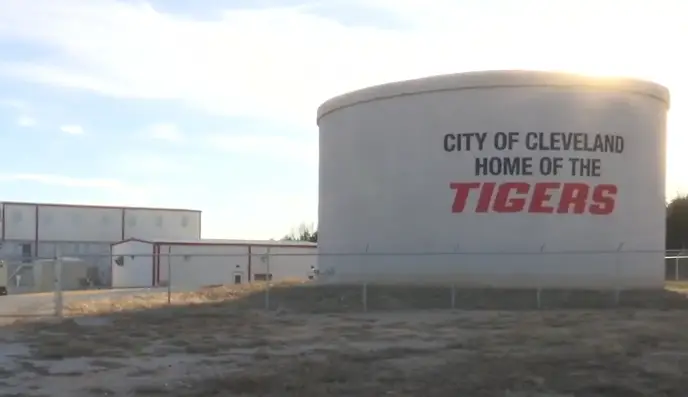
CLEVELAND, Okla. — Trihalomethanes, a chemical byproduct found in drinking water, are not added directly by cities. Instead, they form during the water disinfection process — something nearly every municipality uses to keep drinking water safe.
FOX23 received an email from a viewer who lives in Cleveland after they received a letter from the city warning about elevated levels of Total Trihalomethanes, also known as TTHMs.

The viewer said they were concerned and unsure whether the city’s water was safe to drink.
According to Cleveland City Manager Mike Vaughn, the city has been dealing with elevated levels of TTHMs for years.
“So [in] 2005, they were high. [In] 2015, they were higher. In 2022, they were higher,” said Vaughn. “But back in 2017, DEQ gave a consent order to the City of Cleveland to build a new water plant.”
Vaughn said construction on the new water treatment facility began in 2021 and the plant became operational in the fall of 2023. He said the upgrade has helped reduce several water quality concerns, including total organic compounds and turbidity — both of which are now below legal limits.
However, Vaughn said TTH levels are still above what the state allows.
“When it comes to the TTHMs that we’re talking about here with the trihalomethanes, we’re still over that,” said Vaughn.
He acknowledged that the letters sent to residents can be alarming, especially for those new to the area.
“If I was new to town and I wasn’t aware of all the things that had gone on with it and all of the DEQ standards, it would be a concern,” said Vaughn. “I want them to know that our first and foremost thing is the safety of our citizens.”
FOX23 reached out to the Oklahoma Department of Environmental Quality, which confirmed Cleveland is currently under a consent order.
“Cleveland is currently under a Consent Order with DEQ to address Disinfection Byproduct Rule violations,” the agency said in a statement. “Total trihalomethanes are disinfected byproducts. The agency notified Cleveland that an emergency report to address the ongoing violations is needed.”
FOX23 also contacted Cleveland’s Public Works Department to better understand the potential health impacts of elevated trihalomethanes and whether the water is safe to drink.
In a response, the department cited language included in the consumer notice set to residents, which states, “Some people who drink the water containing excess TTHMs over many years may experience problems with liver, kidneys, or nervous system and may have an increased risk of getting cancer.”
When asked what they want the people of Cleveland who may have concerns to understand about the recent increased levels, the Public Works Department said, “The levels have not increased, as they are actually lower. A new water plant was built and started up in late 2023 to help with turbidity, TOCs and TTHMs. Both turbidity and TOCs have been corrected.”
“We are continuing to work with OKDEQ and engineers to get TTHMs under allowed levels. Our job is to continue improvements to the plant and distribution system to further improve water quality,” said Cleveland Public Works.
Vaughn said if the water were unsafe for immediate use, residents would be notified.
“If it was unsafe, certainly we would have let them know,” Vaughn said. “We wouldn’t want people drinking something that was wrong. The DEQ governs us. They are fully aware, and we have to report all of this.”
City officials said water is tested quarterly, and residents are notified anytime results exceed state limits in order to keep the public informed.
Vaughn said testing for TTHMs happens quarterly.
“Some things are daily, some things are quarterly,” said Vaughn. “So, the TTHMs that we’re talking about here, those are quarterly. So, any time we exceed that, we have to send out a letter. So that’s a rolling 12month average. When we send this letter out, that means that over the previous 12-month period, whether that’s January, December, or…February to February — whatever it is, it’s a quarterly thing that we have to send out.”
Vaughn said that it is the city’s responsibility to continue to improve the water.