


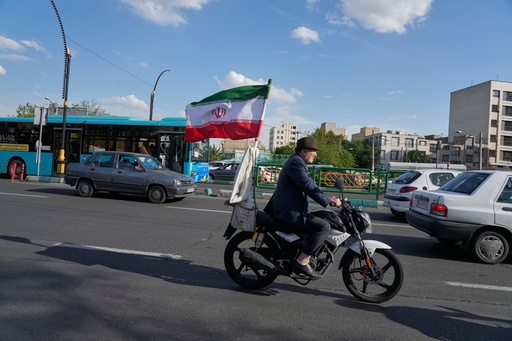
U.S. President Donald Trump said the United States was indefinitely extending its ceasefire with Iran as a new round of peace talks was on hold.
Pakistan had planned to host a second round of talks, but the White House suspended Vice President JD Vance’s planned trip to Islamabad as Iran rebuffed efforts to restart negotiations. Iran acknowledged the ceasefire extension but didn't say Tehran was ready to attend a new round of talks to end the war, state television reported Wednesday.
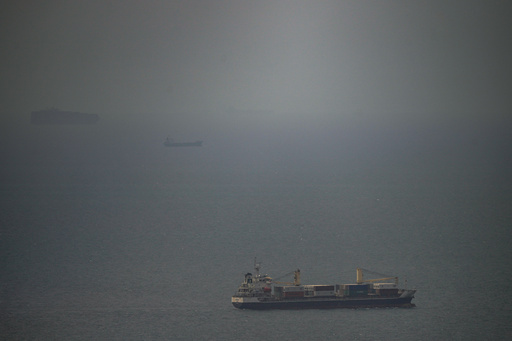
Meanwhile, Iran’s semiofficial news agencies are reporting that the paramilitary Revolutionary Guard has attacked a third ship on Wednesday in the Strait of Hormuz, throwing into question efforts to end the war. Nour News, Fars and Mehr all reported the attack by the Guard on a vessel called the Euphoria. They said the vessel had become “stranded” on the Iranian coast, without elaborating. The Guard has seized the other two ships that were attacked, Iranian state television separately reported.
Here is the latest:
The U.S. military’s Central Command said Thursday its forces in the Mideast had “directed 31 vessels to turn around or return to port as part of the U.S. blockade against Iran.”
The Central American nation’s foreign ministry wrote in a statement that the boat, owned by the Italian company MSC Francesca, was “forcibly taken” into Iranian waters on Wednesday, and it accused Iran of violating international law. It wasn’t immediately clear if the boat remained in Iranian custody.
The seizure “represents a serious attack on maritime security and constitutes an unnecessary escalation,” it wrote.
Panama has one of the largest ship registries, with around 16% of the world’s ships flying under the country’s flag, according to 2024 data from Panamanian authorities.
The Pentagon told lawmakers this week it will likely take six months to clear the mines set in the strait, according to a person familiar with the situation who was granted anonymity to discuss the sensitive information.
Officials from the Department of Defense delivered the information during a classified briefing at the House Armed Services Committee on Tuesday.
The session left more questions than answers as lawmakers probed for information about the cost of the war against Iran, the strategy and objectives, the person said. The lawmakers also raised questions that have still gone unanswered about the strike on a school compound during the early days of the war.
___
— By Lisa Mascaro
The U.S. Senate rejected the resolution 46-51 on Wednesday as Republicans in Congress have largely backed Trump’s military efforts.
It was the fifth time this year that the Senate voted to cede its war powers to the president in a conflict that Democrats say is illegal and unjustified. The resolution would require the U.S. to withdraw forces from the conflict until Congress authorizes further action.
“The longer Trump waits to extricate the U.S. from this war, the deeper the hole gets and the harder it will be for him to get out,” said Senate Democratic Leader Chuck Schumer.
Republicans have been reluctant to criticize Trump or the war, even as they say they want it to end quickly.
Senate Majority Leader John Thune said Tuesday that most Republicans believe “that the president is correct in making sure Iran can’t threaten the world with a nuclear weapon.”
At least five people, including three children, were killed by an Israeli strike in Gaza on Wednesday night, according to Shifa hospital, where the bodies were taken.
Local health authorities said the group of people was targeted by a drone while they were in a street in Beit Lahiya, in the northern part of the Gaza Strip.
The Israeli military did not immediately respond to a request for comment.
Israeli attacks have killed more than 780 people since the fragile ceasefire between Hamas and Israel was put in place six months ago, according to Gaza’s Health Ministry. The ministry, part of the Hamas-led government, maintains detailed casualty records that are seen as generally reliable by U.N. agencies and independent experts. It does not distinguish between civilian and militant deaths.
Overall, the health ministry says 72,300 Palestinians have been killed since the war in Gaza began with the Oct. 7, 2023, Hamas-led attack on Israel.
The U.S. stock market rallied to more records Wednesday after GE Vernova, Boston Scientific and other big companies joined the parade, reporting fatter profits for the start of the year than analysts expected. But caution still hung over Wall Street, and oil prices rose on uncertainty about what would happen in the war with Iran.
The S&P 500 jumped 1% and topped its prior all-time high set on Friday. The Dow Jones Industrial Average added 340 points, or 0.7%, and the Nasdaq composite set its own record after jumping 1.6%.
Strong performances have helped the S&P 500 power higher, and the index recorded its 13th gain in its last 16 days.
Still, another rise in oil prices helped keep enthusiasm in check on Wall Street. The price for a barrel of Brent crude oil, the international standard, climbed 3.5% to $101.91.
The body of a Lebanese journalist killed in an Israeli airstrike on southern Lebanon on Wednesday has been pulled from under the rubble hours after the attack.
The daily Al-Akhbar newspaper confirmed that its reporter, Amal Khalil, was killed in the strike on the southern village of al-Tiri.
Information Minister Paul Morcos also confirmed Khalil’s death.
Khalil had been covering the Israel-Hezbollah war since it started in October 2023 and had been reporting from different parts of southern Lebanon on the hostilities.
Earlier on Wednesday, Reporters Without Borders, or RSF, called on the international community to immediately pressure the Israeli army to allow the rescue of Khalil.
However, it was unclear whether it would ultimately take part.
“The Ministry of Youth and Sports made an announcement about the full preparedness of our national soccer team for presence in the 2026 World Cup in the U.S., by the order of the minister,” Iranian government spokesperson Fatemeh Mohejerani told Iran’s state TV on Wednesday.
“They informed that the necessary arrangements that these dear ones need for the team’s proud and successful participation, (have been made),” Mohejerani added.
The tournament is scheduled to be held in the United States, Canada and Mexico this summer.
Press secretary Karoline Leavitt told reporters that Trump hasn’t set a deadline for receiving a proposal from the Iranians.
“Ultimately, the timeline would be dictated by the commander in chief,” she said.
Trump announced a ceasefire extension on Tuesday.
Iran taking control of two ships is not a violation of the truce terms because “these were not U.S. or Israeli ships, these were two international vessels,” White House press secretary Karoline Leavitt told Fox News Channel.
She said Iran’s navy has been decimated and that the ships in question “were taken by speedy gun boats,” meaning that Iran is acting “like a bunch of pirates.”
Leavitt said Trump’s blockade remains in place “on ships coming to and from Iranian ports” and that the seizure by Iranian forces “is piracy that we are seeing on display.”
The group added in a statement that the two attacks targeting soldiers and vehicles in the village of Qantara on Wednesday evening were in retaliation for alleged Israeli violations of the 10-day ceasefire that took effect Friday.
The strikes marked the group’s third attack on Wednesday. Israel did not immediately comment on the latest attacks but has previously accused Hezbollah of breaching the ceasefire.
The ministry said two Israeli strikes on al-Tiri in southern Lebanon killed two people. The journalist Amal Khalil and her colleague took cover in a house, which the ministry said was targeted in the second strike. When rescuers arrived, they were able to recover the two bodies and one injured journalist. But the Israeli military fired live ammunition at the ambulance, preventing the team from completing the search for Khalil, the ministry said. Lebanon’s National News Agency showed pictures of the damage to the ambulance.
Khalil’s condition is not clear. She is a prominent journalist with the Lebanese daily Al-Akhbar.
Israel’s military alleged the individuals in the village violated the ceasefire, posing a risk to the troops’ safety. It denied that it prevented rescue teams from reaching the area or that it targets journalists.
“A complete ceasefire only makes sense if it is not violated by the maritime/naval blockade and taking the world’s economy hostage, and if the Zionist warmongering across all fronts is halted,” Iran’s parliamentary Speaker Mohammad Bagher Qalibaf said on Wednesday.
“Reopening the Strait of Hormuz is impossible with such flagrant breach of the ceasefire,” Qalibaf added. “The only way forward is to recognize the rights of the Iranian nation.”
Lebanese officials and Reporters Without Borders said a journalist was missing following an Israeli strike near the southern village of al-Tiri on Wednesday, while another journalist was wounded.
The Israeli military said it struck a vehicle and a structure in the area after identifying what it described as militants posing an immediate threat near the border.
The military said it was aware of reports that journalists were injured but did not confirm them and denied preventing rescue teams from reaching the area.
The details of the incident are under review, it added.
The president said he has been informed that four of the women will be “released immediately,” while four others will be sentenced to one month each in prison.
“I very much appreciate that Iran, and its leaders, respected my request … and terminated the planned execution,” Trump wrote on the Truth Social platform.
He said the women protesters were expected to be executed Wednesday.
Rights groups that monitor Iran had said two of the women were already released on bail in March, and two others were known to face charges that carry the death sentences. They had been arrested during the January anti-government protests.
Trump re-posted a photo of the women, including two teen girls, on Tuesday on social media, which a conservative activist noted are facing prosecution in Iran.
The Iranian judiciary responded promptly, denying that any of them were on the verge of execution, saying some were already released.
The ministry added that the Wednesday afternoon strike on the village of Yohmor also wounded two people.
Arsenio Dominguez, secretary-general of the International Maritime Organization, on Wednesday condemned attacks on shipping after Iran’s Revolutionary Guard fired on three ships in the Strait of Hormuz, seizing two and taking them to Iran. Earlier, Trump said the United States would continue to blockade Iranian ports.
“The attacks on and seizures of commercial ships are unacceptable,” Dominguez said, urging an immediate halt and the release of vessels and crews. He warned that the situation remains “extremely volatile” and questioned why companies risk seafarers’ lives.
Nearly 20,000 seafarers remain at sea after seven weeks, uncertain when they can return home, he added.
An analytics firm focusing on global energy and freight markets says it recorded 34 movements of sanctioned and Iranian-linked tankers in and out of the Persian Gulf in the week after the U.S. imposed a naval blockade of Iranian ports.
The firm, Vortexa, says it identified 19 outbound and 15 inbound movements of such vessels between April 13 and Monday.
Six of those outbound movements were “confirmed laden with Iranian crude, representing about 10.7 million barrels,” it said in an email to The Associated Press.
It was not immediately clear whether all those barrels reached markets overseas.
Reporters Without Borders, or RSF, called on the international community on Wednesday to immediately pressure the Israeli army into allowing the rescue of journalist Amal Khalil, who works for the daily Al-Akhbar.
RSF added that Khalil is currently trapped near the southern Lebanese village of al-Tiri following an Israeli airstrike close to her vehicle.
“Her life is in danger right now! Continued Israeli airstrikes are preventing rescuers from reaching her,” RSF said.
Lebanon’s President Joseph Aoun called on the Lebanese Red Cross to work on the rescue of Khalil, along with another journalist, Zeinab Faraj, who was with her.
Aoun requested the Lebanese Red Cross to coordinate with the Lebanese army and U.N. peacekeepers “to carry out the rescue operation in the shortest possible time.”
The management company of a container ship that was fired upon in the Strait of Hormuz early Wednesday says the Liberian-registered Epaminondas was “approached and fired upon by a manned gunboat” while transiting the strait about 20 nautical miles off the coast of Oman.
The Technomar company said all crew were “safe and accounted for” and no injuries were reported, but that preliminary inspections indicated the ship’s bridge had been damaged.
“Technomar remains in close contact with the crew and relevant authorities. Our priority remains the safety and well-being of our crew as we work with all relevant stakeholders to ensure their continued safety and investigate the incident,” the company said. It did not provide further details, but said more information would be released “when there are material developments.”
Sadri Haghshenas spends her days selling borek — a layered, savory pastry — at a shop in Istanbul, but her mind is on her daughter in Tehran.
The family had to send her home to Iran after they ran into difficulties renewing her visa, despite fears that a shaky ceasefire could soon collapse.
For years, short-term residency permits have allowed tens of thousands of Iranians to pursue economic opportunities and enjoy relative stability in neighboring Turkey. But it’s a precarious situation, and the war has raised the stakes.
“I swear, I cry every day,” Haghshenas said, raising her hands from behind the counter of the pastry shop. “There is no life in my country, there is no life here, what shall I do?”
Turkey hasn't seen an influx of refugees, as most Iranians have sought safety within their country. Many who've crossed the land border were transiting to other countries where they have citizenship or residency.
The strike targeted a vehicle in the town of Tayri on Wednesday, according to Lebanon’s state-run National News Agency.
No further details on the identities of the victims were immediately available.
The Israeli military did not immediately comment on the attack.
The strike comes despite a 10-day ceasefire that went into effect Friday. Since then, several Israeli strikes have been reported, while Hezbollah has claimed a couple of attacks since Tuesday.
On Saturday, a U.N. peacekeeping force in southern Lebanon came under attack with small arms fire leaving one French peacekeeper dead and three others wounded, two of them seriously.
French President Emmanuel Macron posted on X that a wounded soldier, who was repatriated Tuesday from Lebanon “where he had been seriously wounded by Hezbollah fighters, died this morning from his injuries.”
Hezbollah had denied is was behind the attack.
“We entered the negotiations in good faith and with seriousness, but the negotiating party (the United States) has shown disregard and lack of good faith,” Iran’s foreign ministry spokesperson, Esmaeil Baqaei, said Wednesday, according to Iran’s State TV.
A second round of negotiations, expected in Pakistan’s capital later this week, has not yet been confirmed. On Tuesday, President Trump extended a ceasefire with Iran indefinitely, leaving the next steps for resuming talks unclear.
“Iran has not yet decided whether it will participate in the new round of peace negotiations with the United States scheduled for later this week,” Baqaei said.
GE Vernova, Boston Scientific and Boeing are leading the U.S. stock market toward another record after joining the list of companies reporting fatter profits for the start of the year than analysts expected.
But caution is still hanging over Wall Street on Wednesday, and oil prices are also rising on uncertainty about what will happen in the war with Iran.
The S&P 500 climbed 0.7% and was on track to top its all-time high set Friday. The Dow Jones Industrial Average added 360 points and the Nasdaq composite gained 0.9%. The price for a barrel of Brent crude oil briefly topped $100.
Talking about the repercussions of the Iran war, the head of the International Energy Agency said Wednesday that “we are facing the biggest energy crisis in the history.”
IEA Executive Director Fatih Birol said at the Petersberg Climate Dialogue in Berlin that what ”we lost in the this war is much bigger than all the crises put together in terms of oil and gas. Plus, plus, there are vital commodities that we are losing — petrochemicals, fertilizers, helium, sulfur.”
However, Birol also pointed out that “there will be a major response to this crisis as well” and that “it is now the job of the governments to design their energy policies in terms of industrial sector, while keeping the competitiveness of the existing industries, preparing the next steps for the tomorrow’s industries.”
He said he also expects that “there will be a similar response in all parts of the economy, car manufacturing industry, electric industry and in the industry sector.”
“And this is a wonderful opportunity,” he added.
The Israeli military said it intercepted around 40 Israeli civilians that attempted to enter Syria on Wednesday afternoon. The military said the civilians gathered at the border and then were able to infiltrate several hundred meters into the Israeli-military controlled buffer zone in Syria before being returned to Israel and taken into police custody.
The Israeli media identified the infiltrators as part of the right-wing group “Pioneers of Bashan,” which calls for establishing Jewish settlements in Lebanon and Syria.