

For traditionalist Catholics who worship at churches affiliated with the breakaway Society of St. Pius X, Sunday Mass now comes with an extraordinary question.
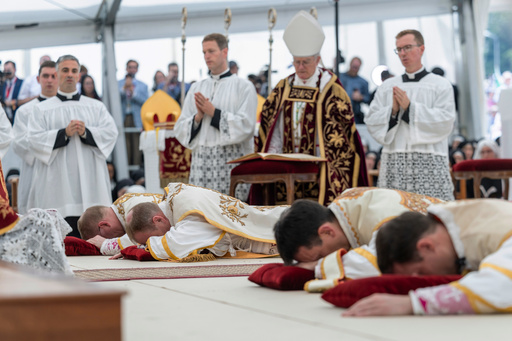
Their priests and bishops have been excommunicated after the fringe movement on the Catholic right committed what the Vatican considers one of the faith's gravest crimes: rupturing church unity by consecrating bishops without the pope’s consent. The Vatican says Catholics should stop going to the breakaway group's worship services and activities, and that some sacraments administered by the society's priests are illicit and invalid.
Yet inside the society's churches, normal life has largely carried on. Service in the old Latin Mass is still being celebrated, baptisms performed, camps and pilgrimages are moving forward, and some faithful say they have no intention of leaving.
The consecrations two weeks ago posed a crisis for Pope Leo XIV because of his emphasis on church unity. The American pope has especially reached out to the conservative and traditionalist wing of the church, which in many ways were alienated during the Pope Francis pontificate.
Several bishops in the U.S. are echoing the Holy See’s warning to the society’s faithful, urging them to switch to churches aligned with Rome.
“To embrace the unity called for by Christ is to remain attached to the vine and to be in communion with Pope Leo XIV and the hierarchy of the Catholic Church,” San Antonio Archbishop Gustavo García-Siller wrote to his archdiocese.
His instruction echoes the schism declaration and excommunication decree issued July 2 by the Vatican’s doctrine office against the Society of St. Pius X, also known as SSPX, which has about 750 priests.
Will Catholics heed that call? It largely depends on where worshippers feel most connected, said R. Andrew Chesnut, the Catholic Studies chair at Virginia Commonwealth University.
“Longtime SSPX adherents often regard such statements through the lens of a decades-long conflict with Church authorities,” he said, “and are therefore less likely to be persuaded.”
The society was founded in opposition to the modernizing reforms of the Second Vatican Council, which it considers rife with heresies and errors. The 1960s council revolutionized the church’s relations with Jews and other faiths, supported religious liberty for all, and allowed Mass to be celebrated in people's everyday languages, rather than Latin.
SSPX leaders see the society as a defiant guardian of church tradition, and they have defended its July 1 consecrations as necessary for saving souls. The society has also questioned the soundness of the Vatican's sanctions.
Chesnut said the response from society leaders was “remarkably consistent” with past flare-ups with Rome. Priests have been reassuring the faithful that there is no change in their mission to preserve traditional Catholic liturgy.
The society has appealed the Vatican decree, and U.S. district spokesperson James Vogel said it's too early to judge its effect. For now, Masses and other activities haven't stopped.
“I think a lot of people just continue to hold fast to what they’ve been doing,” he said.
That isn't surprising, said Mike Lewis, managing editor of Where Peter Is, a Catholic commentary website supporting popes Francis and Leo.
“We’re talking about communities that have essentially been separate for 30 to 40 years. People’s families and social lives are wrapped up in this movement,” he said.
Jim De Piante's ties to the Society of St. Pius X run deep. His parents helped bring the movement to North Carolina, and he belongs to St. Anthony of Padua, a society-affiliated church near Charlotte that bought land for a new campus the week after the excommunications.
If anything, the excommunications make him want to do “tradition even harder.”
“St. Anthony’s offers to me the traditional sacraments in the same faith that made every great saint throughout history,” De Piante said. He feels it's his responsibility to preserve that faith for future generations.
While he's not worried, De Piante knows others are, especially newer participants, and he has been offering guidance to SSPX faithful in his orbit. He's noticed a small drop in attendance at St. Anthony's, which draws a few hundred people to Sunday services, and knows families who are rattled and some who don't plan to return. De Piante attended the new bishops' consecrations in Switzerland, and says he remains optimistic about the society's future.
When the Society of St. Pius X consecrated those bishops, the Vatican considered it a schismatic act, a disruption to church unity that resulted in the excommunication of SSPX bishops and priests. The society's faithful were also warned that they, too, would face the church's harshest sanctions if they “formally adhere” to the group.
Excommunication is a “medicinal” sanction or censure that can be lifted. Excommunicated people are not kicked out of the church but are barred from certain church activities.
Bishops such as Frank J. Caggiano of the Diocese of Bridgeport, Connecticut, are inviting the society's churchgoers to come “home.” In a letter to his diocese, he noted that excommunication doesn't apply to people who accept the pope's authority and attended SSPX churches simply to worship.
Still, going against the pope is no small transgression. Staying loyal to the society “would be to share in a separation from the Successor of Peter,” Caggiano warned.
Ross McKnight is wrestling with what to do next.
Drawn to the society during the COVID-19 pandemic, he and his family enjoy the supportive, traditionalist community of a nearby SSPX church in Lacombe, Louisiana. He thinks a fair amount of people are, like him, having a “crisis of conscience.”
“We don’t want to abandon them in their dark hour,” he said. “At the same time, that’s not our first duty. The first duty isn't to any particular person and/or group of priests. So I think that's the source of the conflict.”
García-Siller, the archbishop in Texas, has instructed Catholics not to attend the society's local affiliate, and said he would no longer allow SSPX priests to preside at weddings or to minister in the archdiocese.
But livestreamed worship services show church life carries on at St. Joseph’s, as it does at other society churches.
During Mass on the first Sunday after the excommunications, the Rev. Stephen Zigrang ticked through more mundane announcements — building maintenance, a special collection, a baptism — before reassuring the congregation that there was no need to change course.
“The problem is, of course, family, friends,” said Zigrang, who declined The Associated Press’ request for an interview. “They’ll look at us crooked. But just smile, right? Say, ‘We like the old Mass. … You ought to come and try it.’”
___
Associated Press writer Peter Smith contributed to this report.
___
Associated Press religion coverage receives support through the AP’s collaboration with The Conversation US, with funding from Lilly Endowment Inc. The AP is solely responsible for this content.