

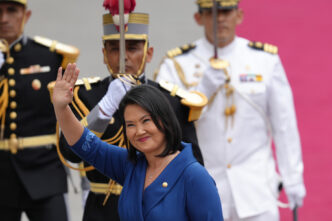
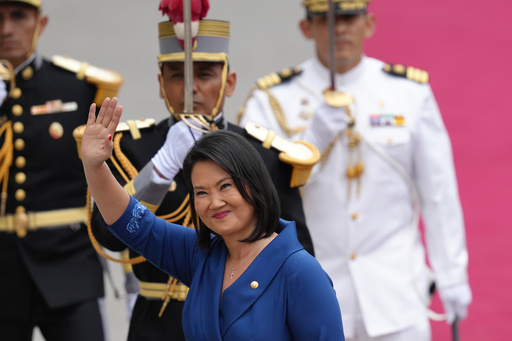
LIMA, Peru (AP) — Conservative leader Keiko Fujimori was sworn in as Peru’s president on Tuesday after winning the June presidential runoff by a margin of fewer than 50,000 votes, a victory that confirmed a regional shift in South America toward the conservative wing.
With the ceremony, Fujimori, a four-time presidential candidate and leader of Peru's largest political party, takes office as the country's ninth president in a decade. The 51-year-old is hoping to stabilize Peru's turbulent politics, reduce crime and boost economic growth.
Over the past decade, only three of Peru’s presidents have been elected by popular vote. The rest have come into office after their predecessors resigned or were removed by congress amid protests or corruption scandals.
Fujimori’s Popular Force party and its main ally, Popular Renovation, will hold half the senate seats once the new legislature is installed, making it harder for opposing legislators to attempt to remove her as president.
Fujimori centered her campaign around promises to improve security in a nation where extortion rackets have become a significant problem. She has also promised to develop infrastructure by making it easier for government agencies to form partnerships with private investors.
She is the daughter of former President Alberto Fujimori, who led the country in the 1990s and stabilized its economy while defeating terror groups, but was later imprisoned for human rights abuses committed under his rule by the Peruvian military as his government took an authoritarian turn. He was pardoned in December 2023 and died in September the following year.
During her campaign, Keiko Fujimori pledged to fight crime with an “iron fist,” implementing some policies adopted by Salvadorean President Nayib Bukele, and also build a megaprison modeled after the notorious Cecot penitentiary in El Salvador.
To guarantee judges their safety, she has said she will implement reforms to enable them to hide their identities as they oversee criminal trials.
She also said on Tuesday she would reorganize social services to fight malnutrition in rural communities and announced a 15% increase in the nation's minimum wage.
Fujimori said that the nation's military will “temporarily” lead security operations in crime afflicted areas. And she also said she will focus on preparing the South American nation for the latest onset of El Niño, a weather pattern that warms ocean temperatures and often leads to flooding along Peru's coast.
“My goal is not only to administer the state,” Fujimori said. “My main objective is to narrow the enormous social deficit that affects millions of Peruvians.”
Opposition leaders have asked Fujimori’s incoming government to reverse a series of laws approved by Peru’s last legislature, which critics say weaken efforts to fight organized crime.
The laws eliminate preventive arrests and stop prosecutors from processing political parties involved in corruption under the same statutes as criminal groups. The laws also make it harder for police to confiscate the goods of criminal groups.
Opposition leaders are also asking the incoming government to create a commission to investigate the deaths of 50 civilians during anti-government protests in late 2022 and early 2023 following the removal of former President Pedro Castillo.
During Fujimori’s swearing-in ceremony, some opposition lawmakers protested outside the parliament in Lima, Peru's capital, holding photos of people killed during the protests. Relatives of the dead have said they do not recognize Fujimori as president and that they are protesting her inauguration.
Fujimori was widely backed by voters in Peru’s capital and along the Pacific coast, but voters in the highlands, where there is a larger Indigenous population, overwhelmingly supported left-wing candidate Roberto Sanchez, an ally of Castillo.
Sanchez challenged the election results, arguing there were irregularities in how votes were counted at Peruvian consulates abroad, but electoral authorities dismissed his complaints.
Despite the political friction, Peru continues to be one of the most stable economies in Latin America. Its central bank has long kept the benchmark interest rate below 5%, and the government is known for a conservative approach toward public spending.
But critics point out a growing gap in living standards between coastal areas and communities in the Andean highlands.
Fujimori's June election victory, along with those of Abelardo de la Espriella in Colombia and José Antonio Kast in Chile, underscored South America's shift toward the conservative wing, a stark contrast from the panorama of a few decades ago when left-wing leaders such as Hugo Chávez in Venezuela or the current Brazilian president Luiz Inácio Lula da Silva emerged.
Conservatives have won seven major presidential elections in Latin America in the past few years, most of them since the January 2025 inauguration of U.S. President Donald Trump, in a winning streak propelled by concerns over crime, immigration and slow economic growth.