



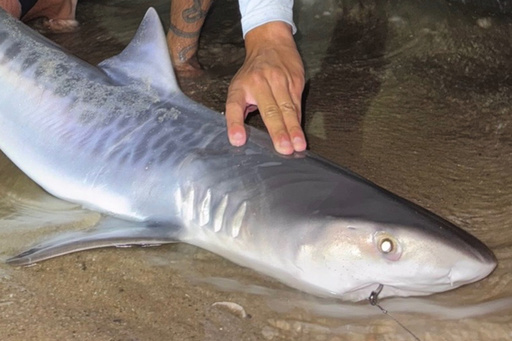
Nate Rouette and his brother Nelson went shark fishing on Cape Cod hoping for an exciting catch, but were shocked by what they reeled in — a tropical species of shark with a reputation for eating everything it can swallow.
The brothers, longtime sport fishermen who live in Massachusetts, released a juvenile tiger shark in late July after catching it from a beach. The five-foot shark is far more common in warmer, southern waters such as the Caribbean Sea, and scientists said its appearance off Falmouth, Massachusetts, is an indicator of warming seas caused by climate change.
Nate and Nelson said the late-night catch was a thrill after hours of seeking far more common brown sharks.
“And I saw those horizontal lines, indicating it was a tiger shark, which was super cool,” said Nate, who is the social media manager for On The Water magazine. “Immediately I started yelling to my brother, ‘It’s a tiger, it's a tiger shark!' And he was in disbelief.”
The Rouette brothers caught a young specimen of a shark that can grow to more than 15 feet (4.6 meters) and 1,400 pounds (635 kilograms). Tiger sharks eat a wide array of other ocean life, including fish, crustaceans and birds, and are famous for sometimes eating man-made items such as old license plates and shoes that are later found in their stomachs. The adults are also more dangerous to humans than most shark species, though unprovoked fatal bites are rare.
Juvenile tiger sharks have been spotted more often in northern waters in recent years, said John Chisholm, adjunct scientist at the New England Aquarium’s Anderson Cabot Center for Ocean Life in Boston. Rising temperatures of global seas appear to have made the Atlantic Ocean off New England more hospitable to them, he said.
Young tiger sharks are historically less common than adults in northern waters, which makes the brothers' discovery even more surprising, Chisholm said.
“Maybe they are coming up here because conditions are right. There's food, there's warm waters,” he said. “Maybe it's becoming a nursery — that's one of the issues that we will investigate.”
Tiger sharks are among many kinds of sea life that have been trending north in recent years as seas have warmed, and other sharks have done the same, scientists have said. Sightings of great whites off Cape Cod have been increasingly frequent, and the big sharks have also been seen off of New Hampshire and Maine. Scientists have attributed the shift in great white sightings to factors including a higher abundance of seals, which the great whites prey on.
Other sea animals, including black sea bass, appear to be moving north because of the warming of the ocean.
For the Rouette brothers, the encounter with a tiger shark provided a thrill they won't forget. Nate said the discovery was a reminder of that warming.
“People are definitely seeing more species that indicate that,” Nate said.