

BUENOS AIRES, Argentina (AP) — Pope Leo XIV will wrap up his visit to Argentina with two poignant moments on Wednesday — a meeting with inmates at a prison with a history linked to the country’s military dictatorship, and a final Mass at Argentina’s national shrine.
Both sites have important sentimental connections to Leo’s predecessor, Pope Francis. But Leo's final Argentine stops will pale in comparison to the emotional highlight of his South American trip, when he returns home later Wednesday to Peru.
A massive national party is planned to greet Leo, who spent more than two decades as a missionary priest and bishop in Peru and holds dual citizenship in the United States and Peru. He's known to Peruvians as Padre Robert and beloved for ministering to poor communities, especially in times of crisis.
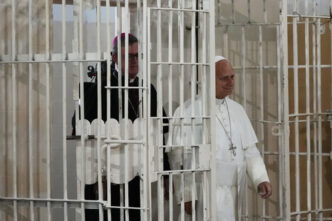
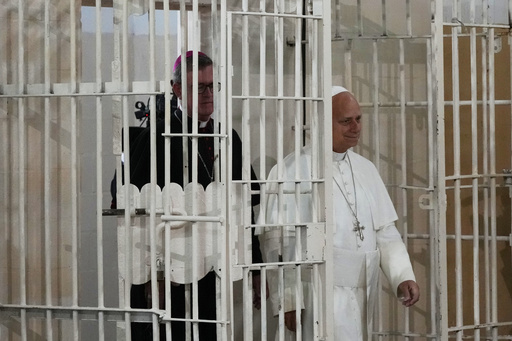
In Buenos Aires, Leo visited Devoto Prison, where Francis often ministered as the city’s archbishop, celebrating Mass, going into cellblocks housing inmates with AIDS and washing prisoners’ feet during the annual Holy Week ritual.
The prison, inaugurated in 1927, is undergoing its definitive closure and transfer of its more than 1,000 inmates to a new penitentiary complex. Only about 75 prisoners were on hand for Leo’s visit, chosen primarily because they were active in the prison’s religious programming, said the prison chaplain, the Rev. Matías De Martini.
Wearing identical white uniforms, they sat in rows in the prison gymnasium, facing a stage bearing the flags of Argentina and the Holy See, and a statue of the Virgin of Luján, which Francis had gifted to the prison during his years as archbishop.
“When he was a pope he sometimes used to say ‘Whenever I go to prisons I always think why them and not me,’” recalled the prison chaplain, the Rev. Matias de Martini. “This is what he always used to say here.”
“Everything he recounted as pope is what he experienced in this prison,” he said.
The prison is grim and shows its age. Its corridors were dank, and harsh fluorescent light glinted off the worn bars dividing each wing. Red fire extinguishers lined the main hallway, and guards stood at attention, some holding plastic riot shields.
During the last military dictatorship (1976–1983), it functioned as a clandestine detention and torture center and was designated as a Memory Site in 2012, to ensure the military repression isn't forgotten.
Human rights activist lawyers have petitioned the courts to prevent any decision involving the sale or disposal of the prison’s land and facilities once all inmates are transferred, saying “the space must be preserved until the investigations regarding the crimes against humanity that occurred” there are finalized.
In 1978, during Argentina’s military dictatorship, 65 inmates held on ordinary criminal charges were killed at Devoto in what became known as the Seventh Pavilion Massacre. The military government described the killings as a riot and covered them up. Decades later, Argentine courts ruled that the deaths were an act of state violence.
Nearly a half-century later, in December 2025, a federal court found that 153 inmates had been tortured, including the 65 who died in a fire that broke out as guards violently cracked down on the prisoners, and called the events grave human rights violations. It sentenced two former prison chiefs, Juan Carlos Ruiz and Horacio Martín Galíndez, to 25 years in prison. Both men were over 90.
Leo has carried on Francis’ practice of meeting inmates on his foreign trips, reminding them that they aren't alone and remain beloved children of God. Leo's last such visit, to a prison in Equatorial Guinea, produced some of the most chilling moments of his pontificate, when inmates were forced to sing and dance for him in pouring rain.
After the prison visit, Leo will make a pilgrimage to the Basilica de Nuestra Señora de Luján, dedicated to Argentina’s patron saint.
The municipality of Luján, about 72 kilometers (45 miles) northwest of Buenos Aires, urged pilgrims to arrive days in advance because of the sheer scale of the event and the extensive security and logistical deployment.
The basilica hosts one of the greatest demonstrations of faith and religious devotion in Argentina. Each October, hundreds of thousands of pilgrims walk there from Buenos Aires and other nearby towns to give thanks or make requests to the Virgin of Luján, to whom Francis was particularly devoted.
This year’s pilgrimage took place under persistent rain. And yet more than 2.8 million people took part, a record for the shrine, municipal authorities said.
During the Mass in Luján, the bread and wine will be carried to the altar by community volunteers, among them Sara Ramírez, who works with young people in a poor neighborhood in Santa Fe province where she said hundreds of families lack drinking water.
“With these hands that I use to show my brothers and sisters that it’s possible to get ahead, I'll bring the offerings to the pope,” she said.
___
Associated Press religion coverage receives support through the AP’s collaboration with The Conversation US, with funding from Lilly Endowment Inc. The AP is solely responsible for this content.