

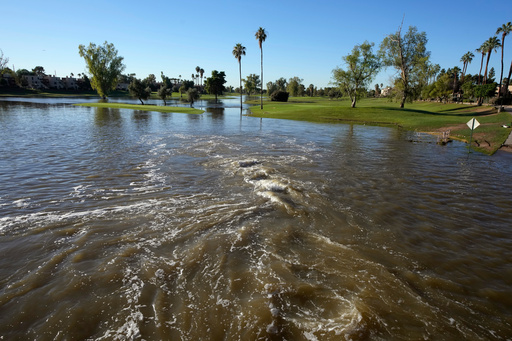
A massive amount of water from unusually heavy rain was flowing through flood-weary parts of the Southwest on Monday, forcing hundreds of evacuations and keeping swift-water rescue teams busy.
One person died in the flooding, and police suspect a second death also is weather-related. The National Weather Service estimated as much as 4 inches (10 centimeters) of rain could fall through Monday across the Four Corners region — where New Mexico, Arizona, Colorado and Utah meet — as the phenomenon fueled by the warming Pacific known as El Niño disrupts weather patterns.
Over 20 trillion gallons of water has fallen on the Four Corners states and Nevada in the past two weeks, according to calculations by former National Oceanic and Atmospheric Administration chief scientist Ryan Maue.
Officials had warned of “potentially catastrophic” flooding in Pagosa Springs, Colorado, a town of about 2,000 that was nearly wiped out when the San Juan River crested at approximately 17.8 feet (5.4 meters) in 1911. Readings late Sunday night showed the river reached 16.81 feet (5.1 meters) this time, flooding downtown streets, before receding Monday, the weather service said.
Alternative voting plans were arranged for evacuated or marooned Pagosa Springs residents by the Colorado Secretary of State's office. Other elections officials had urged voters to cast their ballots before the storms hit.
People had to leave their homes along the Animas River in southwestern Colorado, where Durango police Chief Brice Current said authorities were checking Monday on residents who rode out the flooding at home.
"There's still a lot of people stranded,” Current said.
The Animas River was closed to kayaks and other recreational watercraft, and Current warned that sewage and chemicals in the water could make people sick. Riverside trails and foot bridges were also closed, he said.
Evacuations also were ordered along the San Juan River in New Mexico and on the Navajo Nation. The Utah Navajo Health System posted about highway closures and detours. The village of Chama in New Mexico was evacuated and cut off by road closures. Farther south, the rising Jemez River made campgrounds and fishing sites inaccessible.
Record rainfall was reported across Arizona, including an eye-popping 7.3 inches (18.5 cm) over two days at Workman Creek, in a wilderness area near Phoenix.
Flagstaff's two-day total of 5.15 inches (13 cm) contributed to its wettest Nov. 1 ever recorded. The city typically has less than a handful of days per year where rainfall tops an inch, said meteorologist Jennifer Tate with the NWS Weather Prediction Center.
“What really stood out to me was that this wasn’t localized. It was a very broad system that brought a lot of rain to a lot of places,” Tate said Monday.
A man was seen falling into fast-moving floodwaters that went into a drainage tunnel in Flagstaff, where rain fell nearly nonstop Sunday. Police said the body of Williams Singavarapu, 73, of New York, was found Monday about 12 hours later, about 15 blocks from where he vanished in the flood.
Flagstaff police said a second man, whose identity hasn’t been released, also was found dead Monday in a drainage area, and that it appeared to be weather-related, pending an official cause and manner of death.
In Sedona, officials ordered residents near Oak Creek to leave Sunday as floodwaters trapped multiple people in their homes. The heavy rain washed out part of a main highway between Flagstaff and Sedona, mangling guard rails and littering the road with boulders and trees.
Swiftwater rescues also were happening in Tucson, where weather service meteorologist Aaron Hardin said “we are getting two or three months of rain in a span of a couple of days.”
And manhole covers were popping up in the Pinetop-Lakeside area of central Arizona, where residents reported sewage backing up into homes because of flooding, the region’s sanitary district announced.
Ryan Benally spent the weekend building dirt berms to divert floodwaters from his parents’ home on the Navajo Nation near Montezuma Creek, Utah. So far, the barriers have held, but parts of their small cattle ranch are under water.
Benally said his parents, both in their 60s, have lived in the area all their lives and have never seen flooding this severe.
“These storms have been one after another after another,” Benally said Monday. “It’s compounding in ways people out here just weren’t prepared for.”
A professor at Utah State University, Benally has been coordinating efforts to deliver bottled water, waterproof boots, toiletries and other supplies to shelters. As for the families who stayed at home, they're increasingly difficult to reach, he said: Emergency routes built to help remote residents access roads have washed out, leaving some effectively landlocked.
Residents of Pagosa Springs who received a ballot by mail can get a replacement at any vote center across the state, the secretary of state's office said.
Voters who cast in-person ballots outside their home county can vote for only statewide races, but mail ballots can be returned to any drop box or vote center in Colorado by 7 p.m. on Election Day, the office said.
Pagosa Springs had just lifted an evacuation order from previous flooding last week, only to reimpose it Saturday.
Katie German, owner and chef of Bruin Coffee in Pagosa Springs, said Sunday that downtown was evacuated as the streets flooded.
“I’m worried about my business, worried about my employees, definitely worried for everybody in this town,” German said.
___
Weber reported from Los Angeles and Bynum from Savannah, Georgia. Contributing were Associated Press journalists Kathy McCormack in Concord, New Hampshire; Sarah Raza in Sioux Falls, South Dakota; and Savannah Peters in Santa Fe, New Mexico.