

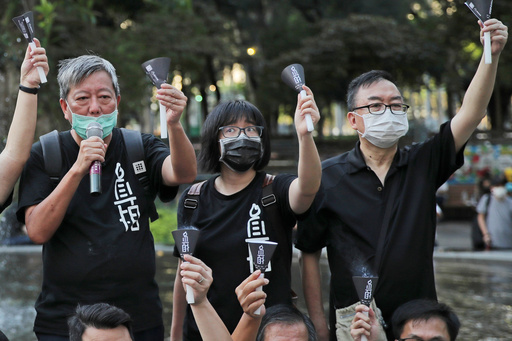
HONG KONG (AP) — Two former organizers of Hong Kong’s annual vigils in remembrance of the 1989 Tiananmen Square crackdown were convicted Friday for what the government-approved judges ruled was inciting others to overthrow China’s communist leadership.
Lee Cheuk-yan and Chow Hang-tung, former leaders of the Hong Kong Alliance in Support of Patriotic Democratic Movements of China, were charged in 2021 with inciting subversion under a China-imposed national security law that has effectively crushed the city’s previously thriving pro-democracy movement. They face a maximum prison term of 10 years. The alliance was also found guilty.
The three judges ruled that the alliance’s call to “end one-party dictatorship” aimed to end the ruling Communist Party’s leadership status under the constitution, and that the “end” in the phrase carried the meaning of “overthrowing” and “undermining.”
In the verdict, they wrote that the defendants persisted in the call after the law's introduction, neglecting that it was in breach of the constitution, which states the party's leadership is a defining feature of socialism with Chinese characteristics. That falls within “other unlawful means” under the security law, the judges said.
The defendants “intentionally encouraged supporters of the alliance to wait for the right time to carry out the goal to ‘end one-party dictatorship’ by unlawful means,” they said.
“They did not genuinely believe their words and deeds had not violated the national security law. They just refused to pull back from the brink,” wrote the judges, who insisted they weren't tried because of political views.
Lee and Chow smiled and waved at the public gallery before they left the courtroom. They are expected to be sentenced at a later date. They will plead for lesser sentences next week, one of the judges said.
The verdict is among the latest involving Hong Kong’s once-vibrant pro-democracy movement, which has largely been dismantled after the security law's introduction in 2020.
For decades, Hong Kong’s annual candlelight vigil was the only large-scale public commemoration of the Tiananmen crackdown in China, drawing tens of thousands of people annually. The crackdown remains a political taboo on the mainland, where authorities tightly censor discussion and prohibit public commemorations.
Hong Kong’s greater political freedoms, granted under Beijing’s “one country, two systems” governing framework, allowed the vigil to occur until authorities banned it during the coronavirus pandemic.
Observers said their trial symbolized the erosion of freedom of expression in the former British colony, which returned to Chinese rule in 1997.
Eric Lai, a senior fellow with the Georgetown Center for Asian Law, said every actor in Hong Kong civil society who assumed that renouncing violence and working within the law would be fine has to revise that assumption.
“Moderation of method offers no protection if the objective itself is held to be unconstitutional,” he said.
During the trial, Lee told the court that their call wasn't about ending the party’s leadership but about moving toward democracy, letting the people decide who leads them, and that the Communist Party shouldn't enforce “dictatorship.”
In a Patreon post Thursday, Chow recalled being shackled in handcuffs, and in waist and ankle chains, for trips to court from prison, saying she was walked by correctional service officers “like a dog.”
“Justice lives in the hearts of the people,” she said. “One verdict doesn’t matter much.”
When the trial began in January, codefendant Albert Ho pleaded guilty, which typically could result in a reduced sentence. He will also plead for a lesser sentence next week.
After the conviction, Lee’s wife, Elizabeth Tang, told reporters that she was disappointed and angry about the result.
“I feel it's unfair. I feel the judges did not consider our lawyers' opinions and materials,” she said, adding that they would decide whether to appeal later.
Chow's mother, Medina Chow Lau Wah-chun, said that she hoped the “environment can be a little healthier” and “flowers and plants of all colors can bloom.”
Dozens of people lined up outside the court under drizzling rain before the hearing.
Tang Ngok-kwan, a former alliance member, said police wouldn't let him join the line if he insisted on bringing along “sensitive” materials, including bookmarks printed with “vindicate June 4.” The date is the anniversary of the Tiananmen Square crackdown. He decided not to go into the court.
Former vigil goer Margaret Chan, who joined the line at 6 a.m., said that the alliance’s name carried the word “patriotic.”
“Everyone is patriotic. How to incite? Incite others to be patriotic?” she said.
Hong Kong leader John Lee said the alliance has long deliberately planted seeds of hatred against the party and the central government in society, and their acts endangered national security.
Steve Li, chief superintendent of the police's national security department, said the case would help with future law enforcement.
“It also lets the public know that it is not that one cannot criticize,” he said. “It is simply that there must be no incitement, and no subversion of state power.”
Riley Barnes, the U.S. assistant secretary of state for democracy, human rights and labor, said on X that the U.S. condemns the guilty verdict, saying the peaceful vigils sought only to remember the past and honor the lives lost in that assault.
Rosie Winterton, the minister for the Indo-Pacific region at the U.K. Foreign Office, said that the verdict is a further demonstration that even peaceful acts of remembrance in Hong Kong are now treated by the authorities as threats to national security. The European Union said the convictions confirmed the ongoing deterioration of the city's freedom of expression.
Hundreds of people, possibly thousands, were killed in the 1989 crackdown as military tanks rolled into the center of Beijing. The Tiananmen Square crackdown was a pivotal moment in China’s modern history, showing that the market reform that transformed the country into the world’s second-largest economy wouldn't be coupled with political liberalization.
After COVID-19 restrictions were lifted, the former vigil site in Hong Kong was occupied instead by a carnival organized by pro-Beijing groups.
Beijing said the security law was necessary for the city’s stability. Many leading activists have been jailed under the same law, including pro-democracy former media tycoon Jimmy Lai. Under the drastic political changes, the alliance was among dozens of civil society groups dissolved.