

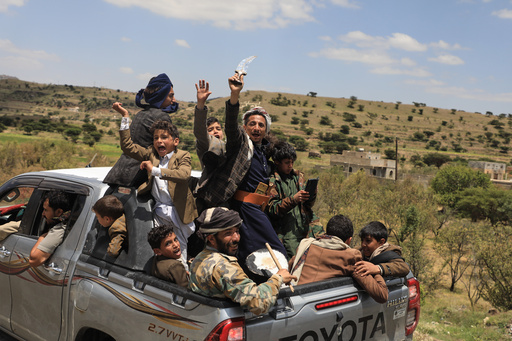
Yemen’s Houthi rebels have seized the strategic islands of Greater and Lesser Hanish in the southern Red Sea, bolstering the Iran-backed rebels' ability to control a key maritime shipping route.
Meanwhile, repairs to a crucial Saudi Arabian oil pipeline that was struck in an attack last week could last three to five weeks, putting it mostly out of service, two regional officials said.
Here’s a look at the latest news in the Middle East. Full coverage can be found here.
Houthi officials said Monday that rebels had taken over the two islands just as Saudi-backed government forces tried to claw back territory from the rebels' swift advances around the Bab el-Mandeb Strait, a crucial shipping alternative to the Strait of Hormuz.
Iran effectively closed the Strait of Hormuz — through which a fifth of the world’s traded oil and gas transits in peacetime — in the opening days of the war. The Saudis have since used the Bab el-Mandeb Strait, which leads out of the Red Sea, for crude oil exports.
The Houthis’ latest takeover, following the seizure of the Red Sea port of Mokha and a strategic island last week, puts more pressure on Saudi shipments and, in turn, global oil supplies and prices.
This could give Iran additional leverage in its war with the United States.
Saudi Arabia relies on the East-West Pipeline to move crude from Gulf ports to ports on its western, Red Sea coast. From there it can be put on tankers for export.
Two officials briefed on the matter said repairing damage from an attack on Sept. 10 could take weeks, including at a major pumping facility.
The officials spoke on condition of anonymity because they weren’t authorized to brief the media. One said the line may work partially while teams carry out the repairs.
China, a major Middle East oil importer, called Houthi attacks on Saudi energy infrastructure “unacceptable” and said that it was “deeply concerned” about further escalations by the rebels.
— By Samy Magdy in Cairo
Iranian Foreign Ministry spokesman Esmail Baghaei said Monday that Saudi Arabia had “demanded" that a meeting bringing together Iran with other regional countries to discuss the Strait of Hormuz be scrapped “for the time being.”
Baghaei called the meeting, which was to be hosted by Oman, a “proper opportunity” to restore security in the region.
The spokesman said that an agreement between Iran and Oman on the Strait of Hormuz has been finalized and it will be announced later.
Saudi Arabia had submitted amendments to the agreement, citing concerns that it could have lasting implications for the Strait of Hormuz, negatively impacting other Gulf Cooperation Council countries, according to a Gulf official familiar with the matter who wasn't authorized to comment publicly and spoke on condition of anonymity.
Iran denounced on Monday the refusal by Austria to issue visas to the Iranian nuclear chief and other delegation members for the International Atomic Energy Agency’s general conference in Vienna, calling the decision “completely unjustified.”
Baghaei said that Tehran summoned the Austrian chargé d’affaires, saying Austria was obligated as the host country to issue the visas.
Baghaei accused Western countries of denying Iran an opportunity to defend itself and blamed the U.S. for pressuring Austria to deny the visas.
The refusal is part of U.N. sanctions on Iran, reinstated last year, that include a travel ban on Iranian officials.
U.S. Energy Secretary Chris Wright on Monday criticized Iran’s failure to cooperate with the U.N. nuclear watchdog.
Wright was particularly critical of Tehran’s refusal to grant U.N. inspectors access to Iran’s nuclear sites affected by the war. He said that Iran had “ample time to address its egregious negligence" toward its obligations "but that time is up.”
Speaking at the IAEA general conference in Vienna, Wright said that giving Iran more time "only delays overdue accountability.”
Wright repeated the Trump administration’s mantra that Iran “must never develop or obtain a nuclear weapon.”
Wright said that additional safeguards contained in a U.S.-Saudi nuclear accord include “absolutely rigorous” terms against proliferation. He told the IAEA general conference that the U.N. nuclear agency "was part of it all along.”
The U.S.-Saudi accord, signed in July, could potentially provide the kingdom the capability to enrich uranium for its civilian nuclear program.
Wright was responding to a question from the media about why the U.S. requested Iran to sign an Additional Protocol and not Saudi Arabia. The Additional Protocol is an agreement between the IAEA and a country that grants agency inspectors increased access to nuclear sites.
Nearly 94,000 people have fled their homes in Yemen since fighting between Iran-backed Houthi rebels and government forces escalated this month, the International Organization for Migration said Monday.
The worst-hit areas are Taiz and Lahj, where 48,000 have been displaced. The figure is nearly a 25% increase from a number the U.N. agency released a day earlier. The agency called for shelter, water and sanitation relief.
More than 2,000 people have fled across the sea into Djibouti, the agency said. In a video recorded Sunday, U.N. staff helped families arrive in small boats and distributed food. Women and children took cover from the scorching sun under canopies on the shore.
Fears mount that Yemen is inching closer to a return to a civil war that killed 150,000 before a 2022 ceasefire. The World Health Organization said more than 500 people were killed in a weeklong period ending Saturday, a sharp increase.
WHO said at least seven health facilities in three governorates, or regions, have been put out of service or damaged.
Israeli strikes across the Gaza Strip on Monday killed two people and wounded several others, hospital officials and the health ministry said.
One person was killed in Gaza City, while the other was killed when a strike hit tents in Muwasi, according to Shifa and Nasser hospitals.
The strikes also wounded people in Zawaida in central Gaza and Khan Younis in southern Gaza, the health ministry said. The Israeli military confirmed the strikes and said they targeted militants.
The heaviest fighting between Israel and Hamas has subsided since a ceasefire last October, but Israeli fire has killed more than 1,360 Palestinians in Gaza, according to health officials in the territory.
The B’Tselem human rights group said Monday Israel is carrying out a systematic and accelerated project aimed at “dismantling the foundations of Palestinian existence” in the occupied West Bank.
The group said in a new report that Israeli actions against Palestinians in the West Bank by settlers and the military are designed to undermine Palestinian collective life “while entrenching a permanent system of Jewish supremacy” across the territory.
Settler violence has surged under the ultranationalist government of Israeli Prime Minister Benjamin Netanyahu. Rights groups say the military frequently turns a blind eye to the violence, and that when it intervenes it often focuses on protecting the settlers.
The B’Tselem report also says that Israeli actions rely heavily on open cooperation between state authorities and armed settlers who attack Palestinian communities, while the military either fails to prevent the violence or sometimes participates in it.
Crown Prince Mohammed bin Salman of Saudi Arabia met Monday with Adm. Brad Cooper, the top U.S. military commander in the Middle East, in the coastal city of Jeddah, according to the Saudi state-run news agency.
Bin Salman, the kingdom’s de facto ruler, discussed with Cooper “bilateral relations and the latest regional developments,” SPA reported, without providing further details.
The meeting came as Saudi Arabia has been squeezed by attacks from the Iran-backed groups in Yemen and Iraq.
___
This report will be updated throughout the day as new developments emerge.