

BEIRUT (AP) — Lebanon reeled Thursday after the deadliest day of the renewed war between Israel and the Iranian-backed Hezbollah militant group, while Israel made the surprise announcement of authorizing direct talks with Lebanon despite their lack of diplomatic ties. Israeli attacks continued.
There was no immediate response from Lebanon, which had repeatedly proposed talks to end the war, nor from Hezbollah. Israeli Prime Minister Benjamin Netanyahu said talks would focus on disarming Hezbollah and “establishing peaceful relations” between the countries.
Israel's announcement came hours after it had warned of escalation and said it had killed an aide and nephew of Hezbollah leader Naim Kassem, Ali Yusuf Harshi.
Iran’s parliament speaker, Mohammad Bagher Qalibaf, earlier said continued Israeli attacks on Lebanon would bring “explicit costs and STRONG responses,” while insisting that a two-week ceasefire in the Iran war extended to Lebanon. Israel has disagreed.
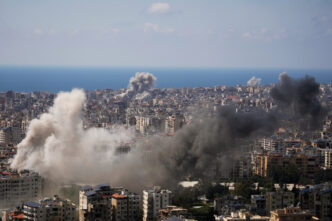
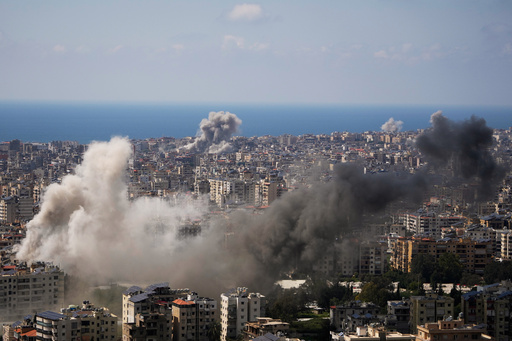
Israeli strikes on Wednesday without warning killed at least 203 people and wounded more than 1,000, Lebanon’s health ministry said. Israel's military said it targeted Hezbollah sites, but several strikes hit densely packed commercial and residential areas during rush hour, leading to widespread civilian casualties. Lebanese President Joseph Aoun called the attacks “barbaric.”
U.S. Vice President JD Vance on Wednesday said Washington asked Israel to scale back attacks on Lebanon to ensure negotiations with Iran are successful.
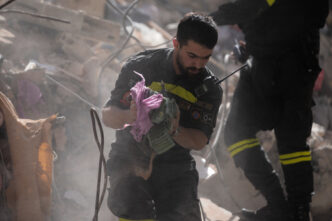
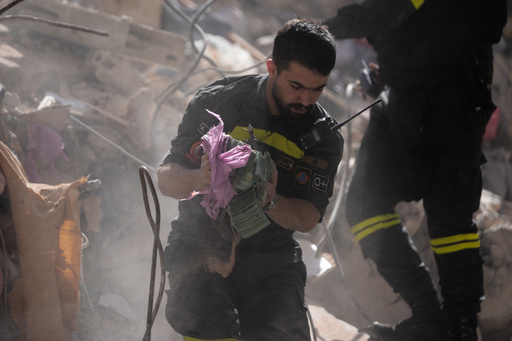
In Beirut, people waited anxiously on the ragged edges of search and rescue work, shielding their faces from the dust. Exhausted firefighters sat on a charred car amid collapsed buildings.
Lebanese Civil Defense spokesperson Elie Khairallah told The Associated Press that a wounded woman was found alive overnight in the seaside neighborhood of Ain Mreisseh, and a man was found alive in his collapsed apartment building in the southern suburbs.
Mohammad Chehab, a Syrian man from Deir el-Zour, said six of his 10 family members had been found dead in a destroyed building.
“They’ve been searching all day” for the rest, he said.
At hospitals, survivors and doctors described the carnage while relatives gathered to identify bodies.
Abdul Rahman Mohammad, a Syrian who lost five relatives in the Hay al-Sellom neighborhood, waited at Rafik Hariri Hospital to retrieve the bodies of his mother, two sisters, brother and brother-in-law. “They were struck without any warning. This is Israeli brutality,” he said.
Dr. Mohamad El Zaatari, director of the public hospital, said it had treated 45 injured people, including 10 cases in intensive care.
At the Makassed hospital, Rabee Koshok lay on his bed. “I thought I was dead. What happened?" he recalled. “ A big flash of light struck my face and eyes, and I found someone flying over and landing next to me. He was dead.” Koshok had been in the commercial district of Corniche al Mazraa when a strike hit a nearby building.
Dr. Wael Jarrosh said the hospital received around 70 injured patients within 10 minutes of the blasts. Two people died and five remained hospitalized, including three in intensive care.
“This has destroyed us psychologically,” the doctor said.
Israeli Prime Minister Benjamin Netanyahu earlier had said strikes would proceed “with force, precision and determination." Israel's military has accused Hezbollah members of moving out of the group’s main areas of influence in southern Lebanon and Beirut’s southern suburbs, known as Dahiyeh, and blending into civilian areas.
Lebanese Prime Minister Nawaf Salam said his country will file an urgent complaint with the U.N. Security Council, calling the attacks a “blatant violation” of international and humanitarian law.
In a cabinet session earlier Thursday, the Lebanese government announced a plan to demilitarize Beirut and deploy larger numbers of security patrols.
Even before the renewed war, Lebanon's government had sought Hezbollah's disarmament. The issue has inflamed tensions among Lebanese who are deeply divided over Hezbollah and its arsenal.
Melhem Khalaf, a reformist legislator representing Beirut, was critical of Israel’s strikes but also of Hezbollah for dragging Lebanon back into war.
“All the targeted areas are safe residential Lebanese areas,” Khalaf said, while watching a bulldozer clear rubble. “What we are witnessing is a massacre against civilians."
More than a million people have been displaced by the war, many from the south and Dahiyeh. Israel's military has issued warnings for the population to leave those areas, followed by heavy bombardment.
Israel has also launched a ground invasion in the border region. The death toll in Lebanon has reached 1,739, the health ministry said, with 5,873 wounded.
Meanwhile, the main border crossing between Lebanon and Syria returned to service Thursday, five days after the Israeli military warned of plans to strike it, alleging that Hezbollah was using it to smuggle military equipment. Lebanese and Syrian authorities denied the claim.
More than 200,000 people have fled Lebanon into Syria since the war resumed.
___
Abou AlJoud reported from Beirut. Associated Press journalists Ali Sharafeddine and Hussein Malla in Beirut and Ghaith AlSayed in Jdeidet Yabous, Syria, contributed to this report.